Académies, nude studies for artists and the first photographs of naked men
In nineteenth-century Paris a photograph of a naked man could be sold openly only if it claimed to be a study for painters. Delacroix posed models for Eugène Durieu, Marconi sold prints to the École des beaux-arts, and the académie became the first archive of the male body.
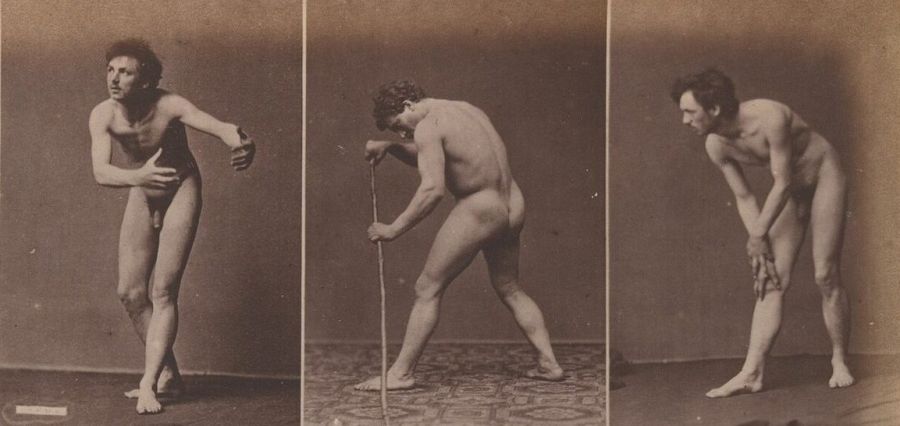
Paris, Sunday 18 June 1854. The painter Eugène Delacroix, fifty-six years old and the most famous artist in France, stands beside an amateur photographer, Eugène Durieu, and tells a naked model how to hold himself: weight on one leg, an arm raised, a staff in his hand. Durieu exposes his paper negatives one after another. A week later, on Sunday 25 June, they do it again1.
The prints from those two Sundays, kept today in an album at the Bibliothèque nationale de France, are among the most famous early académies: photographs of naked models sold, or made, as studies for artists. In the middle of the nineteenth century they were the only respectable way to own a photograph of a naked man. This is the story of who made them, who bought them and why the police kept an eye on them.
What an académie was
The word came from the art schools. In the academies of Paris and the rest of Europe, students drew from the living model for years, and a finished study of a single naked figure was called an académie. As the chapter on neoclassicism explains, the model on the platform was usually a man.
Photography, made public in Paris in 1839, offered a cheaper model who never got tired. Within a few years photographers were selling nude studies under the old name, and the label did a lot of work. An académie was officially a tool for painters and sculptors. In principle it could be registered, put in a shop window and sold. A nude without that alibi was obscene2.
Most of the trade was in female nudes, and much of it was aimed at buyers who had no intention of painting. But male académies were made too, and many more of them were taken seriously as working tools, because the male nude was still the centre of academic training.
Two Sundays with Delacroix
Jean Louis Marie Eugène Durieu, born in 1800, had been a senior official in the French administration before retiring early in 1849 to devote himself to photography. He was a founder of the Société héliographique in 1851 and of the Société française de photographie in 1854, and he argued that photography could be an art1.
Delacroix had been interested in photographs of the nude for some time. In September 1850 he was looking for daguerreotypes of male nudes, and in May 1853 he was showing prints by Durieu to friends. In June 1854 the two men worked together: Delacroix arranged the poses and Durieu took the pictures.

The album that survives contains thirty-two photographs, mostly of two models, a man and a woman. Most are calotypes, prints made from paper negatives, with soft contours that Delacroix seems to have found useful: they gave him the mass of a body without the hard detail of a daguerreotype. The last few were made from glass negatives and are much sharper1.
Delacroix did what the label promised. He copied the photographs in pencil, again and again, and used them in his work. In his journal he wrote that he looked "with passion and without fatigue" at photographs of naked men, a human body he was learning to read like a poem3.
A shop on every corner
By the 1850s Paris was full of photographic studios, and nudes were part of their business. Félix-Jacques-Antoine Moulin listed himself in the city directories as a specialist in académies when he opened his studio in 1851. That same year he was arrested and tried for selling obscene images. He served a month in prison, his stock was seized, and afterwards he was careful to register his work with the authorities.
The rules were never written as clearly as photographers wanted. Photographs for sale were supposed to be deposited with the state, and the authorities decided case by case which nudes passed as studies and which did not. The Paris police kept their own register of seized obscene photographs, with the prints pasted in as evidence, and the historian David Ogawa has used it to show how thin the line between académie and pornography could be4.
The stereoscope made things worse in the eyes of the police. A pair of photographs seen through a viewer jumped into three dimensions, and stereo nudes, often hand-coloured, became a booming and mostly illegal trade. Respectable photographers such as Auguste Belloc made them too, and some were caught.
The photographer of the École des beaux-arts
The most famous name in the trade was Gaudenzio Marconi. Born in 1841 in the Italian-speaking Swiss canton of Ticino, he trained as a painter and set up in Paris in the early 1860s, first in the rue de Buci, then in a studio he took over from Belloc in 1868.
His académies show men and women in poses borrowed from ancient and Renaissance sculpture, usually against a plain backdrop with a few props: a staff, a block, a drape. From 1871 his studio stamp read "photographer of the École des beaux-arts", and students of the school bought his prints because they cost far less than hiring a live model2.
The protection was not total. In July 1873, during a period of strict moral censorship in France after the fall of the Second Empire, Marconi was convicted of an offence against public morals. A few years later he moved to Brussels, where he went on working until his death in 1885.

Sixteen men on a page
By the 1870s and 1880s académies had become an industry. Publishers sold them in sets and albums, often with many small photographs mounted on a single sheet so that a student could flip through dozens of poses at once.
One of the best known suppliers was the publisher A. Calavas, at 68 rue de Lafayette in Paris, who sold the work of the photographer Louis Igout (1837 to 1881). An album of about 1880, now in the Metropolitan Museum of Art, mixes reproductions of paintings with sheets of sixteen photographs each: men standing with a staff, pulling a rope, lifting a pole, wrestling, a few women, a few close-ups of hands and feet5.
The men on these sheets are working models, professionals who earned their living on the platforms of the art schools and in the studios of painters and sculptors. They are moustached, bearded, muscular, and entirely naked, with no fig leaf.
The same catalogues also offered photographs of children for artists. This site does not show them.
Bought for art, kept for other reasons
Who bought the male académies? Painters and students, certainly. But the Canadian film historian Thomas Waugh, in his history of gay erotic images before 1969, argued that these prints also became the first photographic archive of the male body for men who desired it6.
A photograph of a naked man could not be sold as erotic. Sold as a study for artists, it could be bought, carried home, kept in a drawer and looked at with no questions asked. Waugh pointed out that the same poses, the same props and the same classical alibi would serve, decades later, the physique photographers of the twentieth century6.
There is no way to know who most of the buyers were. The trade left catalogues, police records and surviving prints, not diaries. But the académie established a pattern that lasted almost a hundred years: the naked male body could be shown, provided it claimed to be for something else.
From the studio to the sun
By the 1880s photographers began to take the académie out of the studio. Thomas Eakins in Philadelphia photographed his students naked by a lake. In Sicily, Wilhelm von Gloeden posed young local men among olive trees and Greek ruins and sold the prints to tourists and collectors, still under the cover of art.
The académies themselves did not disappear. They went on being sold to art students into the twentieth century, and today they turn up in museum collections, auction rooms and exhibitions about the nude. The wider story of the century that put the male nude on a pedestal and then put it in front of a camera is told in the chapter on neoclassicism and the camera.
- Christophe Leribault (ed.), Delacroix et la photographie, Musée du Louvre Éditions and Le Passage, 2008
- Sylvie Aubenas and others, L'Art du nu au XIXe siècle: le photographe et son modèle, Bibliothèque nationale de France and Hazan, 1997
- Eugène Delacroix, Journal, edited by Michèle Hannoosh, José Corti, 2009
- David Ogawa, Arresting Nudes in Second Empire Paris, History of Photography 31, 2007
- The Metropolitan Museum of Art, Louis Igout, Album d'Études–Poses, about 1880 (1993.270)
- Thomas Waugh, Hard to Imagine: Gay Male Eroticism in Photography and Film from Their Beginnings to Stonewall, Columbia University Press, 1996