Winckelmann, the scholar who fell in love with Greek statues
A cobbler's son from Prussia went to Rome, wrote the first history of ancient art and put the naked male body at its summit. Johann Joachim Winckelmann wrote about beauty like a man in love, and was stabbed to death in a Trieste inn in 1768.
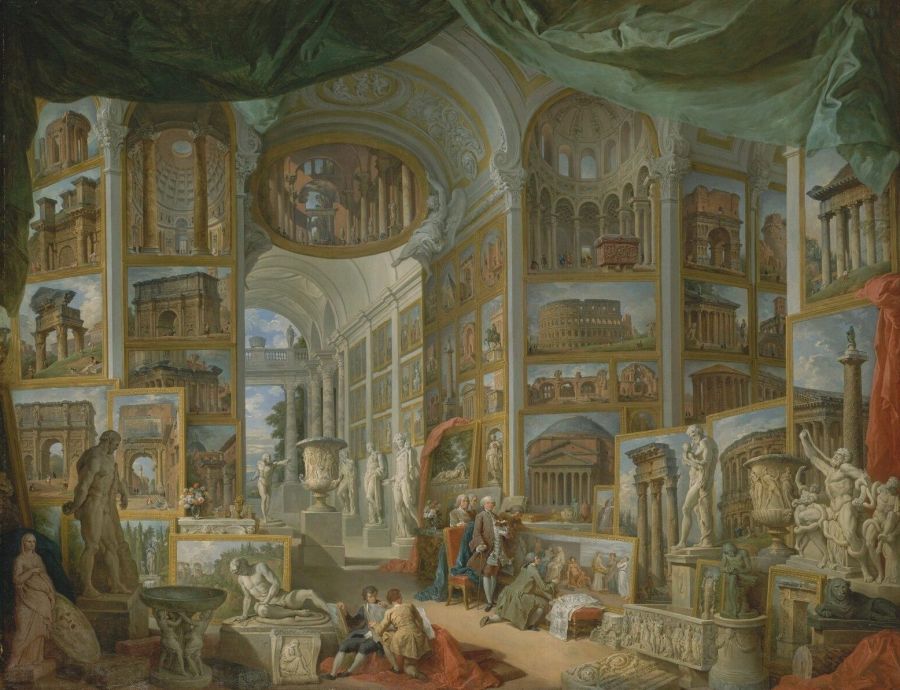
Rome, November 1755. A thirty-seven-year-old Prussian, the son of a cobbler and until recently a badly paid librarian near Dresden, arrives in the city with a small pension from the Elector of Saxony and almost no Italian. One of his first tasks is to go to the Vatican, to the courtyard of the Belvedere, and write descriptions of the statues kept there: the Laocoön, the Belvedere Torso, the so-called Antinous and, above all, the Apollo Belvedere1.
The newcomer was Johann Joachim Winckelmann, and within ten years he would be the most famous expert on ancient art in Europe. More than anyone else, he made the naked Greek male body the highest ideal of beauty, the model that academies, sculptors and museums followed for a century. He wrote about it as a man in love, and he died in a hotel room in Trieste. This is his story.
A cobbler's son who wanted Greece
Winckelmann was born on 9 December 1717 in Stendal, a small town in the Prussian province of the Altmark. His father mended shoes; his mother was a weaver's daughter. The family was poor, and the boy got his education by singing in choirs, running errands and winning the favour of teachers1.
He studied theology at Halle and some medicine at Jena, but what he really wanted was Greek, which he largely taught himself. From 1743 to 1748 he was deputy headmaster of the school at Seehausen, on a salary so low that he relied on his pupils' parents for meals.
It was there that he first fell in love with a younger man, Friedrich Wilhelm Peter Lamprecht, the son of a family for whom he had worked as a tutor. The love was not returned, and it set a pattern that would repeat for the rest of Winckelmann's life1.
In 1748 he became secretary in the great private library of Count Heinrich von Bünau at Nöthnitz, near Dresden. Dresden had one of the finest collections of paintings and ancient sculpture north of the Alps, and Winckelmann spent his free hours in front of them. In 1755 he published a short essay, Thoughts on the Imitation of Greek Works in Painting and Sculpture. It contained the phrase, usually translated as "noble simplicity and quiet grandeur", that became the motto of neoclassicism.
To get to Rome he paid a price. In 1754 he converted to Catholicism, which opened the doors of Roman patrons and the papal library. Friends at home were shocked. Goethe later wrote, with some admiration, that Winckelmann had been at heart a pagan all along.
Librarian among marble gods
In Rome Winckelmann climbed fast. He worked for Cardinal Passionei, then for Cardinal Archinto, and in 1759 he became librarian and adviser to Cardinal Alessandro Albani, the most passionate collector of ancient sculpture in the city. Albani was then filling his new villa on the Via Salaria with statues, reliefs and busts, and Winckelmann lived among them2.
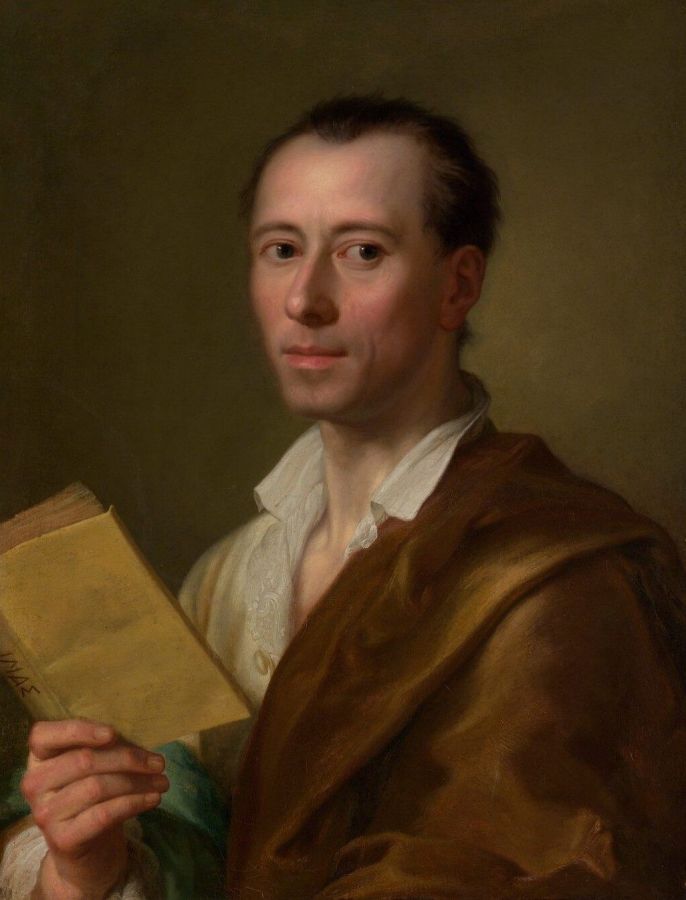
His closest companion in the first years was the painter Anton Raphael Mengs, with whom he shared a house. Mengs turned Winckelmann's ideas into paintings, including the ceiling fresco of Parnassus in Albani's villa. In 1758 and 1762 Winckelmann travelled to Naples to see the finds from Herculaneum and Pompeii, and wrote open letters complaining about how badly the excavations were run.
In 1763, with Albani's support, Pope Clement XIII appointed him Prefect of Antiquities in Rome. He was in charge of the ancient monuments of the city and of the export of finds. The cobbler's son now showed princes around the Vatican.
The book that put a naked god at the top
In 1764 Winckelmann published his masterpiece, the History of the Art of Antiquity. Nothing like it existed. Instead of a catalogue of objects, it told the story of ancient art as a living thing that is born, grows, reaches its peak and declines, and it tied that story to climate, politics and freedom. Many historians date the birth of art history as a discipline to this book3.
At the peak stood the male body. Winckelmann's examples of supreme beauty were young gods and athletes: Apollo, Bacchus, Mercury, Antinous, the victors of the games. He believed the Greeks had made such statues because they lived among naked bodies, in the gymnasium and at the games, and looked at them freely every day3.
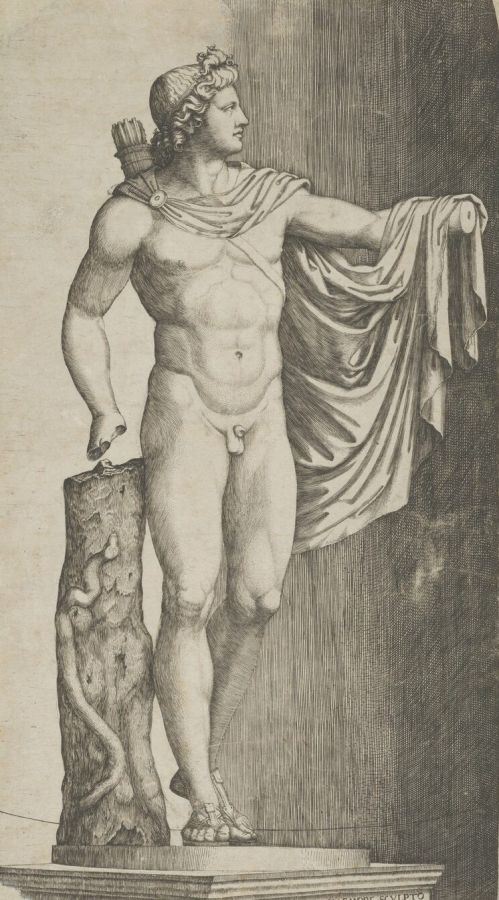
His most famous page describes the Apollo Belvedere. He wrote of the god's body as something above nature, of an eternal spring of youth on its skin, and he told his reader that, standing in front of it, he forgot everything else and his chest swelled as if he too were rising into the air. It reads less like a description than a declaration of love, and generations of travellers copied it into their diaries before going to see the statue for themselves.
Love letters to a young baron
Winckelmann did not keep his feelings out of his theory. In 1762 he met in Rome Friedrich Reinhold von Berg, a young nobleman from Livonia on his travels, and fell in love with him. The following year he dedicated to Berg a short treatise on the capacity to feel beauty in art.
In it he argued that men who notice beauty only in women, and are hardly moved by beauty in men, will never truly understand the art of the Greeks, because its highest beauty is male. The letters he wrote to Berg after the young man left Rome are passionate love letters, full of longing and of the language of ancient friendship.
The art historian Alex Potts has shown how Winckelmann's ideal body works on two levels at once. It is a lofty abstraction, an image of freedom and of a lost golden age, and it is also a very physical object of desire, described with the eye of a man who looked at bodies with longing4.
His contemporaries understood. His homosexuality was no secret among his friends, and Katherine Harloe has traced how the wide network of correspondents he wrote to in German, French and Italian shaped his public image as the lover of Greek beauty2. What he wrote about the Greeks, who as chapter I explains loved adolescents as well as men, he wrote about as an ideal from the past. What he admired in Rome were statues of adult gods and the young men around him.
A week in Trieste
In April 1768 Winckelmann set out for Germany, his first journey north in thirteen years. He did not get far before regretting it. In the Tyrol he became depressed and wanted to go back. The sculptor and dealer Bartolomeo Cavaceppi, who was travelling with him, persuaded him to go on to Munich and Vienna.
In Vienna he was received at court. The empress Maria Theresa and her chancellor Kaunitz gave him gold and silver medals. Then he left Cavaceppi and headed back south alone, and on 1 June he reached Trieste, the Habsburg port on the Adriatic, to wait for a ship to Ancona.
He took a room at the Osteria Grande on the main square and signed the register as "Signor Giovanni". In the room next door lived Francesco Arcangeli, a thirty-one-year-old cook from a village near Pistoia, out of work and with a criminal record. Arcangeli offered to help him find a ship. For a week the two men ate together, walked together and sat in a café on the square, and in the evenings Winckelmann showed his neighbour the medals5.
On 7 June Arcangeli bought a knife in one shop and a length of rope in another. On the morning of 8 June, after the maid had left Winckelmann's room, he came in, threw the rope around Winckelmann's neck and, when the older man fought back, stabbed him several times. Winckelmann staggered down the stairs calling for help.
He lived for several hours more. He received the last rites from a Capuchin friar, dictated a will that left his estate to Cardinal Albani, and forgave the man who had killed him. He died that afternoon and was buried in the cathedral of San Giusto5.
A robbery, or something else
Arcangeli fled without the medals, which stayed in Winckelmann's luggage. He was caught a few days later on the road inland and brought back to Trieste. He confessed. On 18 July 1768 he was sentenced to be broken on the wheel, and two days later the sentence was carried out in the square in front of the inn5.
The court treated the crime as a robbery, and so do many historians. But the question began immediately: why had the most celebrated scholar in Europe, travelling under a false name, spent a week in the company of an unemployed cook with a record? Some writers have imagined a lovers' quarrel, a blackmail attempt or a sexual advance that went wrong; others, a political plot. The trial papers do not support any of these with evidence, and the editors of the most recent study of the case treat it as what the court found it to be, an ordinary and squalid crime that the legend has never stopped retelling5.
In 1833 a monument to Winckelmann by the sculptor Antonio Bosa was unveiled in the Orto Lapidario, the garden of ancient inscriptions near the cathedral, on the initiative of the Trieste patrician Domenico Rossetti.
The long life of a dead man
Winckelmann's influence grew after his death. His book was translated into French, Italian and English, and the sculptors of the next generation, Canova and Thorvaldsen among them, built their careers on his ideal of calm, naked, idealised bodies. Lessing, Herder and Kant read him closely.
In 1805 Goethe, who had travelled to Rome in his footsteps, published a volume of essays and letters called Winckelmann and His Century. In it he wrote, in the careful language of the time, of Winckelmann's friendships with young men as something the Greeks would have understood, and treated it as part of his greatness rather than a stain on it6.
Sixty years later, in January 1867, the Oxford don Walter Pater published an essay on Winckelmann in the Westminster Review, later collected in his Studies in the History of the Renaissance (1873). Pater described Winckelmann's enthusiasm for beauty as something that ran through his friendships with young men and his feeling for Greek statues alike7. For a generation of English aesthetes, Oscar Wilde among them, that essay became a treasured text.
From there the line is direct. The photographers who, a century after his death, posed naked young men among ruins in Sicily called their pictures Greek and quoted the same statues. The wider story of the age that put the male nude on a pedestal, and of the camera that followed, is told in the chapter on neoclassicism and the camera.
- Wolfgang Leppmann, Winckelmann, Knopf, 1970
- Katherine Harloe, Winckelmann and the Invention of Antiquity: History and Aesthetics in the Age of Altertumswissenschaft, Oxford University Press, 2013
- Johann Joachim Winckelmann, History of the Art of Antiquity, translated by Harry Francis Mallgrave, Getty Research Institute, 2006
- Alex Potts, Flesh and the Ideal: Winckelmann and the Origins of Art History, Yale University Press, 1994
- Maria Carolina Foi and Paolo Panizzo (eds), Trieste 1768: Winckelmann privato, EUT Edizioni Università di Trieste, 2019
- Johann Wolfgang von Goethe, Winckelmann und sein Jahrhundert, Cotta, 1805
- Walter Pater, Studies in the History of the Renaissance, Macmillan, 1873