Condoms on set, how gay porn learned to show safer sex
In 1985 a gay video stopped between scenes so that a doctor could talk about safe sex, and within a few years condoms were the unwritten rule of the industry. Then came bareback studios, workplace inspectors, a vote in Los Angeles and a pill that changed everything again.

San Francisco, 1985. HIS Video releases a gay feature called Lifeguard, starring Cole Taylor and some of the most popular performers of the day. Between the sex scenes the film does something no porn tape had done before: it hands the floor to Robert Bolan, a San Francisco physician who led the board of the San Francisco AIDS Foundation, and he talks to the viewer about safe sex. It may be the first gay adult film built around condoms1.
It took the rest of the industry years to follow. This page tells how condoms came onto the sets of gay porn in the 1980s, how they became the unwritten rule of the 1990s, and how, after 2000, they became the subject of a long fight involving bareback studios, workplace-safety inspectors, a vote in Los Angeles County and, finally, a pill.
Spermicide and silence
In the first years of the epidemic most studios carried on as if nothing had changed. Their fantasy was sex without consequences, and a condom on screen looked like an admission that the fantasy was over.
Some tried other remedies. According to John Rutherford, who later ran production at Falcon, the studio's first response was not the condom but spermicide, injected into performers' bodies before scenes because some people believed it could kill the virus. Falcon, he recalled, was one of the last companies to adopt condoms2.
The fear was commercial as much as aesthetic. Producers believed that buyers would not pay for films with condoms, and for several years almost nobody wanted to test the idea.
The star who said no
The first big name to break ranks was Al Parker, the bearded star of the clone era, who ran his own company, Surge Studio. After his partner and business associate, known on screen as Steve Taylor, died of AIDS in September 1986, Parker publicly attacked the gay film industry for doing nothing while its men were dying3.
According to his biographer Roger Edmonson, he became one of the first producers to insist that the performers in his films wear condoms, and he refused to make unsafe videos even when it cost him money3.
The message mattered because of who was delivering it. Parker was not a health educator asking men to give something up. He was the man many of them had fantasised about, showing that a condom could be part of the scene.
De rigueur
From the late 1980s the big studios came round one by one. Falcon, the best-known name in the business, began treating every performer as possibly positive and made safe sex the rule on set2.
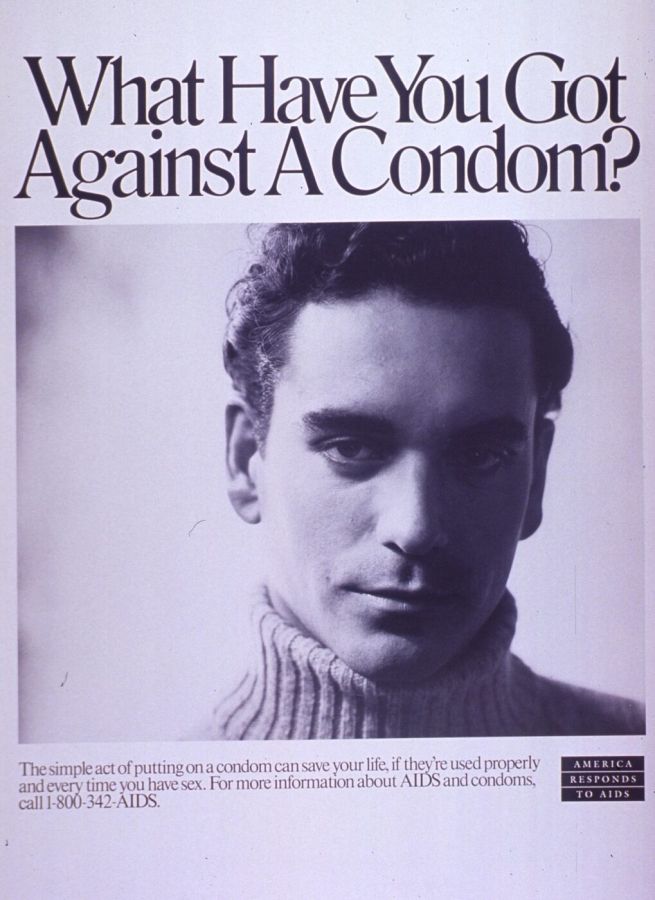
There was never a law, and never a single industry agreement. The norm spread studio by studio, pushed by deaths, by activists, by performers who refused to work without protection and by buyers who came to expect it. The historian Jeffrey Escoffier describes condoms in American gay porn of the 1990s as simply de rigueur1.
New studios of the 1990s made a point of it. Titan Media, founded in San Francisco in 1995, set out to make safer sex erotic, and Hot House and Titan treated condoms as a matter of principle long after others had begun to waver.
The bareback challenge
The consensus did not last. After 1996 combination therapy turned HIV into a treatable illness for those who could get it, and a subculture of men who chose sex without condoms, and called it barebacking, became visible. In 1998 Treasure Island Media was founded in San Francisco to film it, and other bareback labels followed.
Some directors pushed back hard. In January 2008 Chi Chi LaRue, one of the most prolific directors in gay porn, released a public service announcement promoting condoms and vowed never to shoot bareback, at a time of reports of rising HIV infections among young gay men4.
LaRue's argument was practical. Speaking to the Canadian Medical Association Journal in 2011, LaRue said it was entirely possible to make and sell dirty, filthy movies while protecting everyone who worked in them, and explained having left Vivid Entertainment when the company stopped using condoms5.
Inspectors on the set
A new player entered the argument in the 2000s: the state. California's workplace-safety agency, Cal/OSHA, enforces a standard on bloodborne pathogens that requires employers to protect workers from contact with blood and other potentially infectious fluids. Health campaigners, led by the AIDS Healthcare Foundation, argued that a porn set was a workplace like any other5.
The test case was gay. Cal/OSHA cited Treasure Island Media for two serious violations, in part over a 2009 film that the AIDS Healthcare Foundation had sent to the agency as evidence: no plan to control performers' exposure to semen, and no barrier protection such as condoms6.
In January 2014 an administrative law judge, Mary Dryovage, upheld both citations. She cut the fines from 20,485 to 8,670 dollars, but her finding mattered far more than the money: adult-film performers were employees, not independent contractors, and the safety rules applied to them6.
Measure B
Los Angeles County went further. On 6 November 2012 its voters approved Measure B, the Safer Sex in the Adult Film Industry Act, by about 57 per cent to 43. It required producers filming in the county to obtain a public-health permit and performers to use condoms for anal and vaginal sex7.
The straight studio Vivid Entertainment and two performers challenged it as a violation of free speech. In December 2014 the federal Court of Appeals for the Ninth Circuit refused to block the condom requirement, holding that it was likely to survive First Amendment scrutiny.
The campaign then went statewide, and stalled. In February 2016 Cal/OSHA's standards board rejected a proposed rule written specifically for adult films, which won only three of the four votes it needed. In November 2016 California voters turned down Proposition 60, which would have required condoms in all porn filmed in the state, by about 54 per cent to 46.
The condom disappears
What changed the screen in the end was not a law but a pill. In 2012 the American Food and Drug Administration approved Truvada for pre-exposure prophylaxis, PrEP, which sharply reduces the risk of sexually acquired HIV. Combined with testing, it gave studios a new argument for dropping condoms.
Even the old guard hesitated. In January 2014 Falcon announced that it had filmed California Dreamin' with condoms and would remove them digitally in post-production, as a throwback to its carefree poolside films of the 1970s and 1980s9.
Within a few years the trickle became a flood. In 2018 Raging Stallion, a studio of the Falcon group, made its first bareback film, and by then, according to the gay press, only four major American studios were still making condom-only films: TitanMen, GayHoopla, GayRoom and PrideStudios10.
For about twenty-five years the condom had been the most visible sign in gay porn of what the epidemic had done, and of how men had learned to live with it. The wider story of those years is told in the chapter on the AIDS years.
- Jeffrey Escoffier, Bigger Than Life: The History of Gay Porn Cinema from Beefcake to Hardcore, Running Press, 2009
- Eloise Hendy, How Chuck Holmes Founded the World's First Gay Porn Empire, Vice, 2024
- Roger Edmonson, Clone: The Life and Legacy of Al Parker, Gay Superstar, Alyson Books, 2000
- Andy Towle, Exclusive PSA Premiere: Chi Chi LaRue on Barebacking in Gay Porn, Towleroad, 2008
- Lauren Vogel, Public health advocates push for safer sex in pornographic film industry, CMAJ 183 (5), 2011
- Josh Cable, Judge Upholds Cal/OSHA Citations Against San Francisco Porn Maker for Unprotected Sex, EHS Today, 2014
- United States Court of Appeals for the Ninth Circuit, Vivid Entertainment, LLC v. Fielding, 774 F.3d 566, 2014
- Jason A. Wilken et al., Occupational HIV Transmission Among Male Adult Film Performers, Multiple States, 2014, Morbidity and Mortality Weekly Report 65 (5), 2016
- Matthew Tharrett, Gay Porn's Falcon Studios to "Digitally Remove Condoms" From Upcoming Film, Queerty, 2014
- Ryan Shea, Raging Stallion Studios Is the Latest Porn Studio to Go Bareback, Instinct, 2018