Underwear ads as soft porn, from union suits to the Calvin Klein billboard in Times Square
Over Times Square in the early 1980s, a pole vaulter in white Calvin Klein briefs, forty feet by fifty, stopped the traffic and had his posters stolen from the bus shelters. For a century underwear ads had found excuses to show a man undressed; this one needed none, and it spoke to gay men as clearly as to anyone.

Times Square, New York, in the early 1980s. Above the traffic, where cigarette and whisky brands had always hung their billboards, a new picture goes up: a photograph about forty feet by fifty of a deeply tanned man in nothing but a pair of white briefs, leaning back on a sunlit rooftop, the outline of his penis plainly visible through the cotton. The man is Tom Hintnaus, an Olympic-class pole vaulter. The photographer is Bruce Weber. The name on the waistband is Calvin Klein1.
The picture went up in 1982 by most accounts, 1983 by others, and it changed how men's bodies were sold. Underwear advertising had existed for a century, but it had always found an excuse for the man to be undressed. This one offered none. This page tells how underwear ads went from catalogue drawings of union suits to the most public soft porn in America, looked at by women, by straight men, and very carefully, by gay men.
Men in union suits
For most of the nineteenth and early twentieth centuries, men's underwear meant the union suit: a one-piece garment of wool or cotton covering the body from neck to ankles, buttoned down the front. Magazines and newspapers advertised it with drawings and, later, photographs of men wearing it, the only respectable way to show a man in his underclothes2.

Manufacturers fought over comfort and over the awkward problem of the fly. In 1910 Cooper's of Kenosha, Wisconsin, patented a union suit with two overlapping flaps of fabric in place of buttons, and sold it under the gloriously blunt name of the Kenosha Klosed Krotch.
The ads of the 1920s were already selling more than cotton. Topkis showed a broad-shouldered man in a sleeveless athletic union suit, sitting on the floor with his knees up, and promised "clean-cut men of business" the comfort of summer at their desks. B.V.D. drew a lean man reading a book in his union suit beside a bookcase. The pretext was always comfort, health or efficiency; the picture was a man's body.


A blizzard in Chicago
The modern brief was born in the 1930s. After men's swimwear seen on the French Riviera gave the company an idea, Cooper's designer Arthur Kneibler produced a short, close-fitting garment with a Y-shaped overlapping fly, and the company called it the Jockey, after the support of a jockstrap2.
On 19 January 1935 Marshall Field's department store in Chicago put the new briefs in its State Street window. A blizzard hit the city that day, and the managers, embarrassed by bare-legged mannequins in a snowstorm, wanted the display taken down. Before they could, the briefs were selling: hundreds by noon, about 12,000 pairs in the following week, more than 30,000 in three months.
The brief made the male crotch a shape rather than a bundle of fabric. For the next forty years advertisers worked hard not to notice. Underwear ads showed men dressing, golfing or joking with their wives, and the garment was drawn, posed or airbrushed so that nothing inside it could be seen.
The pitcher in his briefs
The first crack came from sport. In 1977 Jockey ran a campaign with eight professional athletes photographed in their underwear under the line "Take away their uniforms and who are they?". The most popular was Jim Palmer, the Baltimore Orioles pitcher, then in his early thirties.
Palmer became Jockey's man for the next decade, in magazines, on television and on billboards in Times Square and other cities. Posters of him in briefs sold so well that he gave the proceeds to the Cystic Fibrosis Foundation. Susan Bordo, who studied the ads in her book The Male Body, notes that his crotch was airbrushed, and dates one Palmer ad of 1981 that is credited with a hundred million dollars of sales in a year1.

The athlete was the alibi. A man shown in his briefs because he was a famous pitcher was a sportsman, not a pin-up, and the women who bought most men's underwear for their husbands could look without anyone saying so.
A pole vaulter on a Greek rooftop
Calvin Klein had built his fame on jeans. In 1980 his jeans advertisements had already been banned by some American television stations as too suggestive. In 1982 he moved into men's underwear, with briefs that carried his name on the waistband, and hired Bruce Weber to shoot a campaign said to have cost about half a million dollars3.
Weber took Tom Hintnaus to the Greek island of Santorini and photographed him leaning against a whitewashed chimney in white briefs, his skin glistening and dark against the white walls and the sky. Hintnaus, born in Brazil to Czech parents and raised in California, had cleared 5.60 metres at the 1980 American Olympic trials and then lost his chance of Moscow to the American boycott. He later vaulted for Brazil.

Bordo's point about the picture is that it gave no excuse. The man was not getting dressed, not playing a sport, not part of a family scene. He was sunbathing, and the picture asked you to look at him1.
The briefs flew off the shelves at Bloomingdale's. When Klein's company papered Manhattan's bus shelters with poster versions of the photograph, the posters were stolen, by Bordo's account overnight1.
Selling to two audiences at once
Bruce Weber's men looked like the ideal of a particular world. The lean, muscular, sun-browned body, photographed with obvious adoration, came straight from gay erotic photography and from the gyms and beaches of gay men in New York and California. Bordo calls the method "dual marketing": images that straight viewers could read as athletic and wholesome, and that gay viewers recognised at once as their own1.
There was money behind the idea. A survey of The Advocate's readers carried out between 1977 and 1980 found that most of them earned well above the national median. In 1982 The New York Times Magazine described advertisers newly interested in "the white, single, well educated, well-paid man who happens to be homosexual"1.
Nobody in the business said publicly that a billboard was aimed at gay men. The ads simply borrowed the look of physique photography and the gay press, put it over Times Square, and let every viewer find in it what he or she was looking for.
Stripping in a launderette
On Boxing Day 1985 British television viewers watched a young man walk into a 1950s-style launderette, take off his jeans and T-shirt, put them in a machine and sit down among the other customers in white boxer shorts, while Marvin Gaye's I Heard It Through the Grapevine played. The model was Nick Kamen, the agency was Bartle Bogle Hegarty, and the idea came from its creative director John Hegarty5.
It was an advertisement for Levi's 501 jeans, not for underwear, but everybody remembered the shorts. The original script had Kamen stripping to his Y-fronts; the British Advertising Clearance Centre objected, and he wore boxers instead. The campaign was later credited with pushing sales of 501s up by 800 per cent, to the point where demand outstripped supply, and it was said to have done almost as much for boxer shorts5.
Marky Mark drops his trousers
Ten years after Hintnaus, Calvin Klein found a pop star. Mark Wahlberg, then in his early twenties and performing as Marky Mark, had a habit of letting his baggy jeans slide down on stage to show the waistband of his Calvin Klein underwear. In 1992 the company signed him, and Herb Ritts photographed him bare-chested in white briefs and boxer briefs6.
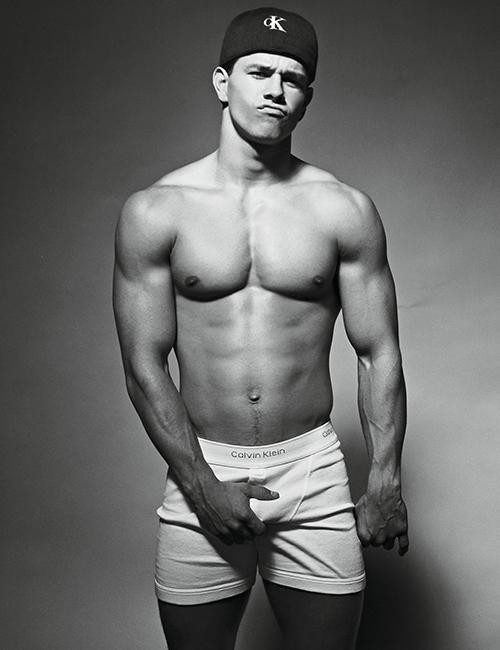
Some of the pictures paired him with the British model Kate Moss, then still a teenager, who later said the shoot had been a distressing experience. The images of Wahlberg alone went on billboards and bus shelters across the United States and made him, for a couple of years, the most looked-at male body in the country6.
A photo book of him, Marky Mark, followed, and Playgirl ran a feature on him in 1993, joking that someone had forgotten to put on his Calvins for the camera. The audience was mixed in exactly the way Bordo described: teenage girls, women, and a large and openly delighted gay following.
Too far, and back again
In 1995 Calvin Klein went too far. A jeans campaign photographed by Steven Meisel showed young models in a cheap basement setting, posed and questioned off camera in a way that critics compared to auditions for amateur porn. The outcry was immediate, and the Justice Department opened an inquiry into whether the ads broke child pornography laws7.
The company withdrew the campaign. The inquiry was dropped after it was shown that the models were adults, but the episode marked a line that advertisers have watched ever since: grown men in underwear could be sold as sex, anything suggesting youth could not.
The formula itself never went away. Calvin Klein kept putting famous men on its billboards, from the singer Justin Bieber in 2015 to the actor Jeremy Allen White in 2024, and other brands built their whole identity on near-naked men photographed for a gay eye. By then nobody needed an alibi. The wider story of how the same bodies filled gay magazines and films in those years is told in the chapter on the studio age.
- Susan Bordo, The Male Body: A New Look at Men in Public and in Private, Farrar, Straus and Giroux, 1999
- Shaun Cole, The Story of Men's Underwear, Parkstone International, 2012
- Steven Gaines and Sharon Churcher, Obsession: The Lives and Times of Calvin Klein, Carol Publishing Group, 1994
- Remember This Guy? Calvin Klein Model Tom Hintnaus Once Made a Splash in Houston, CultureMap Houston, 2010
- Russell Parsons, How Levi's 'Laundrette' ad led to an 800% sales boost, Marketing Week, 2019
- Mhairi Graham, The Icons of Calvin Klein: Kate Moss and Mark Wahlberg, AnOther Magazine, 2015
- Sexy Calvin Klein Ads Spark FBI Inquiry, The Washington Post, 1995