Falcon Studios, Chuck Holmes and the gay porn empire built by mail order
A laid-off salesman from Indiana started Falcon in San Francisco with borrowed money, a mailing list and ten-minute loops shipped within a day. By 1978 he had put the first Falcon feature on videotape, and by his death in 2000 his porn fortune was paying for gay and AIDS causes across America.

San Francisco, the early 1970s. A salesman from Indiana called Chuck Holmes, newly arrived in the city, buys a few gay erotic films and the mailing lists of men who might want more. He adds films of his own, ten minutes long and in black and white, and starts sending them out by post. According to the history kept with the company's archive, this is how Falcon Studios began1.
Within a decade Falcon was the best-known name in gay porn, and it stayed near the top for forty years: the studio of the first gay feature on videocassette, of the glossy California look, of exclusive contracts and of a founder who gave millions to gay and AIDS causes and is remembered on the front of San Francisco's LGBT community centre. This is the story of the company, the man who built it and what happened to both.
The salesman and the mailing list
Charles M. Holmes was born on 5 May 1945 in Terre Haute, Indiana, and took a degree in business administration at Indiana State University. According to the ONE Archives, he had lost his job selling aluminium siding when he moved to San Francisco in 19711.
The start-up capital was small. Interviews gathered for the documentary Seed Money say that Holmes began with 5,000 dollars he had borrowed, and paid an acquaintance, Vaughn Kincey, for his contacts and lists of buyers2. The archive's own history names the source of the films and lists as Matt Sterling, a name Falcon later gave to a whole series of its films, the Matt Sterling Collection1.
The founding date is just as unsettled. Most accounts give 1971, the year Holmes reached the city. The archive dates the formation of Falcon Studios as a mail-order business to 19721.
Ten minutes, by return of post
The product was the loop: a short, silent 8mm film with a single scene and no story, sold to be projected at home. Customers answered small advertisements in men's magazines, joined the mailing list and ordered from a printed brochure. Falcon's selling point was speed. It shipped within a day, when competitors could take two weeks3.
The money was serious. John Rutherford, who later directed for Falcon and ran it as president, remembered loops selling for upwards of 150 dollars and the company taking in tens of thousands of dollars a day3.
So was the risk. In 1973 Holmes was indicted for sending obscene material through the mail. He was defended by Michael Kennedy, a radical lawyer who had represented the Black Panthers, and the case never reached trial3.
Holmes ran the business largely by himself until the middle of the decade, when it had grown enough for him to hire directors and producers and to put models under contract1.
Lake Tahoe on videotape
The turning point came in 1978 with The Other Side of Aspen. Its sex scenes were shot at Lake Tahoe, its cast was led by Casey Donovan, the star of Boys in the Sand, with Al Parker, and it was released in November on 8mm film and, for the first time for Falcon, on videocassette. Its success set the standard for the glossy, star-led features of the following years, with higher production values and a recognisable house look4.


It had not been planned that way. The critic John F. Karr, writing for the Bay Area Reporter, explained that Aspen was meant to be several loops. "But video was just being born," he wrote, "and the much-deliberated decision to release the film in the new format would reward the company with massive sales"5.
The tape went on to sell in numbers no gay film had reached before, by some estimates around 45,000 copies by the early 1990s. Video let men watch at home without walking into an adult cinema, and Falcon had bet on it before most of its rivals.
The Falcon look
In the 1980s Holmes ran Falcon like an old Hollywood studio. Its best models signed exclusive contracts, and the studio built them up as stars across a series of releases6.
The look changed with the decade. The moustached, super-macho working men of the 1970s gave way to smooth-chested, clean-cut young men with neat hair, filmed in ski lodges, tennis clubs and luxurious houses, a fantasy that matched the aspirations of the 1980s6. The archivists who catalogued Falcon's pictures sum up its identity in three features: high production values, luxurious locations and healthy, clean-cut bodies1.

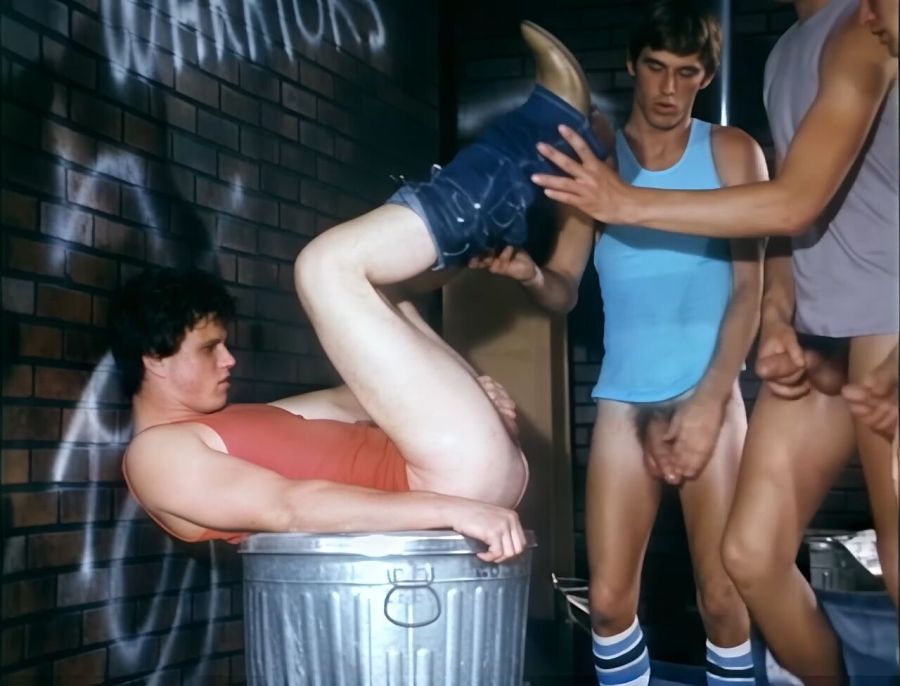
Falcon also became a family of labels. Over the years it added Mustang for mature men, Jocks for younger ones, Massive for the most muscular, the Falcon International Collection for films made in Europe, the Alone With series of solo scenes, and the Matt Sterling Collection1.
Spermicide, then condoms
AIDS hit the studio's world directly, and Falcon was slow to respond. According to John Rutherford, its first answer was not the condom: spermicide was injected into performers' bodies before scenes, because some people believed it could kill the virus. Falcon, he recalled, was one of the last companies to adopt condoms, and only from the late 1980s did it treat every performer as possibly positive and make safe sex the rule on set3.
By the early 2000s the rule was firm for new productions. Rutherford told SF Weekly in 2002 that he mandated safe sex on every current shoot, while the company went on selling its older films made without condoms as "classics" from before anyone knew about HIV7.
Holmes himself had tested positive for HIV in the late 1980s3.
A pornographer's millions
Holmes spent much of his fortune on causes. He gave to more than twenty HIV and AIDS organisations, to the Human Rights Campaign and the Gay and Lesbian Victory Fund, and to Emily's List, Amnesty International, the Sierra Club and the United States Holocaust Memorial Museum7. He was also a major donor to the Democratic Party.
The money was welcome; the source was awkward. Organisations that took his donations often kept their distance from him in public, and Michael Stabile's documentary Seed Money: The Chuck Holmes Story (2015) is built around that uneasy relationship between the gay movement and the porn fortune that helped pay for it6.
Holmes died on 9 September 2000 of an illness related to AIDS, aged fifty-five3. His estate gave one million dollars towards the new San Francisco LGBT Community Center, the largest individual donation any gay community group in the city had received, and the building on Market Street opened in 2002 with the name Charles M. Holmes over the door. SF Weekly asked at the time whether a community centre should carry the name of a porn king; the centre answered that he had made his fortune from the community and was giving it back7.
One and a half million slides
In September 2012 Falcon's still images went to the ONE National Gay and Lesbian Archives at the University of Southern California, the gift of a company called Datatech Enterprises. The collection runs from about 1970 to 2012 and fills 404 boxes and more, 421 linear feet in all1.
After Holmes
In the years after his death Falcon belonged to a company controlled by the Charles M. Holmes Foundation. In 2004, according to the trade press, its managers bought it out, and in 2010 AEBN, a video-on-demand company based in Charlotte, North Carolina, acquired Falcon and merged it with Raging Stallion Studios, creating the largest gay erotic production company in the United States1.
The brand has kept going. In the 2020s new releases and performers' contracts have appeared under the joint name Falcon/NakedSword, after NakedSword, the gay streaming service with which AEBN had merged in 20078.


From a borrowed 5,000 dollars and a mailing list to a slide archive at a university, Falcon's half century follows the whole arc of the business. The wider story of the years when it rose is told in the chapter on the studio age.
- ONE National Gay and Lesbian Archives at the USC Libraries, Guide to the Falcon Studios Still Images Collection (Coll2012-159), Online Archive of California, 2013
- Mike Stabile, A Few Good Men: An Oral History of Early Gay Porn, Out, 2015
- Eloise Hendy, How Chuck Holmes Founded the World's First Gay Porn Empire, Vice, 2024
- Jeffrey Escoffier, Bigger Than Life: The History of Gay Porn Cinema from Beefcake to Hardcore, Running Press, 2009
- John F. Karr, Still Horny After All These Years, Bay Area Reporter 31 (14), 2001
- Mark James, Seed Money: Capturing a Pivotal Era of Gay Porn, Film International, 2015
- Joel P. Engardio and Lisa Hom, The House That Chuck Built, SF Weekly, 2002
- Cade Maddox Renews Exclusive Contract With Falcon/NakedSword, XBIZ, 2021