Colt Studio, Jim French and the making of the Colt man
A Madison Avenue fashion illustrator began selling drawings of cowboys and construction workers by post under a fake German name, then picked up a camera and called himself Rip Colt. From 1967 Colt Studio turned the big, hairy, moustached man of the gay bars into a brand that outlived its founder.
New York, spring 1966. The May–June issue of The Young Physique, one of the small bodybuilding magazines sold to a mostly gay readership, prints a drawing of a man signed with a name nobody has seen before: Kurt Lüger. Behind the signature is a successful Madison Avenue illustrator who draws elegant fashion for department stores during the day. It is the first published picture by the man who will found Colt Studio1.
His real name was Jim French, and over the next half century, as an artist and as the photographer "Rip Colt", he built one of the most recognisable looks in gay erotica: the Colt man, big, hairy, moustached and unmistakably grown up. This page follows the studio from the drawings sold by post to the calendars, books and films, through the models who became famous under the names French gave them, to the archive, the exhibitions and the company that carries the name today.
From department stores to Kurt Lüger
James Thomas French was born on 14 July 1932 in Beaver Falls, Pennsylvania. He studied at the Philadelphia Museum School of Art from 1950 to 1954 and then served in the United States Army. After his discharge he moved to New York and made a career as a commercial artist: fashion drawings for luxury stores, textile designs, and portrait drawings for Columbia Records album covers1.
The critic Ian Lewandowski notes that he drew for Bergdorf Goodman and Neiman Marcus before he ever sold an erotic picture, and that the Lüger name, borrowed from the German pistol, was a phallic joke2.
The Lüger business was a mail-order company that French ran with a friend from his army days. It sold sets of six or eight drawings on a theme: construction workers, men in leather, surfers, cowboys, wrestlers, sailors. Frontal nudity was kept to a minimum, because the drawings had to travel by post1.
The drawings were based on photographs, and French took them himself. He used a Polaroid camera, which developed its own prints, so that pictures considered indecent never had to pass through a photo laboratory2.
A gun in the name
In late 1967, after almost a year spent preparing the first drawings and photographs, French and his business partner Lou Thomas launched a new company. They called it Colt, after the revolvers of the American West, and French signed his photographs Rip Colt. A stallion later became the studio's logo1.
The first Colt magazine, the digest-sized Manpower!, came out in 1969. Books followed under the studio's own imprint, State of Man: Man in 1972, Another Man in 1974 and Quorum in 19761.
In 1974 French bought out Thomas, who went on to found his own studio, Target. French moved west for the weather and for the men: California offered sun all year and many more would-be models. He settled in the Hollywood Hills and ran Colt from offices in the San Fernando Valley1.
The books kept coming for decades. Opus Deorum, a large volume of his photographs published in 1992, carried an introduction by the Chicago fashion photographer Victor Skrebneski, a sign that French's work was now being treated as photography rather than as merchandise4.
The Colt man
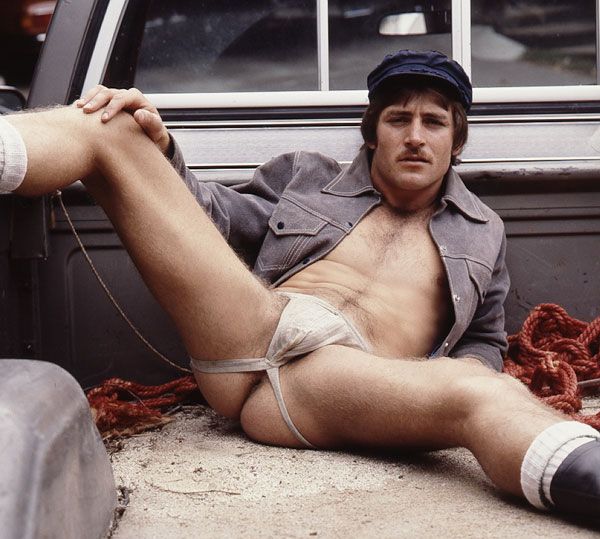
What French photographed was a type. His men were big and heavily built, with chest hair, often a moustache, sometimes a beard. They posed against ranch fences, beside swimming pools, in work boots, jeans and nothing else, or against a plain backdrop that left only the body. There was nothing boyish about them.
The look matched what was happening in the bars. In the 1970s gay men in New York, San Francisco and Los Angeles adopted a deliberately masculine style, with short hair, moustaches, flannel shirts, Levi's and gym-built bodies. The sociologist Martin P. Levine, who studied these men in Greenwich Village, called them by the name they used for themselves, clones, and read the style as an answer to the old stereotype of the effeminate homosexual5.
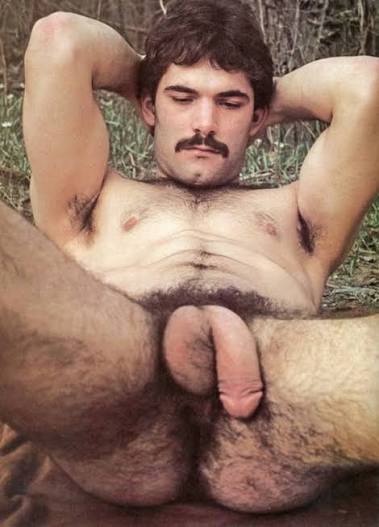
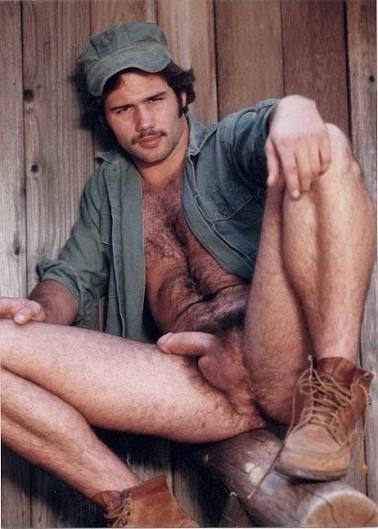
French gave that ideal back to its audience, larger than life and carefully lit. He was more interested in bodies than in sex acts, and the studio's fame rested above all on its photographs. Late in life he said that masculinity could be found in lots of ways, and that much of his own work would come to look dated2.
Calendars, magazines and films
Colt sold its men in every format the market allowed. There were magazines and books, sets of photographs by post, and calendars that put a different model on the wall each month.
In the 1970s French also made short films on 8mm, sold by mail like the photographs. They were later collected on videocassette and, in the 1990s, remastered for DVD. Over his career he photographed more than 800 models1.
Men with new names
Almost none of them worked under their own names. French chose the names himself, and some became famous. The best known is Al Parker: French photographed him in the 1970s and gave him the name under which he became the most famous gay porn star of the clone era6.
Others included Bruno, Ledermeister, Ed Dinakos, Jake Tanner, Pat Sutton, Steve Kelso and John Pruitt, and, under the studio's later owners, the Italian Carlo Masi. For many of them, the Colt name and the Colt portrait were their whole public identity1.
From the mailbox to the gallery
From the 1990s French's photographs moved into galleries. Wessel + O'Connor in New York gave him solo shows in 1994 and 1999. In 2013 and 2014 his work appeared at the Leslie-Lohman Museum of Gay and Lesbian Art in New York, and in 2014 a gallery in Palm Springs showed Jim French Before Colt, the drawings and photographs of his early years7.
His own account of his life appeared in 2011 as Jim French Diaries: The Creator of Colt Studio, edited by Robert Mainardi and published by Bruno Gmünder in Berlin, with his drawings, photographs and memories of the early years1.
The studio after French
In 2003 French sold Colt to John Rutherford, a former director and president of Falcon Studios, and his business partner Tom Settle. The company became Colt Studio Group and moved its base to San Francisco, keeping the rights to French's work1.
In 2007 it celebrated its fortieth anniversary, and a proclamation signed in the name of San Francisco's mayor, Gavin Newsom, declared 23 February "Colt Studio Day". It caused a small scandal. Conservative commentators, among them the Fox News presenter Bill O'Reilly, attacked it, and the San Francisco Chronicle reported that the mayor had not known about the proclamation and wanted closer control of what was issued in his name8.
French himself moved to Palm Springs in 2013 and sold limited-edition prints and original Polaroids from there. He died in his sleep in June 2017, aged eighty-four. The news was announced by his partner, Jeff Turner9.
He left behind a look that outlived its decade: the grown man, built and hairy, photographed without apology. The wider story of the studios that turned that look into an industry is told in the chapter on the studio age.
- Robert Mainardi (ed.), Jim French Diaries: The Creator of Colt Studio, Bruno Gmünder, 2011
- Ian Lewandowski, Jim French, Male Beauty, and Languages of Desire, Hyperallergic, 2016
- The Metropolitan Museum of Art, "Two Cowboys" T-shirt, Vivienne Westwood and Malcolm McLaren, 1974–75 (2018.766), online collection record
- Jim French, Opus Deorum, State of Man Publishing, 1992
- Martin P. Levine, Gay Macho: The Life and Death of the Homosexual Clone, New York University Press, 1998
- Roger Edmonson, Clone: The Life and Legacy of Al Parker, Gay Superstar, Alyson Books, 2000
- Christopher Harrity, In the Galleries: Jim French, Before Colt, The Advocate, 2014
- Cecilia M. Vega, Policy changing after gay porn studio lauded: Mayor was unaware of proclamation, now wants oversight, San Francisco Chronicle, 2007
- Bob Mizer Foundation, Breaking News: COLT Studios Founder Jim French Dies, Bob Mizer Foundation, 2017