Leather and S&M on film, the first gay BDSM porn from Sextool to Born to Raise Hell
In 1975 the Los Angeles police chief warned a producer not to show his leather film anywhere in the city, so Born to Raise Hell premiered in San Francisco instead. With Fred Halsted's Sextool and the new magazine Drummer, it brought the S&M world of the leather bars onto the gay screen.
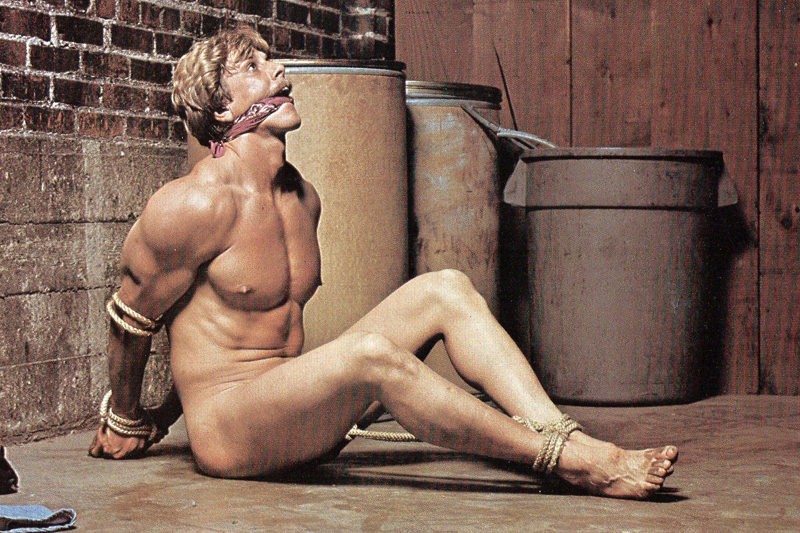
San Francisco, June 1975. At the Powell Theater, near the cable car turntable at the bottom of Market Street, an invited audience of leathermen arrives for the world premiere of Born to Raise Hell, a gay hardcore film about a bearded sadist who picks up men in a bar and tortures them. It should have opened in Los Angeles, where it was made. According to the writer Jack Fritscher, who was there that night, the producer Terry LeGrand had been called into the office of the Los Angeles police chief, Ed Davis, who pounded his desk and warned him not to screen the film in any theatre in the city. So the premiere moved north. Fritscher remembers a standing ovation, and some of the audience walking out in protest1.
Born to Raise Hell was one of the first gay porn films made entirely about sadomasochism, and one of the first made by men from the leather bars for their own world. In the same year Fred Halsted released Sextool, and the magazine Drummer began to give that world a voice. This is the story of the first gay BDSM films: where their look came from, who made them, why the police hated them, and how they survived into the age of AIDS.
Before the films, the jackets
The leatherman was born on a motorcycle. In 1953 Marlon Brando's The Wild One put the biker's cap, jacket and boots on screens across America, and in 1954 a group of gay men in Los Angeles founded the Satyrs, one of the first gay motorcycle clubs.
In Chicago the photographer Chuck Renslow and his partner, the artist Dom Orejudos, ran Kris Studio, one of the earliest and longest-lasting physique studios, and published the magazines Mars, Triumph and Rawhide Male. Orejudos drew under the name Etienne, and from 1953 his muscular men in leather appeared in the physique magazine Tomorrow's Man2.
At the end of the 1950s the two men turned a Chicago bar, the Gold Coast, into a leather bar with a dress code, a back room and Etienne's murals on the walls. It is often described as the first leather bar in the United States, and its Mr. Gold Coast contest grew in 1979 into International Mr. Leather2.
The physique studios could suggest but never show. Their men wore boots, caps and straps, and the sex stayed off the page. Showing what leathermen actually did to each other would have to wait for the end of the obscenity laws that had kept hardcore out of the theatres.

The most famous leather images of the 1960s were not porn at all. Kenneth Anger's Scorpio Rising (1963), a short film about young bikers dressing, polishing their machines and partying to pop songs, was prosecuted for obscenity after a screening in Los Angeles in 1964, and the conviction was overturned on appeal. Halsted and Anger, William E. Jones writes, moved in the same Los Angeles circle, an underground within an underground devoted to the occult and to sadomasochism3.
A pervert with a 35mm camera
Fred Halsted had already put S&M on a gay screen. His L.A. Plays Itself (1972), told in full on its own page, ended with the first fisting ever filmed and took him to the Museum of Modern Art in 19743.
For his next feature he aimed higher. Sextool (1975) was shot on 35mm, the format of real cinemas, in the hope of reaching the art houses. It moves back and forth between a smart Los Angeles party, with drag queens and trans women among the guests, and the sex that some of its dressed-up guests go off to have: cops, boxers, sailors and leathermen3.

The heart of the film is a scene between Halsted and his lover, Joey Yale. Critics writing about the restoration in 2021 described it as the most violent passage in Halsted's work, a scene that seems to go beyond any safe word.
The gamble failed. Film stock was so expensive that Halsted shot very little, and the finished film is choppy, almost schematic. Art cinemas would not take a porn film, and most gay porn theatres had no 35mm projector. Jones writes that it ran for a week at the 55th Street Playhouse in New York and then all but vanished3.
The historian Jeffrey Escoffier still counts Halsted as the first true auteur of gay porn, a director whose films could not be mistaken for anyone else's4.
Sadism's heaviest couple
Joey Yale was more than a co-star. He and Halsted lived the life their films showed, and they were described as sadomasochism's heaviest couple3.
They also turned it into a business. With a third partner they ran Halsted's, a sex club in Silver Lake, Los Angeles, with booths, glory holes and a sling, and in 1982 Halsted released A Night at Halsted's, a film shot entirely inside it. In 1984 Yale directed two films released by Halsted's own company, Cosco3.
Yale died of AIDS in 1986. Halsted, broke and isolated, took his own life in 19893.
A loan from Dean Martin
The men behind Born to Raise Hell came from a less likely place: network television. Roger Earl, the director, worked as Dean Martin's dresser and production coordinator on The Dean Martin Show at NBC. Terry LeGrand, born in Denver in 1939, owned the production company, Marathon Films1.
According to Fritscher, Earl helped finance the film with a personal loan of $10,000 from Martin, who did not ask what it was for. The title came to Earl driving home one night: he pictured a biker with a tattoo1.
Earl wanted a Brando from The Wild One. LeGrand wanted a cast as real as the bikers of Scorpio Rising. They got both by casting leathermen from the Los Angeles bars instead of actors. Their lead, Val Martin, was found tending bar, and Earl cast him as the Bearded Sadist because, he said, Martin frightened even him1.

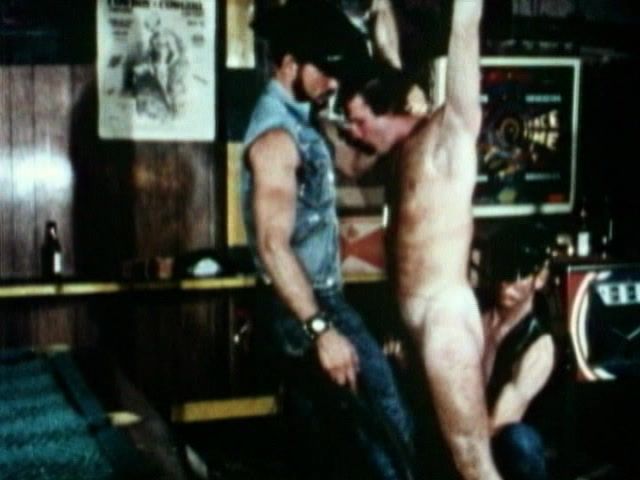
They shot in Griffith Park and in the Truck Stop, an old bar out in the San Fernando Valley. Earl then spent four weeks cutting the 16mm colour negative on his kitchen table, without a work print to fall back on if he made a mistake1.


The chief and the slave auction
For Ed Davis the film was the worst kind of provocation. It showed two men dressed as policemen, and leathermen who, Fritscher notes, looked more convincing in uniform than many of his officers. Davis, Fritscher writes, could not tell consensual S&M from violence and feared the film was real1.
The quarrel did not end with the premiere. When the police raided Drummer's mock slave auction in April 1976, LeGrand, Earl, the editor Jeanne Barney and Val Martin were all among the men arrested. Fritscher believes the film was part of the reason: Davis knew the magazine was promoting it1.
A magazine and a movie
Drummer and Born to Raise Hell grew up together. The film needed publicity that no straight paper would give it. The magazine needed pictures. Barney put Val Martin on the cover of the third issue, in October 1975, and stills from the film had already filled pages of the second1.

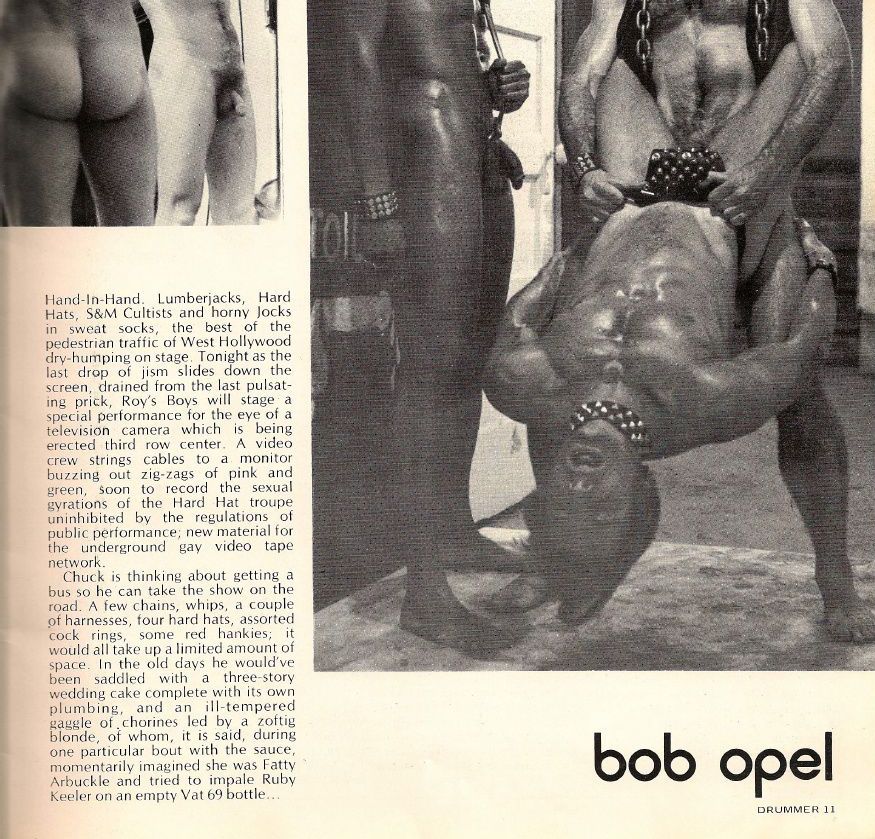
The partnership lasted. Drummer printed so many photographs from Marathon's films over the years that, in Fritscher's words, it sometimes looked like a LeGrand fan magazine, and it put them on its covers again in 1988, 1989 and 19911.
What the films showed was not only sex. The writer Patrick Moore, looking back at these films, argued that they explored a sex that depended less on erections and orgasms than on an emotional stretching, something still shocking decades later6. For many leathermen in the audience, Fritscher adds, Born to Raise Hell worked less as a fantasy than as a sex-education film1.
Downtown at the Mineshaft
New York's answer to Halsted's was the Mineshaft. It opened in October 1976 on two floors of an old market building at 835 Washington Street, in the meatpacking district, as a private club for members only. On busy Saturdays 500 to 600 men passed its doorman, and at weekends it stayed open until ten in the morning7.
The club's manager, Wally Wallace, enforced a written dress code: cycle leather, Western gear, Levi's, uniforms. No cologne, no suits, no designer sweaters, no disco drag. The artist known as Rex drew its posters, and Robert Mapplethorpe's membership card is now in the Los Angeles County Museum of Art7.

Hollywood wanted in. When William Friedkin prepared Cruising (1980), his thriller about a killer in New York's leather bars, the Mineshaft refused to let him film inside7.
The city closed it on 7 November 1985, the first gay venue shut down under New York's emergency rules against AIDS7.
Safe sex in the dungeon
Marathon outlived the decade. In 1988 LeGrand and Earl went to London to shoot Dungeons of Europe, a trilogy that opened with Pictures from the Black Dance, filmed in the studio of the tattoo and piercing artist Mr. Sebastian. In 1989 they followed it with a six-film series in the Netherlands and West Germany, Bound for Europe, shot on video by Fritscher's own crew1.
The difference was in the rules. With AIDS killing their audience, LeGrand argued that gay films had to stop showing unsafe sex. Tony DeBlase, by then the publisher of Drummer, wrote that the action of Pictures from the Black Dance was much closer to Born to Raise Hell, and still all safe sex1.
LeGrand died of complications of AIDS at his home in West Hollywood in April 2018, ten years after Gay Video News had put him in its Hall of Fame. Born to Raise Hell, made on a borrowed $10,000 by men from the bars, is still sold as the standard by which gay S&M films are judged.
The wider story of the studios, the magazines and the clone look is told in the chapter on the studio age.
- Jack Fritscher, Profiles in Gay Courage, Palm Drive Publishing, 2022
- Tracy Baim and Owen Keehnen, Leatherman: The Legend of Chuck Renslow, Prairie Avenue Productions, 2011
- William E. Jones, Halsted Plays Himself, Semiotext(e), 2011
- Jeffrey Escoffier, Bigger Than Life: The History of Gay Porn Cinema from Beefcake to Hardcore, Running Press, 2009
- L.A. Plays Itself: The Fred Halsted Collection, Blu-ray and DVD, Altered Innocence, 2021
- Patrick Moore, Beyond Shame: Reclaiming the Abandoned History of Radical Gay Sexuality, Beacon Press, 2004
- Jay Shockley, Mineshaft, NYC LGBT Historic Sites Project, 2023