The working man trilogy, Joe Gage's Kansas City Trucking Co. and the men who met as equals
At Christmas 1976 a director calling himself Joe Gage put a bearded trucker called Hank on the road, and gay porn found a new hero. Kansas City Trucking Co., El Paso Wrecking Corp. and L.A. Tool & Die turned working men into the stars of the years before AIDS.

Christmas 1976. A new gay feature called Kansas City Trucking Co. reaches the screens, and its director, who signs himself Joe Gage, later remembers the timing exactly: it came out at Christmas and really took off in 19771. Its makers sold it like an independent film. Stills, cast lists and press releases went out to the gay and lesbian papers, the only press in America that would carry the advertisements, and the replies, lists and letters survive in a single folder at the ONE Archives in Los Angeles2.
It was the first of three films that came to be called the working man trilogy, completed by El Paso Wrecking Corp. and L.A. Tool & Die. Truckers, wrecking-yard hands and drifters, played by bearded, hairy men who met as equals, replaced the pretty boys of earlier gay porn. This page follows the three films from the pitch at a party to the cinemas, the men who made them and what became of them.
A pitch at a party
Joe Gage was the pseudonym of Tim Kincaid, a filmmaker born in Santa Barbara, California, in 1944, who had made his first feature, an R-rated sexploitation film, in 1973. He wanted to make a hardcore film that was, as he put it later, theoretically about something1.
The money came through a friend. At a party Kincaid met a casting director who would work as Sam Gage, the producer of all three films. Sam Gage listened to the idea, put him in touch with the people who became his investors, and ended up producing it1.
The men in the film did not come from the bars. Gage said that his working men were not a fantasy but the men he actually met: the phone installer, the neighbour, the guy down the street. His world, he insisted, was not a fantasy world but a real one1.
Hank takes the wheel
The hero of Kansas City Trucking Co. is Hank, a veteran driver played by Richard Locke, bearded, muscular and in his mid-thirties. Hank is paired with a new partner, played by Steve Boyd, who is straight and missing his girlfriend, and much of the film is spent on the road, with sex scenes presented as dreams and fantasies along the way. It was shot in San Francisco and runs for just over an hour.
The other big name in the cast was Jack Wrangler, already the most recognisable cowboy of gay porn. Born John Stillman in Beverly Hills, the son of a television producer, he had trained as an actor and would later cross into straight films, cabaret and theatre3.
Hank also narrates. His voice ties the trilogy together: three films, three jobs and three journeys, all told by the same man.
Men who met as equals
What was new was not the trucks. Earlier gay films often paired a masculine man with a younger or more passive partner, borrowing the roles of straight romance. Gage's men were rugged, rural and working class, and the ONE Archives catalogue singles out exactly this: sex between masculine men who related to each other as equal partners2.
The historian Jeffrey Escoffier adds a second reason for the films' success. Their characters have a great deal of sex with men and show no interest at all in calling themselves gay, which appealed to viewers who felt left out by the identity politics of earlier gay porn4.
Gage also had a theory of the camera. In an interview quoted by Escoffier he said that gay porn, stripped to its basics, was the worship of the penis, so the director had better light it well. That is why his films linger on masturbation and oral sex, which he found easier to photograph, and treat anal sex as something less cinematic4.
Fired in El Paso
The second film, El Paso Wrecking Corp., is usually dated 1978, though some lists give 1977. Hank and his friend Gene lose their trucking jobs after a drunken fight and drift from one blue-collar job to another, always sidetracked by the men they meet. The film is less about sex than about friendship between the two men on the road.
Gene was played by Fred Halsted, the Los Angeles director of L.A. Plays Itself (1972), whose own films were rougher and darker than anything else in gay cinema. Casting him as a sidekick was a nod from one filmmaker to another. Halsted's later life was hard: he lost his partner Joey Yale to AIDS in 1986 and took his own life in 19895.


Grief in Los Angeles
L.A. Tool & Die closed the trilogy in 1979 and was the longest of the three, almost an hour and a half. It is also the most serious. The film historian John Burger summed it up as the story of an unrequited love, in which Locke follows the man of his dreams across the country and they end up living happily ever after6.

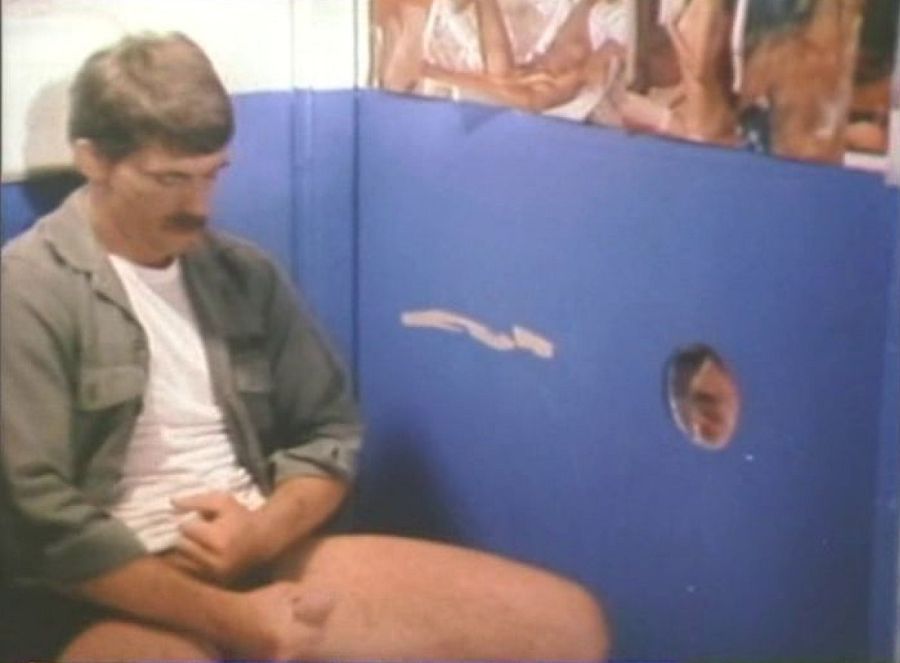
Gage had always said that his films were about sex, not romance, but here he gave Hank a past, a flashback to the Vietnam War and a death, and in the end a home with a long-term partner, played by Will Seagers. The cast also included Michael Kearns, later an actor and writer, and Paul Barresi.
The timing gave the ending a weight nobody intended. Burger placed the film at the very end of gay porn before AIDS, a record of a way of life that was about to disappear6.
Hank after the trilogy
Richard Locke was born in Oakland, California, on 11 June 1941. He later told a friend that he was fairly sure he had been infected with HIV in 1983, and he spent the rest of his life working against the epidemic7.
He toured the country giving talks on safer sex, worked his message into his live shows, spoke on radio, and later used his training as a masseur in hospitals and hospices. In 1987 he published In the Heat of Passion, one of the early books on safe sex and HIV that stayed positive about sex8.
Locke died of AIDS-related illness in Sacramento on 25 September 1996, aged fifty-five, only months after the new combination therapies arrived. A few weeks before his death he left hospital to attend a retreat of gay men, where he spoke about the doctors, nurses and carers he called everyday heroes7.
The director comes back
By the early 1980s Gage was an icon of gay porn, and then he left it. For about twenty years he worked in other fields, directing a play and low-budget genre films and writing novels, before returning to gay porn in the 2000s, working among others for Titan1.
When the magazine BUTT interviewed him in the mid-2000s, the meeting took place at the Wigwam Motel in Rialto, California, on old Route 66, where the director, then sixty-two, and his producer Sam Gage were drinking beer in their concrete teepee. He complained that many of the young models he was offered shaved, trimmed and pierced themselves, and that he tried to make them look different1.
The trilogy kept its reputation. The director Wash West named Kansas City Trucking Co. among his biggest influences, praising the 1970s films as the work of real filmmakers9. The film scholar John Mercer argues that the masculinities of gay porn are more varied and ambiguous than they look, and Gage's tough, tender truckers are a good case in point10. HIS Video later restored the three films and released them on DVD.
Hank's road ended in Los Angeles in 1979, just before the epidemic changed everything for the men who had made and watched the films. The wider story of the studios and stars of those years is told in the chapter on the studio age.
- Frank Rodriguez, Joe Gage (interview), BUTT 19, 2007
- ONE National Gay and Lesbian Archives at the USC Libraries, Guide to the Kansas City Trucking Co. Collection (Coll2011-063), Online Archive of California, 2011
- Jack Wrangler, Actor in Sex Films and Producer, Dies at 62, The New York Times, 2009
- Jeffrey Escoffier, Bigger Than Life: The History of Gay Porn Cinema from Beefcake to Hardcore, Running Press, 2009
- William E. Jones, Halsted Plays Himself, Semiotext(e), 2011
- John R. Burger, One-Handed Histories: The Eroto-Politics of Gay Male Video Pornography, Haworth Press, 1995
- Joe Arcangelini, Two Kinds of Hero: Richard (Butterfly) Locke, The Billys, undated online memorial
- Richard Locke, In the Heat of Passion, Leyland Publications, 1987
- Matthew Hays, The View from Here: Conversations with Gay and Lesbian Filmmakers, Arsenal Pulp Press, 2007
- John Mercer, Gay Pornography: Representations of Sexuality and Masculinity, I.B. Tauris, 2017