Fairy
An old word for a gay man, especially an effeminate one: an insult since the 1890s, a name some gay men chose, and later proudly reclaimed.
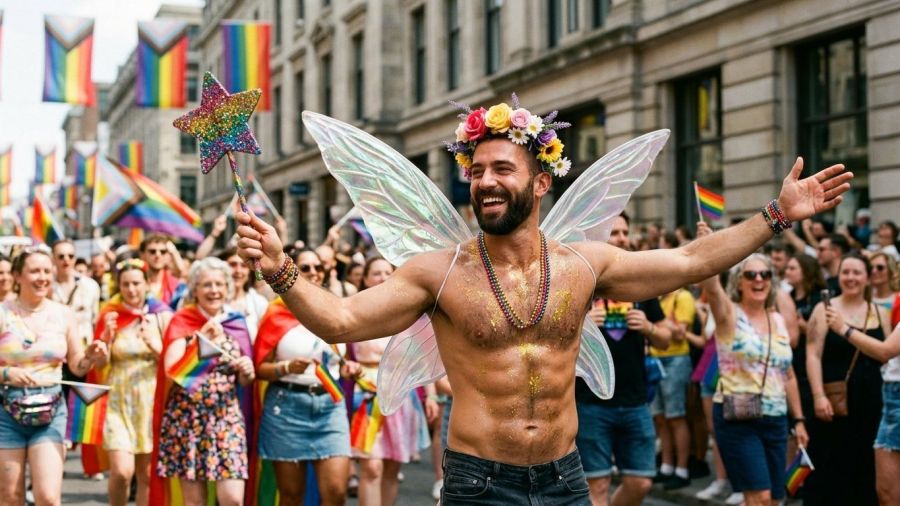
Fairy is an old word for a gay man, and especially for an effeminate one: light, delicate, a little magical, and in the mouth of an enemy, not a real man at all. It has been an insult since the 1890s, and it was also, for a long time, a word gay men used about themselves. Today it lives on as a slur, as camp self-mockery, and in the names of gay spiritual movements that took it back on purpose.
It is softer than fag, and sounds almost sweet to people who never had it shouted at them. That softness is the point of the insult: fairies are pretty, fluttery and harmless, everything a man is not supposed to be.
Where it comes from
Fairy is a plain English word stretched into slang. Green's Dictionary of Slang finds the gay sense around 1890, in a bawdy ballad and in a parody of Oscar Wilde, and in 1895 an American psychology journal described "The Fairies" of New York as a secret society of inverts. By 1909 a writer on New York's poor could note that some men "call themselves 'fairies'". So from the start it was both a label pinned on us and a name some of us chose.
The fairies of old New York
In the historian George Chauncey's account of gay New York between 1890 and 1940, fairies were the visible, flamboyantly effeminate men of the city's gay world, from the Bowery saloons to the Harlem drag balls. In that world men were sorted less by who they slept with than by how they carried themselves: the fairy was the womanly one, and the masculine men who had sex with him often did not count themselves as anything but normal. That is the world in which trade got its meaning, and in which the fairy was both the most visible gay man and the easiest target.
Where it still hurts
Fairy came with its own vocabulary of violence: Green's records "fairy-baiter" in the 1960s and "fairy hawk", a man who attacked and robbed gay men, in 1971. For generations, any boy-ish softness in a man could earn it, and the word did the job of policing every gesture. Older gay men often remember it as the polite-sounding insult that hurt as much as the crude ones.
Taking it back
The most famous reclamation came in 1979, when gay activists including Harry Hay, a founder of the Mattachine Society, called a "Spiritual Conference for Radical Faeries" at an ashram in the Arizona desert; more than 200 men came, and the Radical Faeries became a worldwide movement. The old spelling made the word theirs: not a sneer, but a tribe of gentle, nature-loving, gender-bending gay men. Today gay men call themselves fairies with a wink, and the word sits with queer, poof and pansy in the family of insults we decided to wear.
The phrase "fairy godmother" is nobody's slang, but plenty of older gay men have played exactly that role for younger ones, with or without the wand. See also mother.
Related terms
Sources 3
- Green, Jonathon. "fairy, n.1." Green's Dictionary of Slang, online edition. https://greensdictofslang.com/entry/gmkr3ha
- Chauncey, George. Gay New York: Gender, Urban Culture, and the Making of the Gay Male World, 1890-1940. New York: Basic Books, 1994. https://www.publishersweekly.com/9780465026333
- Griffis, Miles W. "The desert's Radical Faeries." High Country News, 1 March 2024. https://www.hcn.org/issues/56-3/the-deserts-radical-faeries/