Queer
Once "strange", then a slur for gay men, now a word many LGBTQ people use with pride for themselves and for the whole community.
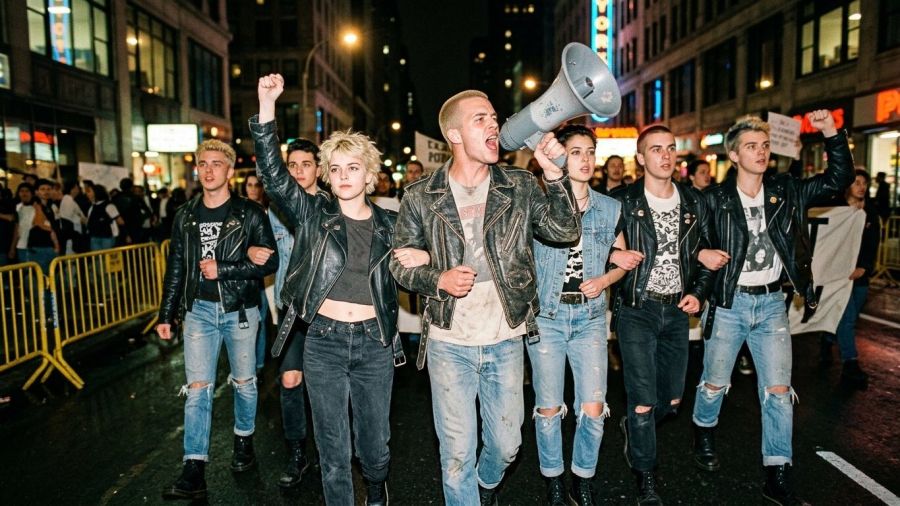
Queer is the word that went the whole way round. It started out meaning strange, then became one of the commonest insults thrown at gay men, and today it is an identity, an academic field, a TV title and the Q in LGBTQ. A gay man can call himself queer with pride, an activist can use it for the whole community, and an older man can still flinch when he hears it.
Today it has two main uses. As an umbrella, it covers anyone who isn't straight or doesn't fit the gender boxes. As a personal label, it is chosen by people who find "gay", "lesbian" or "bi" too narrow, or too tame, or too loaded with things that don't apply to them. Queer often carries a political edge that plain gay does not: it means different, and fine with it.
From strange to slur
Nobody knows for sure where the word comes from. Green's Dictionary of Slang calls the origin uncertain and mentions the German quer, "oblique, skewed", as a possible source. Its earliest slang uses, from the 16th century on, are about things that are wrong or no good: in London's underworld "queer" meant bad, and queer money was counterfeit.
The sexual sense surfaces in the 1890s, around the Oscar Wilde affair. Green's earliest citation is a letter of 1 November 1894 by the Marquess of Queensberry, the father of Wilde's lover Lord Alfred Douglas, who railed against "The Snob Queers". Green's notes that the openly hostile use becomes common from around 1915. Through most of the 20th century "queer" was what you heard in courtrooms, in the papers and in the street, the standard British and American insult for a homosexual man; in Britain it was so familiar that when the American faggot arrived in the 1960s, a New Statesman writer could describe "our own more humane 'queer'".
Taking it back
The turn came in 1990, in the middle of the AIDS crisis. Activists in New York, around the group Queer Nation, handed out a broadsheet called "Queers Read This" at the June 1990 Pride march. Its message was the opposite of polite assimilation: "Being queer is not about a right to privacy; it is about the freedom to be public, to just be who we are". Using the slur on purpose was the point. If they're going to call us queer anyway, we'll say it first, louder.
The universities followed almost at once. In 1990 the feminist scholar Teresa de Lauretis organized a conference at the University of California, Santa Cruz, and gave the field its name: queer theory. The papers came out in 1991 in a special issue of the journal differences, with her introduction "Queer Theory: Lesbian and Gay Sexualities". Queer theory took the word's old meaning, off-center, not fitting, and turned it into a way of questioning the categories themselves.
Pop culture finished the job. In 1999 Channel 4 aired Russell T Davies's Queer as Folk, about gay men on Manchester's Canal Street, its title a pun on the northern saying "there's nowt so queer as folk", from back when queer only meant odd.
Who says it today
Plenty of us now use queer easily, often as our main label, and when LGBTQ organizations and media use the acronym, the Q generally stands for queer. But the reclaiming is not complete. GLAAD's media guide still warns that queer "is not a universally accepted term even within the LGBTQ community" and advises using it for people who describe themselves that way. Plenty of gay men who grew up with it as a street insult will never warm to it, and some dislike how it blurs the specific word gay.
The rule most of us follow is about who is speaking and how. Queer from a friend, a queer bar or a queer studies syllabus is one thing. Queer spat from a car window still means exactly what it meant in 1950. Like fag, homo, poof and dyke, it changes meaning with the mouth it comes out of, and it has travelled further than any of them.
Related terms
Sources 8
- GLAAD. "Glossary of Terms: LGBTQ." GLAAD Media Reference Guide (accessed 19 October 2026). https://glaad.org/reference/terms/
- Green, Jonathon. "queer, adj." Green's Dictionary of Slang, online edition. https://greensdictofslang.com/entry/fiwvawq
- Green, Jonathon. "queer, n." Green's Dictionary of Slang, online edition (sense 6, citing the Marquess of Queensberry's letter of 1 November 1894, in R. Ellmann, Oscar Wilde, 1987, p. 402). https://greensdictofslang.com/entry/n7cbhma
- Quinion, Michael. "Fag." World Wide Words, 16 December 2006. https://worldwidewords.org/qa-fag1.html
- Verso Books. "Queer Nation Manifesto: Queers Read This, 1990." Verso Blog, 12 June 2023. https://www.versobooks.com/blogs/news/queer-nation-manifesto-queers-read-this-1990
- UC Santa Cruz News. "In Memoriam – Teresa de Lauretis (1938-2026)." University of California, Santa Cruz, 23 February 2026. https://news.ucsc.edu/?p=90359
- de Lauretis, Teresa. "Queer Theory: Lesbian and Gay Sexualities. An Introduction." differences: A Journal of Feminist Cultural Studies 3(2), 1991. doi:10.1215/10407391-3-2-iii
- Barran, John. "Queer as Folk." Television Heaven, 10 July 2019. https://televisionheaven.co.uk/reviews/queer-as-folk