The Arcadian photographers, a dream of the South and a body on the stage
A German baron sold postcards of a make-believe ancient Greece from a Sicilian hill town, a strongman in a fig leaf became a star on cabinet cards and world's fair stages, and a Berlin doctor built the first institute of sexual science. Between 1880 and 1930 the male nude learned to hide behind art, health and science, until the scandals, the police and finally the Nazis came for it.

- A sick young man goes south
- Shepherds from a Greek poem
- The cousin in Rome
- What these pictures really show
- The negatives the police took away
- The strongman in a fig leaf
- A body sold by mail
- The magazine that sold muscles
- A photographer on the cross
- Two years' hard labour
- A scandal at the Kaiser's court
- The first magazine for men who loved men
- A doctor with a petition
- After the fire
Berlin, the morning of 6 May 1933. A crowd of students from the German Student Union marches up to a villa at the edge of the Tiergarten, with a brass band playing in front of them. The building is the Institute for Sexual Science. They break in, smash what they find and carry out books, files and photographs by the thousands. A student leader makes a speech, and the group sings the Nazi anthem. In the afternoon the SA arrive to finish the job.
Four days later the Institute's books went onto the great bonfire in the Opernplatz, together with a bronze bust of its founder, Magnus Hirschfeld. That fire closed half a century in which the male body had become, for the first time, something that could be photographed, printed, sold and collected. This chapter goes back to where that story began: a hill town in Sicily, a music hall in Chicago, a Boston aesthete on a cross and a small magazine in Berlin.
A sick young man goes south
Wilhelm von Gloeden was born in 1856 near Wismar, on the Baltic coast of Germany. He called himself a baron, a title his family's claims did not quite support.
In 1877 or 1878, in his early twenties and ill with a lung disease usually described as tuberculosis, he travelled south for his health. He stopped in Taormina, a small town on the east coast of Sicily, perched above the sea with a ruined Greek theatre and a view of Mount Etna. He stayed for the rest of his life.
At first photography was a hobby. Then, in the mid-1890s, his family lost its money when his stepfather was caught up in a political and financial scandal in Berlin. The hobby became his living.
He was not alone in the dream that brought him there. As the historian Robert Aldrich has shown, generations of northern European men looked at the Mediterranean and saw a surviving piece of ancient Greece: the sun, the ruins, and the bodies of poor southern men1.
Shepherds from a Greek poem
Gloeden photographed the whole town: landscapes, fishermen, peasants, old women. But he became famous for one kind of picture.
His models were local boys and young men. He dressed them in simple tunics or loose drapery, or nothing at all, gave them laurel wreaths, amphorae and lyres, and posed them on terraces with the sea behind them. The viewer was invited to see the shepherds of a Greek poem, not the sons of Sicilian labourers paid to stand still through a long exposure.
The pictures were not hidden. They were shown at exhibitions, reproduced in art magazines and sold to visitors as prints and, from around 1900, as postcards that travelled all over Europe2.
His studio became one of the sights of Taormina. Accounts of his life name famous visitors and customers: the industrialist Friedrich Alfred Krupp, the composer Richard Strauss, the German emperor Wilhelm II. Oscar Wilde is said to have come in 1897. Not all these stories are equally well documented, but together they show how Gloeden helped turn Taormina into a destination for wealthy northern men looking for a freedom they could not find at home.
The cousin in Rome
Gloeden was not the first of his family to make this kind of picture. His cousin Wilhelm von Plüschow, born in Wismar in 1852 and known in Italy as Guglielmo, had moved south before him. He worked in Naples and then in Rome, where his studio sold nude studies of young men and boys to artists and collectors.
His pictures were plainer than Gloeden's, with fewer props and more studio backdrops, and they sold to the same kind of foreign buyer3.
Plüschow's career ended in court. In 1902 he was convicted in Rome on charges that included procuring and the corruption of minors, and spent eight months in prison. A second scandal came in 1907, when the police closed his studio and seized photographs. In 1910 he left Italy for good and went back to Berlin, where he died in 1930.
Vincenzo Galdi, born in Naples in 1871, started as Plüschow's model and pupil, and was probably his lover. He later opened his own studio in Rome specialising in nudes. According to Italian sources he too was prosecuted in the investigations of 1907. Around 1910 he gave up photography, became an art dealer and ran a gallery in Rome for decades. He died in 1961.
What these pictures really show
It has to be said plainly. Many of the models of Gloeden, Plüschow and Galdi were adolescents, and some were children.
The pictures were made in a world of deep inequality, where a few lire from a rich foreigner meant a lot to a poor family and the models had little say in how their images were used. Plüschow was convicted precisely for the corruption of minors.
Historians of gay culture take these photographs seriously because they circulated widely among men who desired men and shaped how the male body was imagined for decades3. That is why they are in this chapter. By today's standards many of them show minors in an erotic context, and on this site we do not reproduce them. Every illustration in this chapter shows adult men.
The negatives the police took away
Gloeden left Italy during the First World War, when as a German he risked internment as an enemy alien, and came back afterwards. He died in Taormina on 16 February 1931.
His closest companion was Pancrazio Buciunì, known as il Moro, who started as one of his models and became his assistant. Gloeden left him an archive of some three thousand glass negatives.
Fascist Italy did not like what it found. According to the most common account, the police seized about a thousand negatives and two thousand prints as pornography in 1933, and destroyed another thousand negatives in 1936. Buciunì was put on trial in Messina. He reportedly told the court that it had no competence to judge works of art, and he was acquitted. The destroyed plates were gone for good, and the survivors came back to him only after the Second World War.
The strongman in a fig leaf
While Gloeden sold a dream of youth, an adult body was becoming the most famous in the world.
Eugen Sandow was born Friedrich Wilhelm Müller in Königsberg in 1867. He began as a circus strongman, lifting weights and men. Then he found something new: he simply stood on stage and showed his muscles, in poses copied from classical statues.
In 1893 he arrived in the United States. In New York he posed for Napoleon Sarony, the city's most famous portrait photographer, in a long series of pictures: flexing in trunks, sitting on a stool with his hands behind his head, or nude except for a fig leaf, standing on a plinth like a marble god. The prints were sold as cabinet cards, and people collected them.
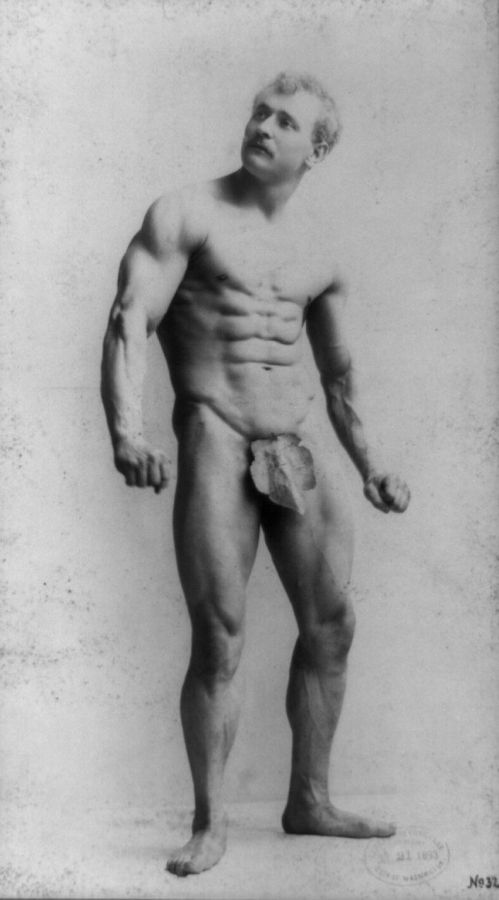
That summer a young impresario, Florenz Ziegfeld, put him on stage at the Trocadero in Chicago, during the World's Columbian Exposition, the great world's fair of 1893. After the show, wealthy spectators were invited backstage to feel his muscles for themselves4.

A body sold by mail
Sandow understood cameras as well as he understood the stage. In 1894 Thomas Edison's company filmed him flexing for a few seconds in its studio in New Jersey.
He wrote books, published a magazine, opened institutes of physical culture in Britain and sold dumbbells and training courses by mail. He died in London in 1925, a rich man.
Officially, all this was about health, strength and the classical ideal. In practice it gave anyone a respectable reason to look at an almost naked man for as long as they liked. Gay men were among his most attentive collectors.

The magazine that sold muscles
Sandow's success created a market, and an American was quick to see it. In March 1899 Bernarr Macfadden launched a monthly magazine in New York called Physical Culture5.
It preached exercise, fresh air and diet, and distrusted doctors and corsets. Its pages were full of men and women in athletic poses, starting with Macfadden himself, often in little more than a loincloth.
That brought him trouble. In October 1905 Anthony Comstock, head of the New York Society for the Suppression of Vice, had him arrested over posters for a physique show at Madison Square Garden. In 1907 Macfadden was convicted of sending obscene material through the mail. The magazine kept selling anyway.
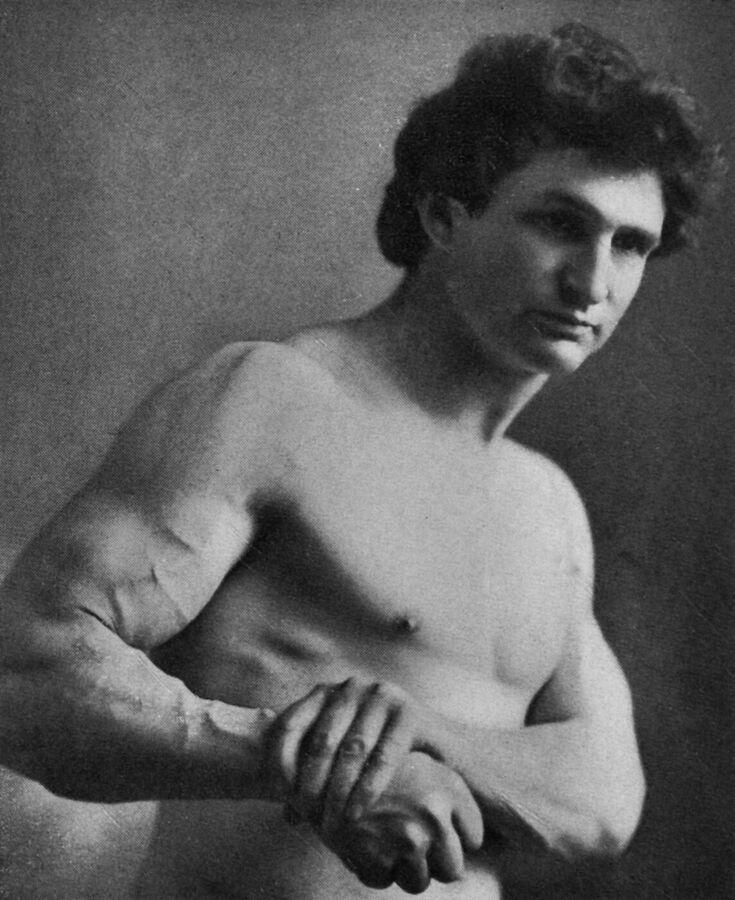
For gay men, magazines like this were a discreet supply of pictures that could be bought at any newsstand. They are the direct ancestors of the physique magazines of chapter VI. In the same years the painter Thomas Eakins, whose nude photographs of students in Philadelphia appear in chapter III, was one of several artists using the camera to study the athletic male body.
A photographer on the cross
Fred Holland Day, born in 1864, was a wealthy Bostonian with a taste for velvet, poetry and scandal. His publishing firm, Copeland and Day, brought out the American edition of Oscar Wilde's Salome.
He was also a leader of pictorialism, the movement that wanted photography to be accepted as an art like painting, with soft focus, careful composition and expensive platinum prints. He photographed the male body in the language of myth and religion. Many of his models were young men from the immigrant neighbourhoods of Boston, and some of his best known pictures show adolescent boys as figures from Greek legend, which raises the same questions as Taormina.
His most daring project used an adult body: his own. In the summer of 1898, after months of fasting and letting his hair and beard grow, he staged the Passion of Christ on a hill near his house in Norwood, Massachusetts, with friends and neighbours as the other figures. He played Christ, on the cross6.

Critics were outraged, both that photography dared to touch such a subject and that a known aesthete dared to play the Son of God. Day went on to organise The New School of American Photography at the Royal Photographic Society in London in 1900. In 1904 a fire in his Boston studio destroyed a large part of his negatives and prints.
Two years' hard labour
All these pictures were made in the shadow of the courtroom.
In 1895 Oscar Wilde, the most famous writer in London, sued the Marquess of Queensberry for libel. Queensberry, the father of Wilde's lover Lord Alfred Douglas, had left a card at Wilde's club accusing him of posing as a sodomite. The case collapsed, Wilde was prosecuted for gross indecency, and in May 1895 he was sentenced to two years' hard labour7.
He came out of prison in 1897 a ruined man and died in Paris in 1900. The trials made the homosexual a public figure in newspapers across the Western world, and a warning to anyone who made or collected pictures of male beauty.

A scandal at the Kaiser's court
Germany had its turn a decade later. From 1906 the journalist Maximilian Harden published articles in his weekly Die Zukunft hinting at homosexual relations in the circle of Emperor Wilhelm II, above all between the emperor's close friend Philipp, Prince of Eulenburg, and General Kuno von Moltke.
Between 1907 and 1909 libel trials, courts martial and a perjury trial against Eulenburg kept the story on the front pages. In October 1907 Magnus Hirschfeld took the stand as an expert witness in Moltke's case against Harden. Words like "homosexual" entered everyday political language8.
The first magazine for men who loved men
In 1896 a young Berlin publisher, Adolf Brand, launched Der Eigene, a title that means something like "The Unique" or "One's Own". It started as a literary and anarchist review and soon became a journal of love between men. It is usually described as the first periodical of its kind in the world, and it appeared, on and off, until 19329.
It mixed poems, stories and essays with pictures: classical statues, paintings and photographs of nude young men outdoors, in the German tradition of naturism. Brand and his circle praised a masculine friendship modelled on ancient Greece, including love between men and youths, and rejected the idea that men who loved men were a medical case.
Brand paid for it. He was fined and imprisoned several times for obscenity. In 1907, in the middle of the Eulenburg affair, he printed a pamphlet accusing the imperial chancellor, Bernhard von Bülow, of a homosexual relationship, and got eighteen months in prison for libel.
A doctor with a petition
Hirschfeld took the other road, through science. In May 1897 the Berlin physician and a few friends founded the Scientific-Humanitarian Committee, generally regarded as the first organisation to campaign for homosexual rights. Its goal was to abolish Paragraph 175, and it gathered signatures from doctors, writers and politicians for a petition to the Reichstag10.
After the war and the fall of the empire, on 6 July 1919, he opened the Institute for Sexual Science in the Tiergarten. It was a clinic, a counselling centre, a library and an archive of books, documents, photographs and objects about sex, and visitors came from all over the world.
The same year he co-wrote and appeared in Anders als die Andern, "Different from the Others", directed by Richard Oswald. Conrad Veidt plays a violinist who is blackmailed for being homosexual and takes his own life. It was one of the first films to treat the subject with sympathy. It reached cinemas in 1919, in a brief gap without film censorship, and in 1920 it was banned for general audiences.
After the fire
That is where this chapter began. The Institute lasted fourteen years, until the students and their brass band arrived in May 1933. Hirschfeld was abroad at the time. He never went back to Germany and died in exile in Nice in 1935.
By then the world of the Arcadian photographers was gone. Gloeden and Plüschow were dead, part of Gloeden's archive had been destroyed, Day had stopped taking pictures, Der Eigene had closed and Hirschfeld's collections had gone up in smoke. Much of what survives exists because private collectors kept prints in albums and dealers kept postcards in a drawer.
The classical costume, the gospel of health and the language of art had given the male nude an alibi to circulate in public. Meanwhile, in back rooms and private screenings, another kind of image was being made on film with no alibi at all, and chapter V follows those anonymous stag films.
- Robert Aldrich, The Seduction of the Mediterranean: Writing, Art and Homosexual Fantasy, Routledge, 1993
- Jack Woody (ed.), Taormina: Wilhelm von Gloeden, introduction by Roland Barthes, Twelvetrees Press, 1986
- Thomas Waugh, Hard to Imagine: Gay Male Eroticism in Photography and Film from Their Beginnings to Stonewall, Columbia University Press, 1996
- David L. Chapman, Sandow the Magnificent: Eugen Sandow and the Beginnings of Bodybuilding, University of Illinois Press, 1994
- Robert Ernst, Weakness Is a Crime: The Life of Bernarr Macfadden, Syracuse University Press, 1991
- Estelle Jussim, Slave to Beauty: The Eccentric Life and Controversial Career of F. Holland Day, David R. Godine, 1981
- Richard Ellmann, Oscar Wilde, Hamish Hamilton, 1987
- Robert Beachy, Gay Berlin: Birthplace of a Modern Identity, Alfred A. Knopf, 2014
- Harry Oosterhuis and Hubert Kennedy (eds), Homosexuality and Male Bonding in Pre-Nazi Germany: Original Transcripts from Der Eigene, Harrington Park Press, 1991
- Ralf Dose, Magnus Hirschfeld: The Origins of the Gay Liberation Movement, Monthly Review Press, 2014