Eugen Sandow, the strongman in a fig leaf who sold his body to the world
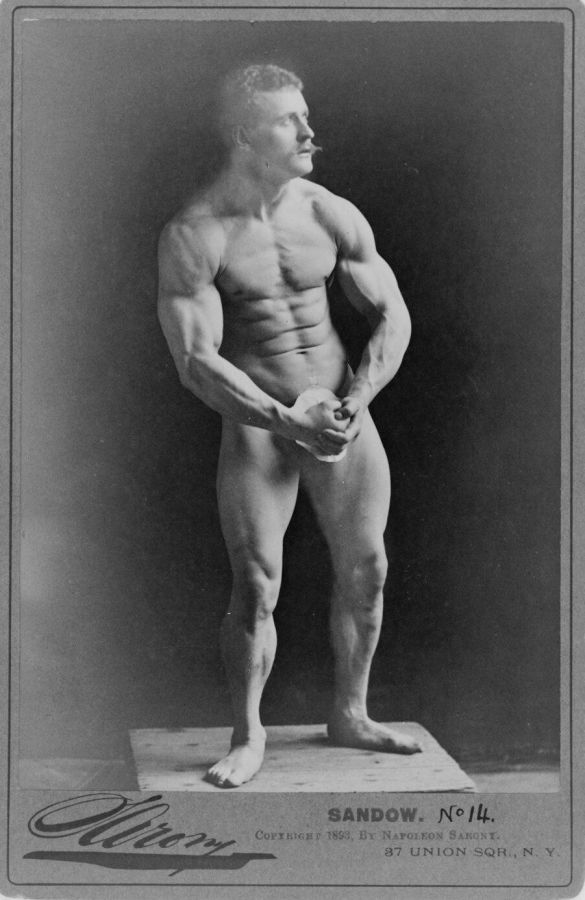
A Prussian circus athlete learned to stop lifting and start posing, and Napoleon Sarony photographed him naked but for a fig leaf. Eugen Sandow sold that body on stage, on cabinet cards and by mail, to a public that included far more than would-be athletes.
London, 14 September 1901. The Royal Albert Hall is full for an event that has never been held before: a contest to find the best-built man in Britain. On the jury sit the sculptor Sir Charles Lawes, the novelist Arthur Conan Doyle and the man who organised the whole thing, Eugen Sandow. The winner, William L. Murray of Nottingham, goes home with a gold statuette of Sandow himself1.
It was a fitting prize. In less than ten years Eugen Sandow had turned his own body into the most famous in the world, sold on stage, on cabinet cards, in books, in a magazine and by mail order. This page follows him from Königsberg to the music halls, from Florenz Ziegfeld's stage in Chicago to Napoleon Sarony's camera in New York, and looks at who bought the pictures of a strongman wearing nothing but a fig leaf.
From Königsberg to the Royal Aquarium
He was born Friedrich Wilhelm Müller on 2 April 1867 in Königsberg, in East Prussia, the city now called Kaliningrad. His family hoped he would become a Lutheran minister. Instead, in 1885, he left Prussia, partly to avoid military service, and drifted through Europe as a circus athlete1.
In Brussels he trained with Louis Durlacher, a strongman who performed as Professor Attila and taught him to use weights systematically. Attila also saw that the young man could make money.
In 1889 Sandow, as he now called himself, went to London and challenged a strongman billed as Samson at the Royal Aquarium in Westminster. He won, and became famous almost overnight. The music halls booked him, and he spent the next years lifting weights, horses and men on stage.
The man who stopped lifting
In June 1893 Sandow arrived in New York. That summer a young impresario, Florenz Ziegfeld Jr, signed him for the Trocadero, a Chicago venue run by the Ziegfeld family, during the World's Columbian Exposition, the great world's fair that brought millions of visitors to the city2.
Ziegfeld understood something Sandow's earlier managers had missed. Audiences did not only want to see a man lift heavy things; they wanted to look at him. The act put more weight on posing. Sandow stood in a frame or on a plinth, lit from above, and moved slowly from one classical pose to another while his muscles did the rest.
Ziegfeld also used the oldest trick of show business, the private invitation. According to the story told by his biographers, wealthy spectators who paid extra could go backstage after the show and touch the strongman's arms and chest for themselves, and leading Chicago society women were among the first to accept2.

A fig leaf at 37 Union Square
Before Chicago, in New York, Sandow posed in the studio of Napoleon Sarony at 37 Union Square. Sarony, then in his seventies, was the most famous portrait photographer in America, the man who had posed Oscar Wilde in velvet and knee breeches in 1882.
He made a long series of pictures of the strongman. In some Sandow wears trunks or a leopard skin. In others he wears nothing but a fig leaf, or stands naked on a low plinth with his hands clasped in front of him, posed like a marble statue, among them the Farnese Hercules3.
The fig leaf was a small piece of theatre. It placed the picture in the museum, where nude statues had worn fig leaves for centuries, and it let the photograph be sold in a shop window. Everything else was on show.
Who bought the pictures
Sandow's cards sold to everyone: young men who wanted his muscles, women who admired them, fans of the music hall. Physical culture gave all of them a respectable reason to own a picture of a nearly naked man.
It also gave cover to men who desired men. The film historian Thomas Waugh places physique photographs like Sandow's at the start of the history of gay male erotic photography, as pictures that could be bought openly and looked at privately in a very different spirit3. Sandow's own biographer, David Chapman, went on to publish Adonis, a collection of male physique pin-ups from 1870 to 1940, with a gay publisher in London4.
That is what can be documented: a large, mixed public, and among it a gay audience that historians have traced through the collections and the later physique trade. Sandow himself married Blanche Brooks in 1894 and had two daughters, and anything more about his private life belongs to speculation.

An empire built on one body
Sandow was a showman who thought like a businessman. In May 1894 he went to Thomas Edison's Black Maria studio in New Jersey and flexed for a few seconds in front of the kinetoscope camera; souvenir strips of the frames were sold too.
Back in Britain he wrote books, starting with Strength and How to Obtain It in 1897, full of charts, exercises and photographs of himself5. In 1898 he launched a monthly magazine, later called Sandow's Magazine of Physical Culture, and opened institutes where paying members trained under his system.
He sold dumbbells, spring grips, cocoa and courses by mail. Readers sent in photographs of their own bodies, and the magazine printed them, turning the customers into pin-ups in turn. The historian Michael Anton Budd has shown how this trade linked fitness, empire and the new pleasure of looking at photographed men6. In 1911 Sandow was appointed instructor in physical culture to King George V.
The night at the Albert Hall
The Great Competition of 1901 was the summit of the business. Entrants had first to win regional contests organised through the magazine, and the finalists came to London to be judged on stage, posing as Sandow had taught them1.
The crowd was so large that many could not get in. Murray took the gold statuette, D. Cooper the silver and A. C. Smythe the bronze. It is usually described as the first big bodybuilding contest in history.
A body in plaster
At the height of his fame Sandow's body was treated as a scientific specimen. A full plaster cast of him was made for the Natural History Museum in London, meant to show the ideal proportions of a European man. Accounts differ on the exact date, usually given as 1901, and on how long it was on show, but the cast survives in the museum's collections, according to his biographer1.
It is a strange object: a music hall star, photographed naked for collectors, filed among the museum's measurements of human types. It says a great deal about how easily, around 1900, the language of art, health and science could be used to look at a man's body.

An unmarked grave in Putney
Sandow died at his home in Kensington on 14 October 1925, aged fifty-eight. Newspapers spoke of a brain haemorrhage, and a story spread that he had strained himself lifting a car out of a ditch; other accounts give an aortic aneurysm. The certain fact is that the strongest man in the world died relatively young1.
His widow had him buried in Putney Vale Cemetery in an unmarked grave. A headstone was added only in 2002.
By then his poses had outlived him. They passed into the physique magazines of the 1940s and 1950s, into the gyms and into the gay pin-up trade, where a man in a posing strap played the same game with the censor that Sandow had played with his fig leaf. The wider story of Sandow, Gloeden and the male nude around 1900 is told in the chapter on the Arcadian photographers.
- David L. Chapman, Sandow the Magnificent: Eugen Sandow and the Beginnings of Bodybuilding, University of Illinois Press, 1994
- John F. Kasson, Houdini, Tarzan, and the Perfect Man: The White Male Body and the Challenge of Modernity in America, Hill and Wang, 2001
- Thomas Waugh, Hard to Imagine: Gay Male Eroticism in Photography and Film from Their Beginnings to Stonewall, Columbia University Press, 1996
- David Chapman, Adonis: The Male Physique Pin-Up 1870–1940, Gay Men's Press, 1989
- Eugen Sandow, Strength and How to Obtain It, Gale & Polden, 1897
- Michael Anton Budd, The Sculpture Machine: Physical Culture and Body Politics in the Age of Empire, New York University Press, 1997