Different from the Others, the 1919 film that fought Paragraph 175
In the brief months when Germany had no film censor, Richard Oswald and Magnus Hirschfeld made a melodrama about a violinist driven to suicide by a blackmailer and the law. Different from the Others was banned in 1920 and survives only because a fragment hid inside another film, in a copy with Ukrainian subtitles.
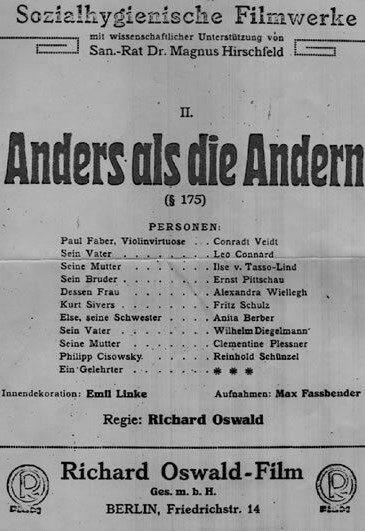
Berlin, 28 May 1919. At the Apollo-Theater a specially invited audience watches the first screening of Anders als die Andern, "Different from the Others". Two days later the film opens to the public at the Prinzeß-Theater, and soon forty copies are travelling around Germany, a large number for the time. On the poster, under the title, the producers have printed a number that every German adult understood: § 1751.
Paragraph 175 was the article of the German criminal code that punished sex between men. Different from the Others was a feature film made to attack it, written by the director Richard Oswald together with the sexologist Magnus Hirschfeld, who also appears on screen. It is usually described as the first film to plead openly for homosexual men. Within fifteen months it was banned, most of its copies were lost, and for decades it survived only as a fragment hidden inside another film.
A window with no censor
The film was possible because of a revolution. On 12 November 1918, days after the fall of the Kaiser, the new revolutionary government in Berlin declared that censorship no longer existed1.
Film producers took the declaration at its word. In the months that followed, German cinemas filled with so-called enlightenment films about venereal disease, prostitution and abortion, sold as public education and watched with great curiosity. Richard Oswald, born in Vienna in 1880, was one of the leading makers of the genre, and his company billed Different from the Others as the second of its "social hygiene" films.
For Hirschfeld the screen was a new weapon in an old fight. Since 1897 his Scientific-Humanitarian Committee had been collecting signatures against Paragraph 175, and in July 1919 he would open his Institute for Sexual Science in Berlin. A film could reach more people in a week than a petition in ten years2.

A violinist and a blackmailer
The story is a melodrama with a thesis. Paul Körner, a celebrated violinist played by Conrad Veidt, falls in love with his young pupil Kurt Sivers, played by Fritz Schulz. Paul's parents push him to marry, and a doctor has to explain to the bewildered family what their son is.
The danger comes from the past. Franz Bollek, played by Reinhold Schünzel, a man Paul once picked up, begins to blackmail him. When Paul stops paying, Bollek denounces him under Paragraph 175. At the trial a doctor, played by Hirschfeld himself, makes the case for understanding: homosexuality is neither a sin nor a crime but a natural variation3.
The court gives Bollek three years for extortion and Paul one week in prison. A week is enough. His career and his name are ruined, his family turns away, and he poisons himself. At his deathbed Kurt wants to follow him, and the doctor stops him with a final appeal to fight the law instead.
The actor who played the victim
Conrad Veidt was twenty-six and not yet a star. A few months later he played the sleepwalking killer Cesare in The Cabinet of Dr. Caligari and became one of the faces of German cinema.
In Different from the Others he plays a homosexual man with dignity and without caricature, at a time when the screen had little else to offer such a character but jokes or crime4.
In 1933, after marrying a Jewish woman, he left Nazi Germany for Britain, became a British subject in 1939 and ended his career in Hollywood, where he played the Nazi officer Major Strasser in Casablanca. He died in Los Angeles in 1943.

Uproar in the cinemas
The film was a hit and a scandal. Audiences came in numbers; conservative newspapers, churches and nationalist groups protested. Opponents claimed to be protecting the young5.
The attacks also carried an ugly second message. Both Oswald and Hirschfeld were Jewish, and part of the campaign against the film presented homosexuality as a Jewish vice spread by Jewish filmmakers. Historians have shown how much of the hostility to the film and to Hirschfeld was antisemitic from the start6.
Only for doctors
The window closed fast. On 12 May 1920 the Reich Motion Picture Law brought back film censorship across Germany, partly in reaction to the enlightenment films1.
On 18 August 1920 the censors banned Different from the Others. It could still be shown, but only to doctors and medical researchers, in medical schools and scientific institutes. For the public it had ceased to exist, and the commercial copies were withdrawn and lost; most of them are presumed destroyed.
Paragraph 175 outlived the film by a long way. The Nazis made it harsher in 1935, West Germany kept that version until 1969, and the article was removed from German law only in 1994.
Hidden inside another film
Hirschfeld did not give up his footage. In 1927 he made Gesetze der Liebe, "Laws of Love", a feature-length educational film about sexuality, and placed a shortened version of Different from the Others inside it as the chapter on homosexuality3. That film too ran into the censors.
What remained of Hirschfeld's world was smashed in May 1933, when students looted his institute and burned its library. He was abroad, and he died in exile in Nice on 14 May 1935, his sixty-seventh birthday.

Read aloud in Frankfurt
The Ukrainian print became the basis of every modern version. At a gay film festival in Frankfurt in 1982, the Munich museum lent a 16mm copy and the organisers read out translations of the Ukrainian titles to the audience1.
The Munich Film Museum then reconstructed the film, restoring German intertitles and adding explanatory titles where scenes are missing. It came out first on video and, in October 2006, on DVD in German and English versions, together with the sequence from Gesetze der Liebe. The scholar James Steakley told the full history of the film in a book published the following year1.
The reconstruction runs about forty minutes. It has since been shown at festivals and cinematheques across Europe and North America, including Outfest in Los Angeles in 2012.
A century on, Different from the Others is studied less as entertainment than as a document of a political campaign, and as the first time a camera took the side of the men the law was hunting4. The wider story of Hirschfeld, his institute and the photographers of the same years is told in the chapter on the Arcadian photographers.
- James D. Steakley, Anders als die Andern: Ein Film und seine Geschichte, Männerschwarm Verlag, 2007
- Ervin Malakaj, Anders als die Andern, McGill-Queen's University Press, 2023
- Ralf Dose, Magnus Hirschfeld: The Origins of the Gay Liberation Movement, Monthly Review Press, 2014
- Richard Dyer, Now You See It: Studies on Lesbian and Gay Film, Routledge, 1990
- Robert Beachy, Gay Berlin: Birthplace of a Modern Identity, Alfred A. Knopf, 2014
- Valerie Weinstein, Homosexual Emancipation, Queer Masculinity, and Jewish Difference in Anders als die Andern (1919), in Rethinking Jewishness in Weimar Cinema, Berghahn Books, 2020