Saint Sebastian, the martyr pierced by arrows who became a gay icon
For three centuries the best painters in Europe put a nearly naked young soldier on church altars and called it devotion. Then Oscar Wilde took his name, Mishima found his desire in him and Derek Jarman put him on screen.
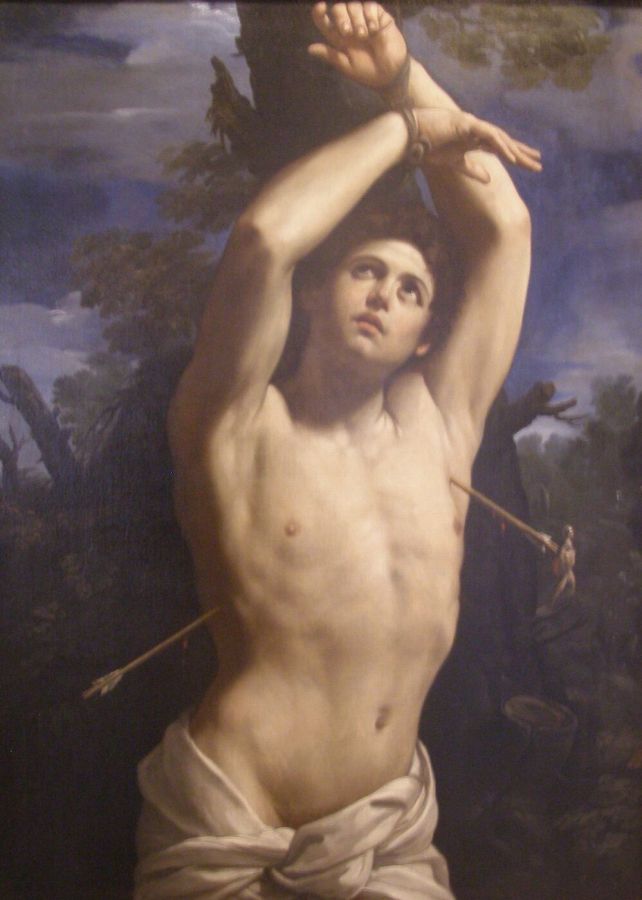
Rome, spring 1877. Oscar Wilde, a 22-year-old Oxford undergraduate on his way home from Greece, stands at the grave of John Keats in the Protestant Cemetery. In the essay he wrote about the visit, published that July in The Irish Monthly, he says the grave made him think of a painting he had seen in Genoa: Guido Reni's Saint Sebastian, a beautiful young man tied to a tree, his eyes raised to heaven. In the sonnet that closes the essay he called Keats "Fair as Sebastian, and as early slain"1.
Twenty years later, released from prison and living in exile, Wilde took the saint's name as his own. Saint Sebastian, a Roman soldier who had been one of the most painted martyrs of the Renaissance, was on his way to becoming the most famous gay icon in Christian art. This is how a plague saint ended up there, and why painters made it so easy.
The soldier who survived his own execution
Very little about the real Sebastian is certain. A Roman calendar of the year 354 already lists his feast on 20 January and places his tomb on the Via Appia, outside Rome. The full story comes from a much later account of his martyrdom, written in the fifth century2.
According to that story, Sebastian was an officer in the imperial guard under Diocletian, around AD 288, and a secret Christian. When his faith was discovered, the emperor had him tied to a stake and shot with arrows by archers. He was left for dead, but a widow named Irene came to bury him and found him alive. She nursed him back to health. Sebastian then went back to confront the emperor, who had him beaten to death with clubs and his body thrown into the main sewer of Rome.
So the arrows did not kill him. That detail matters: for most of history, the scene artists painted was not his death but the moment he survived it.
The earliest pictures look nothing like the later ones. In a mosaic of about 680 in the church of San Pietro in Vincoli in Rome, Sebastian is a grown man with a grey beard, dressed in a court robe, and there is not an arrow in sight.
Arrows against the plague
What made Sebastian important was disease. The historian Paul the Deacon wrote that Rome was freed from a plague in 680 after prayers to the saint. When the Black Death reached Europe in 1347 and 1348, and kept returning for three centuries, Sebastian became one of the two great plague saints, with Saint Roch2.
The logic was the arrow. Since antiquity plague had been imagined as arrows shot from heaven, as Apollo shoots the Greek camp at the start of the Iliad. A saint who had been pierced by arrows and lived was the perfect protector. Towns, confraternities and families ordered his image for altars, banners and private chapels, often as a vow during an epidemic or a thanksgiving after one.
Sheila Barker has shown how this demand changed the picture itself. The bearded official turned into a young, beardless, almost naked man, tied to a column or a tree, his body offered to the viewer like an ancient statue2. By the late fifteenth century Sebastian was one of the few subjects in which a painter could show a nearly nude male body on an altar, and many of the best painters in Italy did.
A body on a column
Andrea Mantegna painted Sebastian three times. The first, a small panel made around 1457 to 1459, probably in Padua, and now in Vienna, ties him to a broken arch among classical ruins. Mantegna signed it in Greek, on the pillar beside the saint: the work of Andrea. The message was clear. This body was meant to stand comparison with the statues of Greece and Rome.
Antonello da Messina went further. His Sebastian, painted around 1478 for the church of San Giuliano in Venice, in a year of plague in the city, stands alone in a sunny square with paved floor, chimneys and balconies. The arrows hardly seem to touch him. He wears only a short white loincloth, and his skin is as smooth as marble.


In Perugino's version of about 1490 to 1500, now in the Louvre, the saint stands under an arch with his hands behind his back and almost no blood at all. Carved into the step at his feet is a line from the Psalms in Latin: your arrows are fixed in me. It is a picture of calm beauty more than of torture.
A banner from Siena
In 1525 the confraternity of San Sebastiano, based near the Porta Camollia in Siena, ordered a processional banner from Giovanni Antonio Bazzi, a painter from Piedmont who had made his career in the city. One side shows the Virgin and Child in glory with saints and kneeling members of the brotherhood. The other shows Sebastian tied to a tree, head thrown back, while an angel flies down with a crown of martyrdom.

Bazzi was known to everyone as Il Sodoma. Giorgio Vasari, who disliked him, explained in his Lives that the nickname came from his habit of surrounding himself with boys and young men, and that Bazzi, far from being offended, used it himself3. Vasari also admired the banner. Merchants from Lucca offered the confraternity large sums for it, and the brothers refused. It stayed in Siena until 1784, when the grand duke Pietro Leopoldo bought it for the Uffizi in Florence, where it still hangs.
Reni and the Baroque
The Counter-Reformation tried to make religious art more decent, and Sebastian came through with his loincloth intact. Guido Reni painted him about seven times, and it is Reni's versions, with their pale, soft-skinned bodies and eyes turned up in something closer to ecstasy than pain, that later generations remembered. The one in Genoa, painted around 1615 and now in the Palazzo Rosso, is the picture Wilde saw.
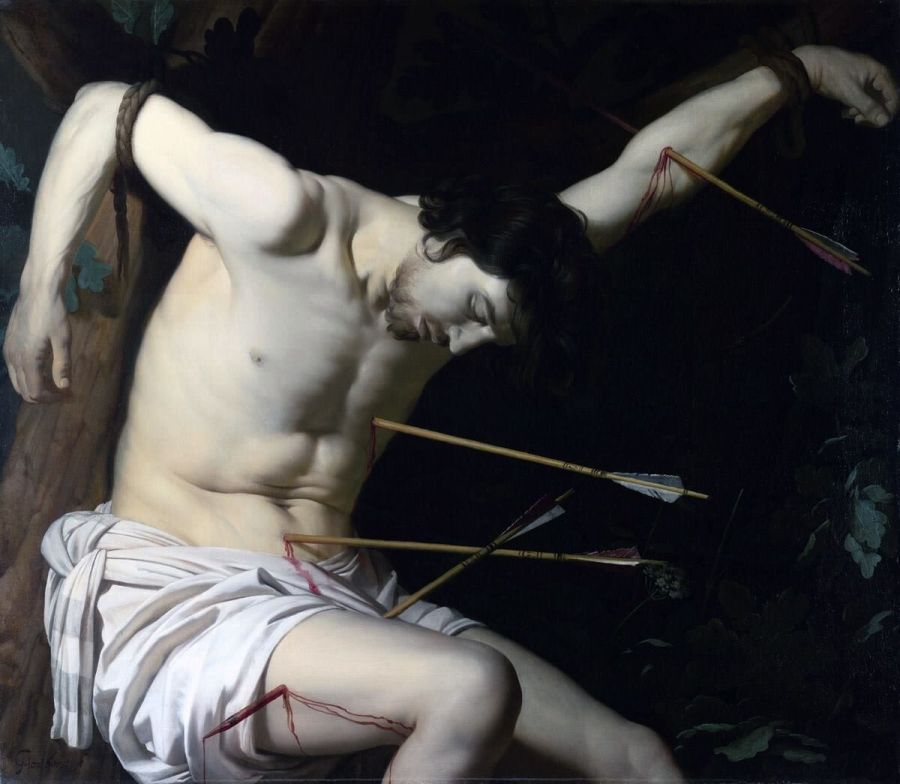
North of the Alps the Utrecht painters who had studied Caravaggio in Rome brought the saint close to the viewer. Gerrit van Honthorst's Saint Sebastian, painted around 1623, fills the canvas with a single slumped, muscular body, four arrows in it and a drop of blood running from his leg towards the edge of the picture. Utrecht was hit by plague between 1624 and 1626, and the National Gallery in London, which bought the painting in 1930, connects it to that devotion4.
His colleague Hendrick ter Brugghen chose the other half of the story in 1625: Irene and her maid pulling the arrows out of the unconscious soldier, whose skin has the greenish pallor of the sick. The subject of Sebastian tended by Irene became a favourite of the period, painted by night, by the light of a lantern.

Sebastian Melmoth
Wilde was released from Reading Gaol on 19 May 1897 and crossed to France the same night. In the seaside village of Berneval, near Dieppe, he registered under a new name, Sebastian Melmoth, and he used it until his death in Paris in November 19005.
Melmoth came from Melmoth the Wanderer, the Gothic novel by Charles Maturin, his mother's uncle, about a man condemned to roam the earth. Sebastian was the martyr. Biographers have linked the choice to the arrows of the saint, and some also to the broad arrows printed on English convict uniforms5. Either way, the most famous homosexual in Europe had chosen to be known by the name of a pierced and beautiful saint.
A photographer, a doctor and a novelist
Around the turn of the century the Boston photographer F. Holland Day, who had already photographed himself as the crucified Christ, made a series of Saint Sebastians, a model bound to a tree in soft platinum tones. His biographer Estelle Jussim tells the story of these religious pictures and of the controversy they caused6.
In Tokyo, after the Second World War, the saint found his way into one of the great gay novels of the century. In Confessions of a Mask (1949) Yukio Mishima's narrator remembers finding, as a schoolboy, a reproduction of Reni's Sebastian in one of his father's art books, and he makes it the moment he understood that his desire was for men. He even cites the Berlin sexologist Magnus Hirschfeld, who had placed pictures of Saint Sebastian among the artworks that homosexual men favoured7.
Mishima never let the image go. In 1970, about two months before his ritual suicide in November, he posed for the photographer Kishin Shinoyama for a portfolio to be called Death of a Man. In one of the pictures he is Sebastian, his bare torso bound to a tree and pierced by arrows8.
From Jarman to the plague years
In 1976 Derek Jarman and Paul Humfress made Sebastiane, shot on a beach in Sardinia with dialogue entirely in Latin, which turned the legend into a story of desire among Roman soldiers and gave the saint's body to a gay audience without any religious alibi9. Its place in the history of male nudity on screen is told in the page on male nudity in mainstream cinema.
A decade later the old plague saint found a new plague. During the AIDS epidemic artists and activists returned to Sebastian as an image of a body attacked from outside and of a community left to suffer. Richard A. Kaye has described how gay men saw in him two things at once: an open advertisement for desire between men and the portrait of a man tortured for what he had to hide10.
That double meaning was there from the start. For three centuries painters and their clients could look at a beautiful naked man, call it devotion and be telling the truth. The wider story of how the Renaissance used myth and religion to paint the male body is told in the chapter on the Renaissance and Baroque.
- Oscar Wilde, The Tomb of Keats, The Irish Monthly 5, 1877
- Sheila Barker, The Making of a Plague Saint: Saint Sebastian's Imagery and Cult before the Counter-Reformation, in Franco Mormando and Thomas Worcester (eds), Piety and Plague: From Byzantium to the Baroque, Truman State University Press, 2007
- Giorgio Vasari, Lives of the Most Excellent Painters, Sculptors and Architects, Giunti, 1568
- National Gallery, Gerrit van Honthorst, Saint Sebastian, about 1623, NG4503
- Richard Ellmann, Oscar Wilde, Hamish Hamilton, 1987
- Estelle Jussim, Slave to Beauty: The Eccentric Life and Controversial Career of F. Holland Day, Photographer, Publisher, Aesthete, David R. Godine, 1981
- Yukio Mishima, Confessions of a Mask, translated by Meredith Weatherby, New Directions, 1958
- Ian Buruma, Obsessions in Tokyo, The New York Review of Books, 2013
- Tony Peake, Derek Jarman, Little, Brown, 1999
- Richard A. Kaye, Losing His Religion: Saint Sebastian as Contemporary Gay Martyr, in Peter Horne and Reina Lewis (eds), Outlooks: Lesbian and Gay Sexualities and Visual Cultures, Routledge, 1996