Michelangelo and Tommaso de' Cavalieri, drawings, letters and sonnets for a young Roman nobleman
In 1532 the most famous artist in Italy met a young Roman nobleman and began sending him love letters, sonnets and drawings made as gifts. Tommaso de' Cavalieri stayed at Michelangelo's side for thirty years, and the poems written for him were turned into poems to a woman after the artist's death.

Rome, 1 January 1533. Michelangelo Buonarroti, fifty-seven years old and the most famous artist in Italy, is trying to write a letter to a young Roman nobleman. He writes it, crosses it out and starts again, and more than one draft survives in the family archive in Florence. In the version he sends, he calls Tommaso de' Cavalieri the light of our century, and a paragon for the whole world1.
It was the beginning of the best documented passion of Michelangelo's life. Over the next few years he sent Tommaso some thirty poems and a set of drawings that were unlike anything he had made before, and the two men stayed close for more than thirty years, until Tommaso stood at his bedside when he died. This page follows the letters, the gifts and the poems, and what later generations did to hide them.
A young man of the Roman nobility
Tommaso was the son of Mario de' Cavalieri and Cassandra Bonaventura, from an old family of the Roman nobility with houses near Sant'Eustachio, close to the Pantheon. His father died in 1524. He grew up among antiquities, humanists and collectors, and drew a little himself2.
His age is a real problem and has to be stated plainly. Older books make him about twenty-three in 1532, born around 1509. But his parents only married in November 1509, and they had an elder son first. The only document that gives his age, from 1536, has been read in two ways: by the art historian Gerda Panofsky-Soergel as saying he was then between sixteen and twenty-five, and by the musicologist Warren Kirkendale as saying he was no more than sixteen. On Kirkendale's reading, Tommaso was a boy of about twelve when Michelangelo met him, a minor by any standard3.
Nobody has settled the question. What can be said is that he was young, probably very young, that the letters show a relationship conducted openly, through friends who carried messages between them, and that nothing in the record shows it was ever physical.
Light of our century
They met in Rome in 1532, probably through friends in the circle of the Medici popes. Michelangelo was then working between Florence and Rome; in 1534 he settled in Rome for good.
The letters are an unequal exchange. Michelangelo's are anxious and extravagant: he writes that he could sooner forget the food that keeps him alive than Tommaso's name, and that his soul is in the young man's hands. Tommaso's replies are polite, warm and a little careful. He promises to love the artist in return and talks about wanting to learn from him1.
Giorgio Vasari, who knew Michelangelo, later wrote that he loved Tommaso more than anyone else, and that he drew a life-size portrait of him in black chalk, the only portrait drawing from life he is known to have made. It does not survive2.

Drawings made as gifts
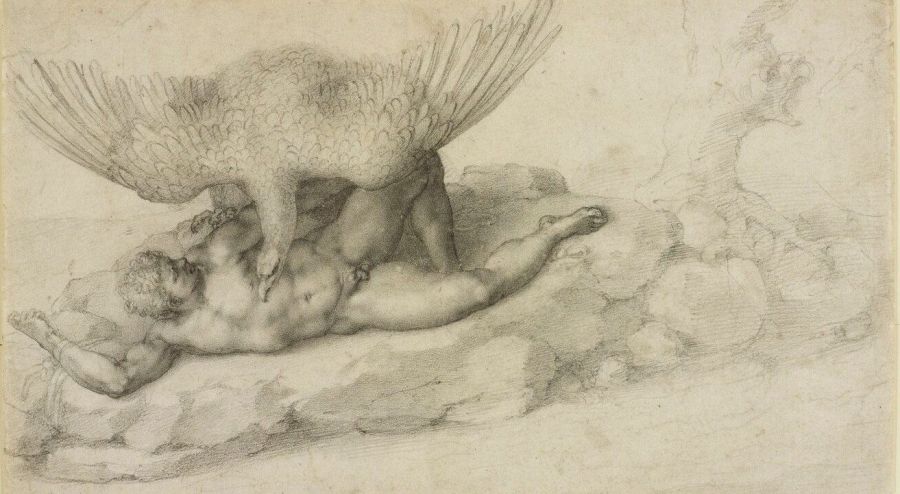
Michelangelo had always drawn to prepare paintings and sculptures. For Tommaso he did something new: highly finished drawings in black chalk, made to be given away, kept and looked at as works in their own right. Art historians call them presentation drawings, and these are the most famous ever made4.
The first group, sent around the end of 1532, included The Punishment of Tityus. In the myth Tityus was a giant who tried to rape the goddess Leto and was chained in the underworld while a vulture tore at his liver, which grew back every day. Michelangelo shows him naked on a rock, his body twisted under the bird's wings, in a pose of pain that is also strangely sensual.
Next came The Fall of Phaeton, the son of the Sun who drove his father's chariot too close to the earth and was struck down by Jupiter. Michelangelo drew it more than once. On the sheet now in the British Museum he wrote a note at the bottom: if Tommaso did not like the sketch, he should tell Urbino, Michelangelo's servant, so that he could make another one the next evening5.
The set also included a Rape of Ganymede, now lost, and a Children's Bacchanal. Scholars have read the group as a meditation on love as punishment and fall, on desire that destroys the one who feels it, in the language of the Neoplatonic philosophy that Michelangelo's generation had learned in Florence6.
Thirty poems for one man
The poems are the heart of the story. About thirty sonnets, madrigals and short verses are addressed to Tommaso or clearly concern him, the largest group Michelangelo wrote for anyone1.
They speak of fire and ice, of chains and prisons, of a beauty that lifts the lover towards God. In one, Michelangelo calls himself the naked prisoner of an armed cavaliere, a knight, a pun on Tommaso's surname. In others he insists that what he loves in the young man is the divine beauty shining through him, not the body alone.
The language is Platonic, the language of Marsilio Ficino and of Florence. Whether it was also a disguise, or simply the only way a man of that time and that faith could write about such a love, is a question every reader answers differently.
Thirty years of friendship
The intensity of the first years did not last, but the friendship did. From 1536 Michelangelo's closest spiritual friend was the poet Vittoria Colonna, and his letters to Tommaso grew calmer.
In 1544 Tommaso married Lavinia della Valle, from another great Roman family. They had two sons, Mario and Emilio, before she died in 1553. Tommaso held civic offices in Rome, and from 1554 he helped to oversee the rebuilding of the Capitoline Hill to Michelangelo's design, the square with the statue of Marcus Aurelius and the palaces around it7.
On 18 February 1564 Michelangelo died in his house in Macel de' Corvi, near the Capitol, at the age of eighty-eight. Tommaso was there, with Daniele da Volterra and a few others. After the death he kept watch over the Capitoline works for years. He died in 1587.
A nephew, a Victorian and the truth
Michelangelo's poems were not collected in print until 1623, when his grandnephew, Michelangelo Buonarroti the Younger, published them and changed them to protect the family's reputation. Poems to Tommaso were turned into poems to a woman or to no one in particular8.
That version was read for two hundred and forty years. In 1863 Cesare Guasti published the poems from the manuscripts, and the masculine words came back. The English writer John Addington Symonds, who was quietly campaigning for the acceptance of love between men, translated the sonnets in 1878 and in his life of Michelangelo, published in 1893, put the story of Tommaso at the centre9.
Since then the relationship has been told as a great love, as a chaste friendship and as an example of the pattern of older man and younger male that historians have found throughout Renaissance Italy. The uncertainty about Tommaso's age makes the last reading harder to dismiss. What survives is a set of drawings, a bundle of letters and some of the most passionate love poetry of the century, all addressed by one man to another. The wider story, from the Officers of the Night to Caravaggio, is told in the chapter on the Renaissance and Baroque.
- James M. Saslow, The Poetry of Michelangelo: An Annotated Translation, Yale University Press, 1991
- Giorgio Vasari, Le vite de' più eccellenti pittori, scultori e architettori, Giunti, 1568
- Warren Kirkendale, Emilio de' Cavalieri "Gentiluomo Romano", Leo S. Olschki, 2001
- Stephanie Buck (ed.), Michelangelo's Dream, Courtauld Gallery and Paul Holberton Publishing, 2010
- Hugo Chapman, Michelangelo Drawings: Closer to the Master, British Museum Press, 2005
- James M. Saslow, Ganymede in the Renaissance: Homosexuality in Art and Society, Yale University Press, 1986
- Maria Ruvoldt, Gossip and Reputation in Sixteenth-Century Rome: Tommaso de' Cavalieri and Lavinia della Valle, Renaissance Studies 34, 2020
- Cesare Guasti (ed.), Le rime di Michelangelo Buonarroti, pittore, scultore e architetto, Le Monnier, 1863
- John Addington Symonds, The Life of Michelangelo Buonarroti, John C. Nimmo, 1893