The trial of the Templars, how a charge of sodomy brought down an order
On Friday 13 October 1307 the king of France arrested every Templar in his kingdom and accused them of heresy, obscene kisses and sex between brothers. Hundreds confessed under torture, only three admitted to the act itself, and the order was destroyed anyway.

Paris, Thursday 12 October 1307. In the funeral procession of Catherine of Courtenay, wife of Charles of Valois and sister-in-law of King Philip IV, one of the men carrying the coffin is Jacques de Molay, Grand Master of the Knights Templar. He is a guest of honour at the court of France. At dawn the next morning, Friday 13 October, the king's men arrest him in the Temple, the order's headquarters in Paris, together with every Templar they can find in the kingdom1.
Within two weeks the most powerful military order of Christendom stood accused of denying Christ, spitting on the cross, kissing new members on the base of the spine and allowing its brothers to have sex with one another. Five years later the order no longer existed, and seven years later its last Grand Master was burned alive. This page tells how the trial of the Templars was built, what the men actually confessed, and why the accusation of sodomy was so useful to the king who brought it.
Monks with swords
The order began around 1120 in Jerusalem, when a knight from Champagne, Hugues de Payns, and a few companions took religious vows and promised to protect pilgrims on the roads of the Holy Land. The king of Jerusalem gave them quarters in the al-Aqsa mosque, which the crusaders called the Temple of Solomon, and the name stuck2.
In 1129 the Council of Troyes gave them a Rule, and Bernard of Clairvaux wrote a treatise praising this new kind of knighthood. Donations of land, money and castles poured in from all over Europe. The Templars were answerable only to the pope, paid no tithes and ran a network of houses from Scotland to Cyprus.
They also became bankers. Pilgrims and kings deposited money with them and drew on it elsewhere, and the Paris Temple for long periods kept the treasury of the kings of France. The fortified enclosure on the right bank of the Seine, with its great keep, was a city within the city3.

A king who needed money
By 1307 the reasons for the order's existence were gone. Acre, the last great crusader city, had fallen in 1291, and the Templars had withdrawn to Cyprus. They were rich, armed, exempt from local authority and, in the eyes of many, useless.
Philip IV, called the Fair, was short of money and hard on anyone who stood in his way. He had already devalued the coinage, squeezed the Lombard bankers, and in 1306 expelled the Jews of France and seized their property. His ministers, above all the lawyer Guillaume de Nogaret, had a method: in 1303 they had attacked Pope Boniface VIII with charges of heresy and sodomy, and sent men to seize him at Anagni1.
The rumours against the Templars came from an informer, Esquiu de Floyrac of Béziers, who said he had heard them from a former brother. He tried them first on King James II of Aragon, who did not believe him. Philip did. On 14 September 1307 sealed orders went out to royal officers all over France, to be opened on the same day and carried out at dawn on 13 October.
The king's letter described the Templars as worse than beasts. When a man was received into the order, it said, he denied Christ three times and spat on the crucifix; he was stripped and kissed by the brother receiving him on the base of the spine, the navel and the mouth; and he was told that he was bound to give himself to his brothers if they asked, because the order allowed it1.
The charges were carefully chosen. Heresy brought in the Inquisition, which in France was run by the king's confessor. The obscene kisses and the permission to commit sodomy made the order disgusting as well as dangerous. Sodomy was, in the language of the time, the sin that could not be named, and an accusation of it was almost impossible to disprove.
The confessions in Paris
The interrogations began on 19 October in the Temple, in front of the inquisitor Guillaume de Paris. Many of the prisoners had first been in royal hands, and torture was used: men were racked, starved and burned on the soles of their feet. By 24 November, 138 Templars had been heard in Paris1.
The numbers show how the trial worked. According to Malcolm Barber's count, 105 admitted denying Christ, 123 admitted spitting on or near the cross and 103 admitted the indecent kisses. One hundred and two said that sex between brothers had been permitted or encouraged. Only three admitted that they had actually done it1.
That gap is the heart of the matter. Anne Gilmour-Bryson, who studied the sexual charges across all the surviving trials, found the same pattern everywhere: many men said they had been told it was allowed, very few said they had done it, and confessions appeared almost only where torture was used4.
On 24 October Molay himself admitted denying Christ and spitting on the cross, though not the sexual charges, and the next day he repeated it in front of the masters of the University of Paris. He was also made to write to his brothers urging them to confess.
The pope steps in
Clement V, a Frenchman who lived in Poitiers and was never to set foot in Rome, was furious that a king had arrested an order that answered only to the papacy. He then tried to take the case over. On 22 November 1307, with the bull Pastoralis praeeminentiae, he ordered every Christian ruler to arrest the Templars in their lands3.
When two cardinals came to Paris in December, Molay withdrew his confession. In August 1308, in the castle of Chinon, three cardinals questioned him and other leaders again; they confessed to the denial of Christ, asked for forgiveness, and were absolved. A record of that hearing was found in the Vatican archives in 2001 by Barbara Frale: in it the leaders deny having practised sodomy and describe the kisses as a sign of respect5.
Six hundred men who wanted to speak
In 1309 a papal commission began hearing the case of the order as a whole, and something unexpected happened. Brothers who had confessed began to come forward to defend it, and by the spring of 1310 nearly six hundred had said they would. Their spokesmen, the priest Pierre de Bologne among them, argued that the confessions had been forced and the charges were lies1.
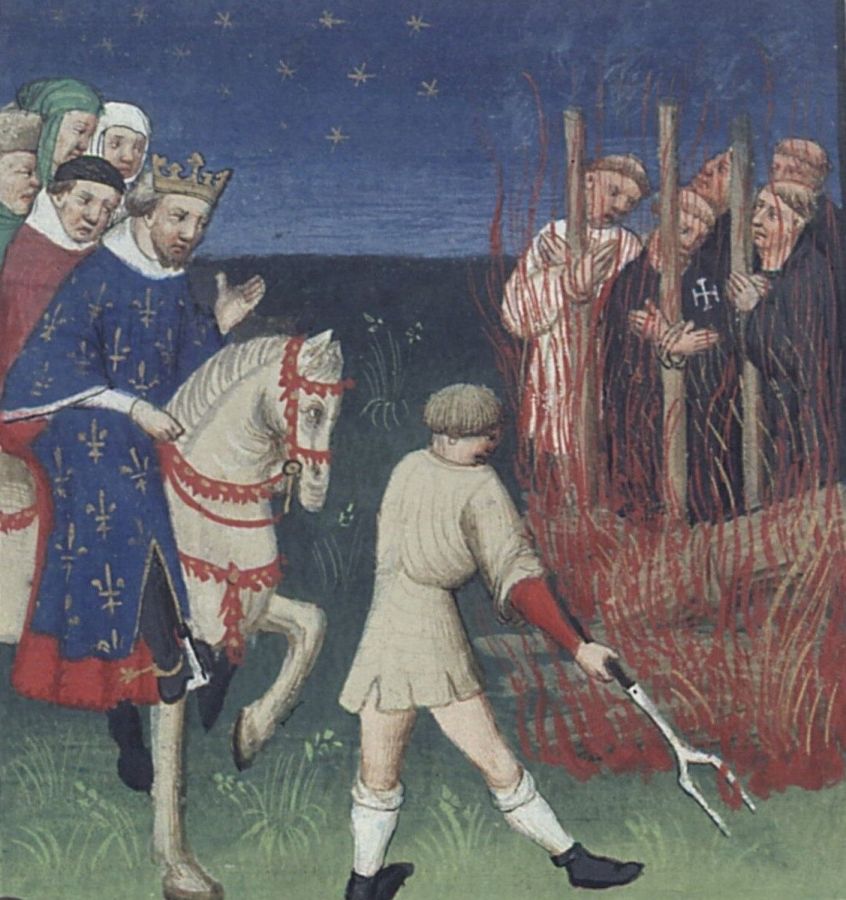
The king's side moved fast. Philippe de Marigny, the newly appointed archbishop of Sens and brother of one of Philip's chief ministers, tried the men of his province as relapsed heretics, those who had confessed and then taken it back. On 12 May 1310 fifty-four Templars were burned outside Paris. The defence collapsed, and Pierre de Bologne disappeared from the record.
Outside France, a different answer
Where torture was not used, the case fell apart. In England, Edward II at first refused to believe the charges, and when the brothers were finally questioned, from 1309, almost none admitted anything. Inquisitors sent from the Continent complained that English law did not allow torture, and only after long pressure did a few men confess6.
In Cyprus the Templars were acquitted at their first trial. In Aragon and Castile the councils that heard their cases found them innocent, and in Portugal King Denis later moved their property to a new order, the Order of Christ. The great crimes that had been confessed by the hundred in Paris left little trace where nobody was put to the rack4.
The scaffold in front of Notre-Dame
In May 1312 the bull Ad providam gave the order's property to the Hospitallers, although the French crown kept large sums as the costs of the trial. The leaders were left in prison for two more years.
On 18 March 1314, on a platform in front of Notre-Dame, three cardinals read their sentence: perpetual imprisonment. Then Molay and Geoffroi de Charney, preceptor of Normandy, stood up and declared that the order was holy and that their only crime had been to betray it to save their lives. The king had them burned the same evening on a small island in the Seine, the Île aux Juifs, near the tip of the Île de la Cité. Some historians prefer an earlier date, 11 March3.
A story soon spread that Molay, in the flames, had summoned the pope and the king to meet him before God within the year. Clement died in April and Philip in November. The curse is a legend; the dates are real.
What the trial left behind
Historians today almost all agree that the Templars were not an order of heretics or sodomites, and that the charges were assembled to destroy a rich and independent body that a king wanted out of the way. Some brothers certainly had sex with men, as in any large community of men, but the trial does not show it was the order's custom2.
What the trial did show was how well sodomy worked as a political weapon. It could not be seen, it could hardly be denied, and once it had been named, nobody wanted to defend the accused. Philip's ministers had used it against a pope; the Templars were its most spectacular victims. A plaque near the Pont Neuf now marks the place where Molay was burned. The wider story, from Paul's letters to the Book of Gomorrah, is told in the chapter on the Middle Ages.
- Malcolm Barber, The Trial of the Templars, Cambridge University Press, 1978, second edition 2006
- Malcolm Barber, The New Knighthood: A History of the Order of the Temple, Cambridge University Press, 1994
- Alain Demurger, The Last Templar: The Tragedy of Jacques de Molay, Last Grand Master of the Temple, Profile Books, 2004
- Anne Gilmour-Bryson, Sodomy and the Knights Templar, Journal of the History of Sexuality 7, 1996
- Barbara Frale, The Chinon Chart: Papal Absolution to the Last Templar, Master Jacques de Molay, Journal of Medieval History 30, 2004
- Helen J. Nicholson, The Knights Templar on Trial: The Trial of the Templars in the British Isles, 1308–1311, The History Press, 2009
- Norman P. Tanner (ed.), Decrees of the Ecumenical Councils, Sheed & Ward and Georgetown University Press, 1990