Antinous, the young Greek the emperor Hadrian turned into a god
In October AD 130 the emperor Hadrian's favourite drowned in the Nile, and nobody has ever known whether it was an accident, a sacrifice or something else. Hadrian answered with a city, a star, a new god and more portraits than Rome had made of anyone but emperors.
Middle Egypt, October AD 130. A fleet of boats carrying the emperor Hadrian, the empress Sabina and the imperial court is sailing up the Nile, near the old city of Hermopolis. Somewhere along this stretch of river a young Greek from Bithynia called Antinous goes into the water and does not come out alive. The historian Cassius Dio, writing about eighty years later, says he died either by falling into the Nile, as Hadrian himself wrote, or, as Dio believed the truth to be, by being offered as a sacrifice1.
What Hadrian did next has no parallel in Roman history. He founded a city on the bank where Antinous died, made him a god and filled the empire with his image. Antinous received an honour that Rome normally kept for emperors and their families, and his became the face that artists copied for eighteen centuries whenever they wanted to show male beauty. This page tells who he was, how he died, and how a drowned favourite became a cult, a city and, much later, a gay icon.
A boy from Bithynia
Antinous came from Bithynion, also called Claudiopolis, a Greek city in the north-west of present-day Turkey, near modern Bolu. His birth was not recorded. Historians usually place it between AD 110 and 112, and an inscription from his later cult suggests that his birthday fell on 27 November2.
Hadrian toured Bithynia in 123, and that is when most historians think he first saw him. The age question has to be said plainly. If the usual dates are right, Antinous was about twelve or thirteen then, and when the relationship with the emperor began he was in his teens, a minor by today's standards. By the time he died he was probably about eighteen or twenty, but the sources never give his age, and scholars still disagree about it2.
The biographer Royston Lambert suggested that the boy was first sent to Rome to be educated in the imperial school for pages on the Caelian Hill, and only later became the emperor's companion. What is documented is that by 128 he was travelling with Hadrian, and that the ancient writers called him the emperor's favourite, his paidika. For the Greek world Hadrian loved, an older man and a beautiful youth was an old and familiar pairing, the one described in the chapter on Greece and Rome. This site does not show statues of Antinous, because the age they give him is uncertain.
An emperor who never stayed home
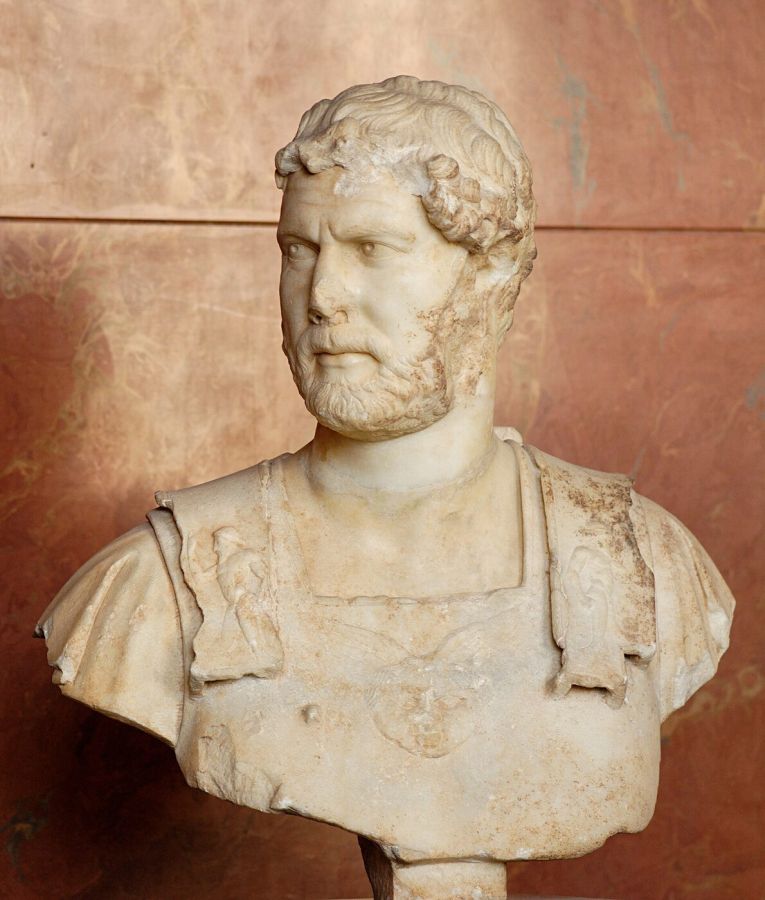
Hadrian, born in 76 and emperor from 117, spent more than half of his reign on the road. He inspected the legions, built a wall across northern Britain, and wore a beard in the Greek fashion, the first emperor to do so. Behind his back Romans called him the Greekling3.
In September 128 he was in Athens, where he was initiated into the Mysteries of Eleusis, and Antinous is generally thought to have been initiated with him. The court then moved through Asia Minor, Syria and Judaea, and in the summer of 130 it reached Alexandria, the greatest city of the Greek East4.
The river in October
From Alexandria the court sailed south. The festival season of Osiris, the Egyptian god who had drowned in the Nile and come back to life, fell in late October, and it was around then, near Hermopolis, that Antinous died2.
Nobody knows exactly how. Hadrian's own memoirs, now lost but read by Dio, called it an accident. Dio thought it was a sacrifice, and there was a belief at the time that a life freely given could lengthen another. The Historia Augusta, a collection of imperial lives put together much later, reports that some said Antinous had devoted himself to death for Hadrian, while others hinted at what his beauty and Hadrian's sensuality suggested3.
Modern historians have added murder by jealous courtiers, a botched ritual and plain suicide. None can be proved. The same source has the most famous line: Hadrian, it says, wept for him like a woman.
A city on the riverbank
On 30 October 130, on the east bank of the Nile, opposite Hermopolis, Hadrian founded Antinoopolis. It was laid out as a Greek city, with a grid of colonnaded streets, a theatre, baths, a hippodrome and a triumphal arch, and settlers were brought in with special privileges4.
The city did well. It held annual games in honour of the new god, the Antinoeia, and under Diocletian, at the end of the third century, it became the capital of the province of the Thebaid. Its cemeteries later gave archaeologists thousands of textiles and painted mummy portraits.
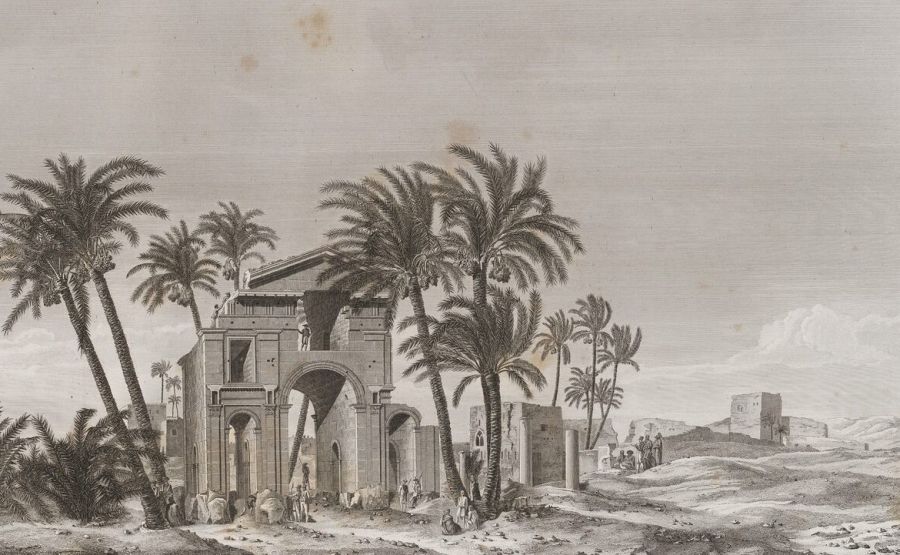
When the scholars of Napoleon's expedition reached the site around 1800, the colonnades and the arch were still standing among the palm trees, and they drew them for the Description de l'Égypte. In the decades that followed, much of what they saw was broken up for building stone and lime.
Making a god
Egyptian priests had a ready answer for a young man taken by the Nile: whoever drowned in the river was joined to Osiris. Hadrian went much further. Without asking the Senate, he declared Antinous a god, and the Greek cities of the East took up the cult with enthusiasm. Hadrian also said he had seen a new star in the sky and accepted the claim that it was the soul of Antinous1.
The cult spread fast. Traces of it have been found in at least seventy cities, and more than thirty, mostly in the Greek East, issued coins with his portrait. In Athens, Mantinea and elsewhere there were temples, priests and games. In 136, in Lanuvium near Rome, a burial club for poor men and slaves dedicated itself jointly to Diana and Antinous, which shows that the new god reached well beyond the court2.
Then came the statues. Caroline Vout has shown that more portraits of Antinous have been identified than of any other figure of classical antiquity except Augustus and Hadrian himself. He was shown as Dionysus, as Hermes, as Apollo and, in Egyptian dress, as Osiris5.
A tomb at the villa
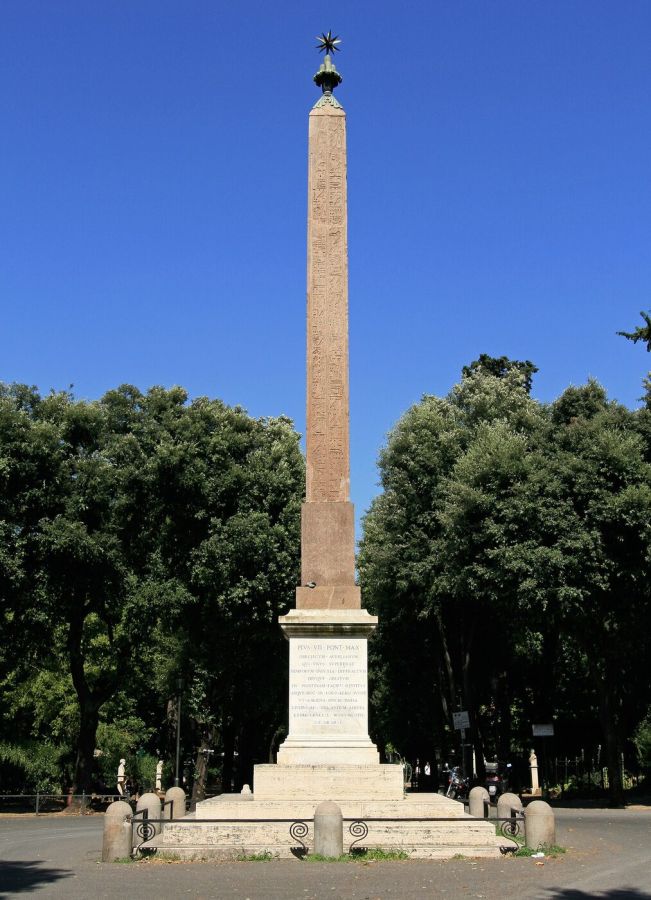
Where was Antinous buried? The best clue is an obelisk of pink Aswan granite, about nine metres high, covered in Egyptian hieroglyphs carved in the 130s. The text calls him Osiris-Antinous and, according to the usual readings, says that he rests in this place, in the estate of the ruler of Rome6.
The obelisk's own journey was long. It was dug up in pieces in a vineyard outside Porta Maggiore in Rome in the sixteenth century, bought by Cardinal Francesco Barberini in 1632, given to Pope Clement XIV in 1773 and set up in the Vatican. Since 1822, when Pius VII had it raised there, it has stood in the public gardens of the Pincio, above Piazza del Popolo.
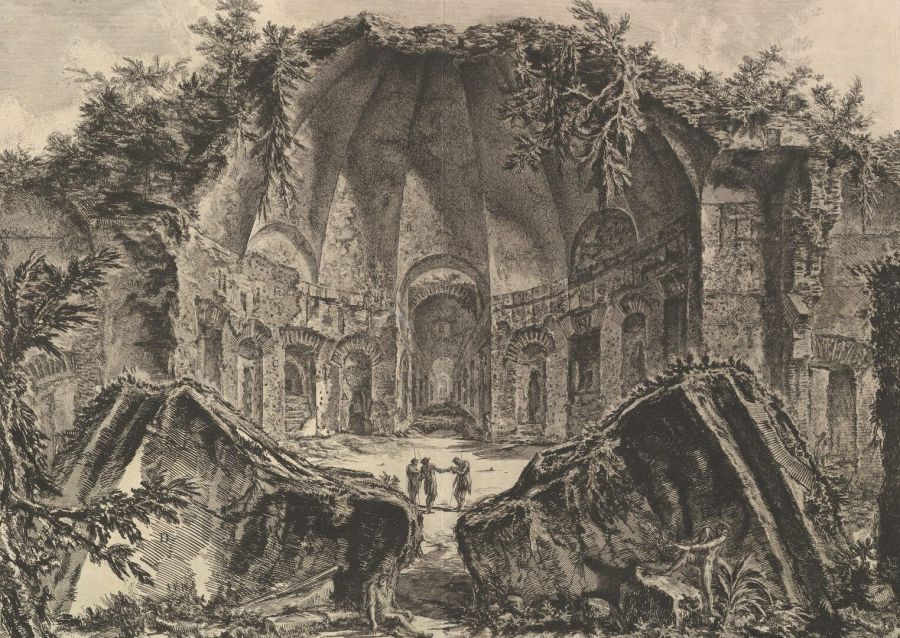
In 1998 archaeologists working at Hadrian's Villa at Tivoli, the emperor's enormous country palace east of Rome, uncovered the foundations of a previously unknown complex near the main entrance: two small temples facing each other across a courtyard, a large semicircular exedra behind them, and in the middle a base that could have carried an obelisk. The excavators, Zaccaria Mari and Sergio Sgalambro, called it the Antinoeion and argued that it was the shrine, and perhaps the tomb, of Antinous6.
Not everyone agrees. Some scholars think the obelisk stood in Rome from the start, and others read the building at Tivoli as an Egyptian-style garden or a temple of other gods. The body itself has never been found.
The face that never went away
Hadrian died in 138. The cult outlived him by two centuries, until the Christian emperors closed the temples, and many statues of Antinous were broken or buried. When they came out of the ground again in Renaissance and Baroque Rome, they went straight into the great collections: the Capitoline, the Vatican, the Villa Albani.
By the eighteenth century Antinous was a model of perfect male beauty for artists and connoisseurs, and for men who loved men he was something more: proof that an emperor had loved a man openly and mourned him in public. Sarah Waters has traced how nineteenth-century writers turned him into a coded hero, and Oscar Wilde used his name in The Picture of Dorian Gray, where the painter compares Dorian's face to that of Antinous7.
What is left
Very little of Antinous himself survives: no words of his, no letter, not even a firm date of birth. What survives is what Hadrian made of him. There is a ruined city in Egypt, an obelisk in a Roman park, a puzzling building at Tivoli and more than a hundred marble portraits in museums from London to Saint Petersburg8.
It is a love story told almost entirely by the one who was left behind, and it is also a story about power, age and grief that does not fit modern categories. The wider story, from the painted cups of Athens to the Warren Cup and the Secret Cabinet in Naples, is told in the chapter on Greece and Rome.
- Cassius Dio, Roman History, Book 69, translated by Earnest Cary, Loeb Classical Library, Harvard University Press, 1925
- Royston Lambert, Beloved and God: The Story of Hadrian and Antinous, Weidenfeld & Nicolson, 1984
- Historia Augusta, Life of Hadrian, translated by David Magie, Loeb Classical Library, Harvard University Press, 1921
- Anthony R. Birley, Hadrian: The Restless Emperor, Routledge, 1997
- Caroline Vout, Power and Eroticism in Imperial Rome, Cambridge University Press, 2007
- Zaccaria Mari and Sergio Sgalambro, The Antinoeion of Hadrian's Villa: Interpretation and Architectural Reconstruction, American Journal of Archaeology 111, 2007
- Sarah Waters, "The Most Famous Fairy in History": Antinous and Homosexual Fantasy, Journal of the History of Sexuality 6, 1995
- Caroline Vout, Antinous: The Face of the Antique, Henry Moore Institute, 2006