Greece and Rome, desire painted on clay and silver
For three centuries Athenian potters decorated drinking cups with scenes of male beauty and courtship, and Roman silversmiths carried the tradition into the empire. This is what those objects show, what they meant to the people who used them and why modern museums locked them away.
- A party, a cup and a picture at the bottom
- Why a vase survives when everything else is lost
- The invention that made bodies visible
- A cockerel, a hare and a hand under the chin
- "Leagros is beautiful"
- What the courtship scenes really show
- Men with men
- Rome changes the rules
- The cup nobody wanted
- An emperor in mourning
- The locked room in Naples
- What was left behind
New York, February 1953. A parcel from England reaches the United States Customs office. Inside, wrapped with care, is a small silver drinking cup almost two thousand years old. The officers look at the figures around it, two couples of men making love, and refuse to let it into the country. The cup is obscene, and it goes back where it came from.
That cup, today one of the treasures of the British Museum, is where the long history of gay porn meets the modern world. To understand why it was made, and why it frightened people so much, we have to go back further, to the painted pottery of Athens, where men drew desire for other men long before anyone had a word for it.
A party, a cup and a picture at the bottom
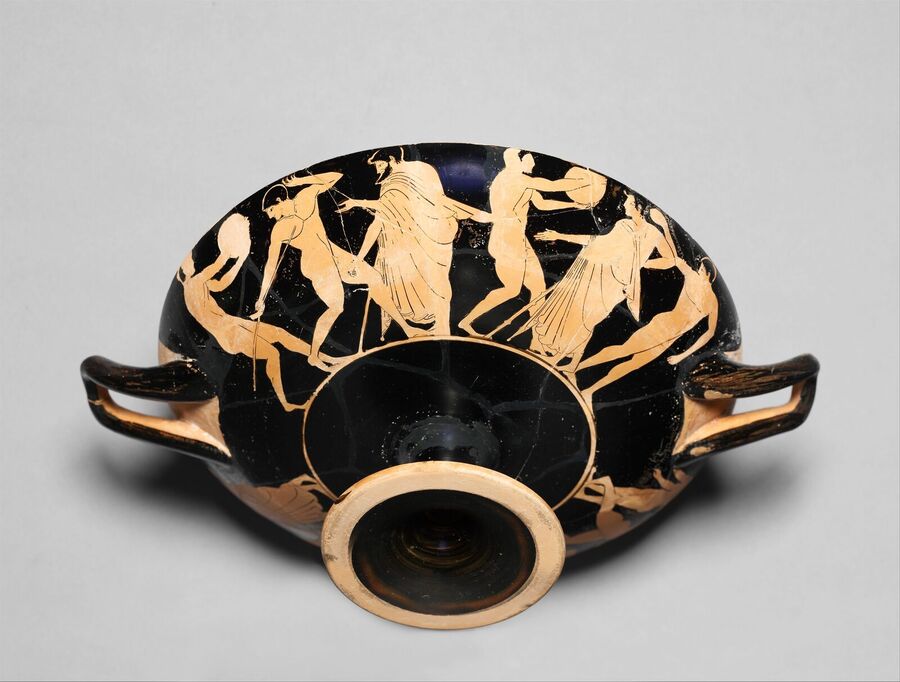
In the Athens of the sixth and fifth centuries BC the best evenings ended with a symposium, literally "drinking together". After dinner the men of the house and their guests moved into the andron, the men's room. They lay on couches in pairs, drank wine mixed with water, sang, recited poetry, played games and flirted with each other and with the musicians hired for the night.
They drank from a wide, shallow cup with two handles, the kylix. At the bottom of the bowl there was a painted picture. As the wine went down, the picture slowly appeared. When a guest lifted the cup to drink, the others saw the scenes painted on the outside.
The decoration was part of the game: a joke, a provocation, a compliment. That is why so many erotic scenes of the ancient world are painted on drinking cups. They were made for men, for a men's room, for the moment of the night when talk turned to sex1.
Why a vase survives when everything else is lost
Almost all Greek painting has disappeared. Walls collapsed, wooden panels rotted, fabrics turned to dust. Fired clay does not rot. Tens of thousands of Athenian vases have come down to us, whole or in pieces, and they are the largest collection of everyday images from the ancient world.
Athens produced pottery on an industrial scale and exported it everywhere. Many of the finest Athenian cups were not found in Greece at all, but in Etruscan tombs in central Italy, where they had been buried with their owners as luxury imports. Among the gods, heroes and warriors there are hundreds of scenes of men looking at, courting and making love to other men.

The invention that made bodies visible
Until about 530 BC Athenian painters worked in black figure: the figures were black silhouettes on orange clay, and muscles and hair were scratched in with a point. Bold, decorative, but flat.
Then a workshop linked to the potter Andokides turned everything upside down. In red figure the background is painted black and the figures are left in the colour of the clay, so the painter can draw the body with a brush: the curve of a back, the tension of an arm, the direction of a look. For a few years some painters worked in both styles, and a handful of "bilingual" vases show the same kind of scene in black figure on one side and red figure on the other2.
For the male nude it was a revolution. The favourite subject of the new style was the athlete, and in Athens athletes trained completely naked in the palaestra, the wrestling ground. On many cups it is impossible to say where admiration for the athlete ends and desire begins. That was probably the point.
A cockerel, a hare and a hand under the chin
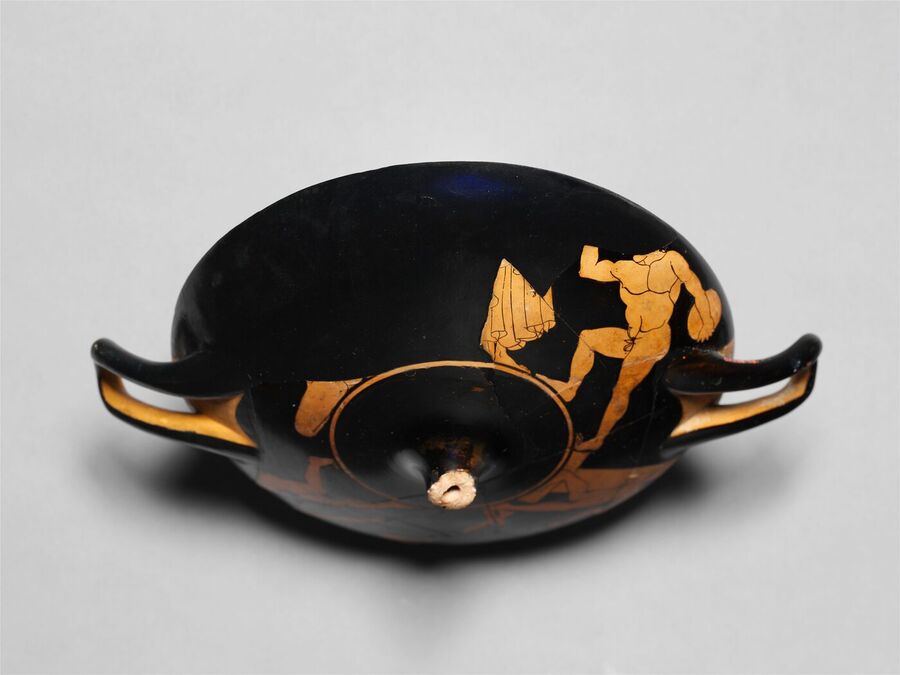
The most common male erotic scenes on Athenian pottery show courtship rather than sex, and they follow a code that any Athenian could read at a glance3.
An older, bearded man approaches a beardless younger one. One of his hands reaches for the chin of the other, the gesture of someone pleading; the other hand reaches lower. Or he offers a gift: a cockerel, the fighting bird of competition and masculinity, or a hare, the prey of the hunt, because in Greek poetry pursuing a lover was a hunt. The younger man hesitates, turns his head, takes the gift and keeps his distance.
The finest example is a cup signed by the painter Peithinos around 500 BC, now in Berlin. On one side of its outer wall couples of men and youths go through every stage of courtship, from the first approach to the embrace. On the other side, the same scene with young men and women, as if to say that desire is desire4.
After the Persian Wars these scenes became rarer. By the 470s BC they were painted much less often, and the cockerels, hares and bearded lovers disappeared from the cups. Why, nobody knows for certain: a change of taste, of market, of the way Athens wanted to see itself.
"Leagros is beautiful"
Hundreds of Athenian vases carry a short inscription: the word kalos, "beautiful", and a man's name. Leagros kalos, Leagros is beautiful. Sometimes just ho pais kalos, the boy is beautiful. They were written mostly between 550 and 450 BC5.
The names belonged to real young men of Athenian society. The same name appears on vases by different painters within a few years, as if the whole potters' quarter agreed on who was the beauty of the season. Leagros, the most praised of all, later became a general and died in battle in northern Greece.
Nobody knows exactly who asked for these inscriptions: an admirer who wanted to give a cup as a present, or just the gossip of the city written on clay. But one thing is clear. In Athens, praising the beauty of a young man in writing, on an object for sale, embarrassed no one.
What the courtship scenes really show
Here we have to be clear. In the ideal relationship described by Athenian writers, the lover, the erastes, was an adult citizen, and the beloved, the eromenos, was a teenager who did not yet have a full beard. The relationship was supposed to be both erotic and educational: the older man introduced the younger one to adult life in the city and was expected to show restraint.
It was an institution of the Greek elite, with its rules and its critics. Plato discussed it at length, comic playwrights mocked men who chased boys too eagerly. It was not a gay relationship in the modern sense, and it involved young people who today would be minors1.
A history of erotic images has to say that these pictures exist and what they meant. It does not have to show them. On this site we describe them for their historical importance, and we use as illustrations only works that show adult men.
Men with men
Not all male desire in Greek art followed the pattern of the older lover and the teenage beloved. The symposium was a party of adult men, and many cups show drinkers lying together on the same couch, embracing, exchanging looks.
The most moving image does not come from a vase but from a grave. In June 1968, near Paestum, a Greek city in southern Italy, archaeologists opened a stone tomb painted on the inside, the only Greek wall painting of that period to survive complete. It is called the Tomb of the Diver, from the young man diving into the water painted on its lid, and it is dated to around 480 BC. On the walls a symposium is in full swing, and on one couch two men lean towards each other, one touching the other's head6.
Myth offered other models. The Iliad never says that Achilles and Patroclus were lovers, but by the fifth century BC many Athenians took it for granted, and Aeschylus wrote a tragedy in which Achilles mourns Patroclus as his lover. Athens even honoured a male couple as national heroes: Harmodius and Aristogeiton, who killed the brother of the tyrant Hippias in 514 BC. Their bronze statues stood in the Agora, the first public monument in the city dedicated to mortal men.
And then there were the satyrs, the half-animal companions of Dionysus. On party cups they do everything, with each other, with animals, with wine jars. They were figures of comedy, the opposite of the self-controlled citizen, and laughing at them allowed painters to show what they could not show with human beings.
Rome changes the rules
Rome conquered Greece and took its art, but not its rules of love. For a Roman, the question was not whether a man desired women or men. The question was who penetrated whom, and who was a citizen7.
A freeborn Roman man was expected to take the active role, and he could do so with women or with men of lower status, slaves and foreigners, without damaging his reputation. What ruined a citizen was being penetrated, or seducing another freeborn youth, a crime the Romans called stuprum. The Greek ideal of the educational love affair had no place here.
So the Roman evidence sounds different: fewer courtship scenes and more insults, boasts and dirty jokes, in the poems of Catullus and Martial, in political attacks and in the graffiti scratched on the walls of Pompeii. And a few extraordinary objects made for the very rich, which borrowed the elegant Greek style to show exactly what Roman morality despised.
The cup nobody wanted
The most famous of those objects is the cup from the beginning of this chapter. It was made in the early first century AD, probably between AD 5 and 15, under the emperor Augustus or his successor Tiberius. It is silver, and around it, in relief, there are two scenes of sex between men in rooms full of cushions, drapery and musical instruments.
On one side a bearded man makes love to a beardless young man, while a boy watches from behind a half-open door. On the other side a young man has sex with a boy. The lyres, pipes and wreaths set the scene in a refined, Greek-style world: this was a luxury object, meant to be handled and admired at a banquet8.
It is named after Edward Perry Warren, a rich American collector who lived in Lewes, in Sussex, with his partner John Marshall, and bought antiquities for the Museum of Fine Arts in Boston. Warren bought the cup in Rome in 1911, reportedly for 2,000 pounds, and was told it had been found near Bittir, south-west of Jerusalem. His friends called it the Holy Grail.
After his death in 1928 nobody wanted it. It failed to sell at auction and ended up in the attic of his former secretary. Then came the 1953 seizure in New York. Back in England, it was offered to several museums, the British Museum among them, and all of them said no. In 1999 the British Museum changed its mind and bought it for 1.8 million pounds, at the time the most expensive single object it had ever acquired9. In 2006 it gave the cup its own exhibition.
An emperor in mourning
One Roman love story between men was told in marble all over the empire. The emperor Hadrian, who reigned from AD 117 to 138, loved Greek culture and travelled with a young Greek from Bithynia, in present-day Turkey, called Antinous.
In AD 130, during a journey along the Nile, Antinous drowned. How it happened is still a mystery: accident, suicide, sacrifice. Hadrian's grief was public and enormous. He founded a city on the spot, Antinoöpolis, declared Antinous a god and encouraged a cult that spread across the eastern provinces.
Hundreds of statues of the young man were made, and dozens survive in museums from Rome to London to Saint Petersburg: strong shoulders, full lips, thick curls, eyes turned down. For the next eighteen centuries artists who wanted to draw male beauty would copy that face.

The locked room in Naples
In AD 79 Vesuvius erupted and buried Pompeii and Herculaneum under ash and mud. Houses, shops, baths and brothels were sealed with their decoration intact.
When the Bourbon kings of Naples began digging in the eighteenth century, the excavators found themselves with hundreds of objects they did not know what to do with: frescoes of couples in bed, statues of the god Priapus with his gigantic phallus, lamps and wind chimes shaped like genitals, and a marble sculpture from Herculaneum of the god Pan having sex with a goat.
Little by little these objects were moved to a separate room of the royal museum in Naples and locked away. According to a famous story, the decision became final in 1819, when the future king Francis I visited the collection with his wife and young daughter and was embarrassed by what he saw10. From then on the Secret Cabinet, the Gabinetto Segreto, was open only to men of mature age and good morals, with a special permit. In Pompeii itself, some frescoes were covered with metal doors that the guards opened for male visitors, in exchange for a tip.
The room was opened and closed again with every change of government. It became accessible to everyone only in 2000, and since 2005 its contents have been displayed in the National Archaeological Museum of Naples.
What was left behind
For the Greeks and Romans there was no gay porn, because there were no gay men in the modern sense and no pornography as a separate kind of image. There were cups, lamps and frescoes that showed sex among many other things, for people who knew how to read them.
But the ancient world left the later history of male erotic images almost everything it needed. The naked athlete as the highest form of beauty, which Renaissance artists and Victorian photographers would pick up again. The memory of a time when desire between men had been celebrated, which became an argument and an alibi for generations of men who could not speak openly. And the pattern of how modern societies would deal with these images: locked in cabinets, seized at borders, and then, slowly, put back on display.

The next chapter follows what happened to that desire when Christianity turned it into the worst of sins, and the first medieval pictures of male couples were painted to condemn them.
- Kenneth J. Dover, Greek Homosexuality, Duckworth, 1978
- John Boardman, Athenian Red Figure Vases: The Archaic Period, Thames & Hudson, 1975
- J. D. Beazley, Some Attic Vases in the Cyprus Museum, Proceedings of the British Academy 33, 1947 (published 1948)
- Kylix signed by Peithinos, Berlin, Antikensammlung F 2279; Beazley Archive, University of Oxford, record 200977
- Andrew Lear and Eva Cantarella, Images of Ancient Greek Pederasty: Boys Were Their Gods, Routledge, 2008
- Mario Napoli, La Tomba del Tuffatore, De Donato, 1970
- Craig A. Williams, Roman Homosexuality, Oxford University Press, 1999, second edition 2010
- Dyfri Williams, The Warren Cup, British Museum Press, 2006
- British Museum, The Warren Cup, collection number 1999,0426.1
- Stefano De Caro, Il Gabinetto Segreto del Museo Archeologico Nazionale di Napoli, Electa, 2000
- Walter Kendrick, The Secret Museum: Pornography in Modern Culture, Viking, 1987