The Middle Ages, how desire between men became the sin against nature
In a thousand years the Christian world turned a phrase from a letter of Paul into laws, sermons, burnings and the first pictures of male couples, painted as images of sin. Yet the same centuries produced Latin love poems by bishops, the wine songs of Baghdad and the Hebrew verse of Granada.
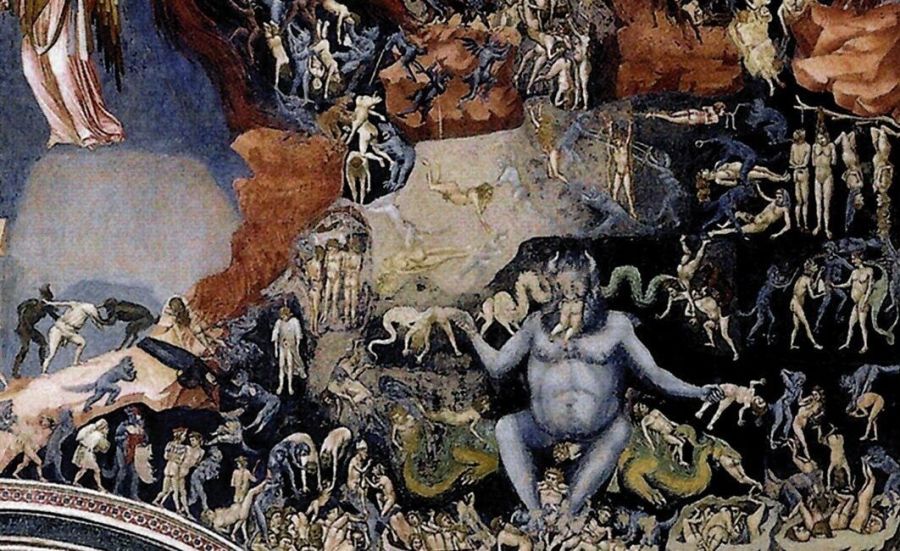
- Against nature, a phrase from a letter
- Fire in the sight of the people
- Years of bread and water
- A hermit writes to the pope
- From sin to crime
- Two couples and three devils
- Exhibitionists under the eaves
- Monkeys in the margins
- Ganymede loses the argument
- Wine poems in Baghdad, love poems in Granada
- The charge that brought down an order
- A king and his brother
- Dante's dear teacher
- The fire and the marble
Paris, 19 October 1307. In the Temple, the fortified headquarters of the Knights Templar on the right bank of the Seine, the Dominican inquisitor Guillaume de Paris, confessor to King Philip IV, begins questioning the brothers of the order. Six days earlier, at dawn on Friday 13 October, the king's officers had arrested every Templar they could find in France, following secret orders sent out a month before. By 24 November, 138 prisoners have given testimony in Paris, and almost all of them have confessed1.
The list of charges was read to each of them. When a new brother was received into the order, it said, he had to deny Christ, spit on the cross, and kiss the man receiving him on the mouth, on the navel and at the base of the spine. He was told that he could have sex with his brothers if they asked. On 24 October the Grand Master himself, Jacques de Molay, admitted to denying Christ and insulting the cross.
Nobody in that room needed the word sodomy explained. In 1307 it was the accusation that could destroy a priest, a king or a whole military order, and it had taken a thousand years to build. This chapter tells how the Christian world turned desire between men into the "sin against nature", and how the first medieval pictures of male couples were painted to condemn them. It also follows the other voices of the age, poets in Latin, Arabic and Hebrew who wrote openly about male beauty.
Against nature, a phrase from a letter
The idea starts with a letter. Around AD 57 the apostle Paul wrote to the Christians of Rome that God had abandoned the pagans to their passions: women exchanged natural relations for those "against nature", and men, giving up women, burned with desire for one another.
"Against nature", para physin in Greek, was not Paul's invention. Plato had used the same words for sex between males. Paul turned a philosopher's phrase into a sign of what happens to people who turn away from God.
Three and a half centuries later Augustine, bishop of Hippo in North Africa, wrote in his Confessions that crimes against nature, like those of the men of Sodom, must be detested and punished everywhere and always. Between Paul and Augustine, the story of Sodom in Genesis, which earlier Jewish readers had often read as a story about cruelty to strangers, became a story about sex between men2.
Fire in the sight of the people
On 6 August 390 the emperors Valentinian II, Theodosius I and Arcadius signed a law that went further than any Roman ruler before them. Men who gave their male bodies to be used as women were to pay for it in avenging flames, in the sight of the people.
The longer version of the text, preserved in a separate collection of laws, suggests that the first targets were men who sold themselves in the brothels of Rome. In 438 the law entered the Theodosian Code, the great compilation of imperial legislation2.
In Constantinople the emperor Justinian went further. According to the chronicler John Malalas, in 528 two bishops, Isaiah of Rhodes and Alexander of Diospolis, were accused of sex with men and brought to the capital. Isaiah was tortured and exiled. Alexander was castrated and paraded through the city on a litter, and many other men arrested in the same campaign died after the same mutilation.
Then came two new laws, Novel 77 in 538 and Novel 141 in 559. They no longer spoke of prostitutes or of the passive partner, but of all men who committed "vile acts" with other men, reminded readers that God had burned Sodom, and warned that famines, earthquakes and plagues fell on cities because of such crimes. By the time of the second law, Constantinople had lived through the great plague of 542. The message was clear: one man's sin could destroy everybody.
Years of bread and water
In the centuries after Rome fell in the West, the people who dealt with sex between men were not judges but confessors. From the sixth century, monks in Ireland and Britain wrote handbooks of penance, the penitentials, which spread to the continent with the missionaries.
They read like price lists. Each sin had its penance, counted in days, months or years of fasting on bread and water. Sex between men was one entry among many, next to theft, drunkenness and adultery, with lighter penances for boys who experimented with each other and heavier ones for repeated acts, married men and clergy2.
The tone is that of an accountant, not a prosecutor.
A hermit writes to the pope
Peter Damian, born in Ravenna around 1007, was a hermit at Fonte Avellana in the Apennines and one of the loudest voices of church reform. Around 1050 he sent the new pope, Leo IX, a short and furious treatise. He called it the Book of Gomorrah.
Damian listed four sexual sins between men in order of gravity, from solitary masturbation to anal intercourse, and claimed that all of them were spreading among the clergy. He was especially enraged by priests who abused the adolescent boys in their care. He attacked the lenient penitentials, demanded that guilty clerics be thrown out of the priesthood, and asked the pope to act3.
Leo IX thanked him and praised his zeal. But he softened the proposal: only clerics who had sinned repeatedly and over a long time were to lose their rank.
The book mattered for another reason. According to the theologian Mark Jordan, Damian was the first to use the abstract noun sodomia, sodomy. Before him there were sins; after him there was a single category, named after a city destroyed by God4.
From sin to crime
In January 1120 the bishops and barons of the crusader Kingdom of Jerusalem met at Nablus. Their canons are the first medieval laws to prescribe death for sodomy: an adult who committed it, "both the one who does it and the one who suffers it", was to be burned. A passive partner who was a child or had been forced could save himself by repenting.
In 1179 the Third Lateran Council, in Rome, became the first general council of the Church to legislate on the subject. Its eleventh canon ordered that clerics guilty of "that unnatural vice for which the wrath of God came down upon the sons of disobedience and destroyed the five cities with fire" be expelled from the clergy or shut away in a monastery to do penance, and that laymen be excommunicated2. Around 1270 Thomas Aquinas gave the idea its philosophical form: among the sins of lust, those against nature were the worst.
The kings followed. A French law book written around 1260, Li Livres de jostice et de plet, punished a first offence with castration, a second with the loss of the member and a third with fire. In 1283 the jurist Philippe de Beaumanoir wrote that a man convicted of sodomy was to be burned and his goods confiscated.
Court records are scarce before the late fourteenth century. Where they survive, the numbers are grim. In Bruges, the historian Marc Boone counted ninety executions for sodomy between 1385 and 1515, about one in seven of all the death sentences and bodily punishments handed out by the city5.
Two couples and three devils
At about the same time the theologians were building the category, painters gave it a face. In Paris in the 1220s, artists working for the French royal family produced the first of the Bibles moralisées, the moralised Bibles: enormous picture books in which every scene from Scripture was paired with a second scene explaining its moral meaning.
The oldest of them, now in the Austrian National Library in Vienna (Cod. 2554), contains on its second leaf a roundel that has become famous. It sits just below the scene of Adam and Eve eating the forbidden fruit, and it shows what the Fall means in daily life6.
Two couples lie wrapped in bedcovers. On the left, two women embrace, one holding the other by the chin, and kiss. On the right, two men embrace: one wears a round cap, which in the art of the time marked a Jew or a heretic, and the other has the shaved crown of a cleric. Devils crowd around them, one standing above the women, another swooping down over the men, a third climbing up at the left edge.
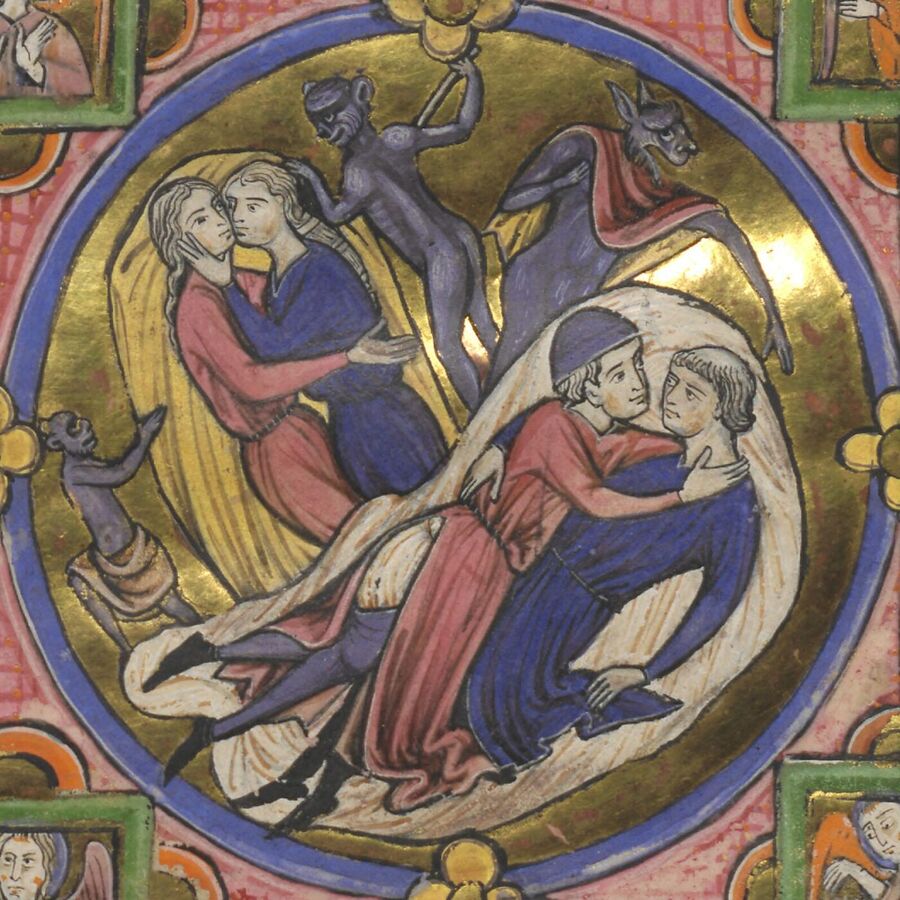
The art historian Robert Mills, who has studied these roundels closely, points out how much the picture packs in: sex between men, sex between women, heresy, Judaism and a corrupt clergy, all in one bed. It is one of the oldest surviving medieval images of two men as a couple, and it was made to show sin6.
The paradox runs through this whole chapter: to condemn the embrace, the painter had to imagine it with care.
Exhibitionists under the eaves
Anyone walking around a village church in northern Spain could look up and see sex. At San Pedro de Cervatos, in Cantabria, built around 1129 and consecrated in 1199, the stone brackets under the roof of the apse are carved with men and women showing their genitals and couples having intercourse. It is often called the most outspoken collection of erotic carving in Spanish Romanesque art.
Cervatos is not alone. Across France and Spain, and later in Britain and Ireland, twelfth-century masons carved naked figures like these on corbels and capitals.
Why they are there is still argued over. In 1986 Anthony Weir and James Jerman, who called them "exhibitionists", argued that they were sermons in stone, grotesque warnings against lust aimed at the faithful7. Others think they were meant to ward off evil, or were simply jokes shared between masons and villagers. No medieval text explains them. Among hundreds of such figures, scenes of two men together appear to be rare: the sin that could not be named was also seldom carved.
Monkeys in the margins
A century later the bawdy figures moved from the walls of churches to the edges of books. In the Gothic manuscripts of the thirteenth and fourteenth centuries, the margins of prayer books fill up with what scholars call drolleries: monkeys dressed as bishops, hybrids half man and half beast, knights fighting snails, nuns and monks in compromising positions, men baring their bottoms at the text.
Michael Camille, in his study of these margins, argued that the edge of the page worked like the edge of the church roof: a licensed space where everything excluded from the centre, including the obscene, could appear, as long as it stayed at the margin8.

The page above comes from a prayer book made in Paris for Queen Jeanne d'Evreux. It measures 9.2 by 6.2 centimetres, and its creatures kept a queen company while she prayed.
Ganymede loses the argument
Not every medieval voice condemned. Around 1100, in the cathedral schools of the Loire valley, churchmen raised on Ovid wrote Latin love poems to other males.
Marbod, master of the school of Angers and later bishop of Rennes (about 1035 to 1123), wrote of a boy whose beauty was his fire, and also wrote a poem condemning sex between men. Baudri, abbot of Bourgueil and later archbishop of Dol (1046 to 1130), left 256 poems, among them verse letters to boys under his authority. Hilary, an Englishman who had studied with Peter Abelard, addressed poems to a boy from Anjou and to an English boy.
Here we have to be plain. The Latin puer could mean a young man, but these poems were often addressed to adolescent pupils by their teachers, and many of the beloveds would be minors today. They show that bishops could put desire between males into elegant verse, but they are not love stories between equals.
The same schools produced a famous debate. In the twelfth-century Latin poem Ganymede and Helen, the Trojan youth whom Jupiter carried off to be his cupbearer argues with Helen of Troy over which love is better, before an assembly of the gods, with Nature and Reason called in to judge. Ganymede argues well, but Helen wins, and he concedes. By then "ganymede" was a common Latin word for the young passive partner of another man.
The historian John Boswell translated many of these texts in 1980, in Christianity, Social Tolerance, and Homosexuality. He argued that the Church had been relatively tolerant until the twelfth century and turned hostile only in its second half9. The book won the National Book Award and changed the field, but many historians found his readings too generous and his medieval "gay" identity hard to accept.
Wine poems in Baghdad, love poems in Granada
Islamic law condemned sex between men as firmly as Christian law did. Islamic literature, however, gave the beauty of young men a place of honour that Latin Europe never allowed.
Its star was Abu Nuwas, born in Ahvaz in Persia in the 750s and died in Baghdad around 814. He was one of the most celebrated poets at the court of the caliphs Harun al-Rashid and al-Amin, a master of the wine song, the khamriyya, and the author of more than five hundred erotic poems and fragments, most of them about males10.
The objects of desire in his poems are mostly the cupbearers of the taverns and beardless youths, adolescents who would be minors today. The poems are funny, rude and openly scandalous, and he lives on as a character in the Thousand and One Nights.
In al-Andalus, Muslim Spain, Jewish poets took up the same themes in Hebrew. Samuel ibn Naghrillah, called ha-Nagid, the Prince (993 to 1056), was grand vizier of Granada and commander of its army, and in his spare time wrote war poems, wine poems and love poems addressed both to women and to boys. Moses ibn Ezra and other poets of the Hebrew golden age did the same. The historian Norman Roth showed in 1982 how common these poems were, and that the beloved was usually a youth, often described as a gazelle or a fawn11.
In Baghdad and Granada a man could be admired for writing about desire for another male, while the law said the act deserved punishment.
The charge that brought down an order
Back to Paris. Within weeks of the arrests, Jacques de Molay retracted his confession in front of papal envoys. Many of his brothers did the same. It did not save them. On 12 May 1310, fifty-four Templars who had withdrawn their confessions were burned outside Paris as relapsed heretics.
On 22 March 1312 Pope Clement V dissolved the order with the bull Vox in excelso. On 18 March 1314 Molay and Geoffroi de Charney, preceptor of Normandy, declared once more that the order was innocent. They were burned the same day on a small island in the Seine, the Île aux Juifs1.
Very few Templars ever admitted to actually having sex with a brother. Most historians, Malcolm Barber among them, see the accusations as a weapon chosen by the king's ministers to destroy a rich and independent order. The same men had already used the charge of sodomy, along with heresy, against Pope Boniface VIII. Sodomy was the perfect accusation: it was invisible, it was unspeakable, and it proved that the accused was an enemy of God.

A king and his brother
Across the Channel, the same accusation followed a king. Edward II of England had been close since his teens to Piers Gaveston, a Gascon knight who joined his household in 1300. As soon as Edward became king in 1307, he made Gaveston Earl of Cornwall, a title normally reserved for the royal family.
The barons hated Gaveston and forced the king to exile him twice. Chroniclers wrote that Edward loved him "beyond measure", and one of them, writing in the 1320s, described a covenant of constancy between them, a bond of indissoluble love. In June 1312 a group of earls captured Gaveston, and on 19 June he was killed on Blacklow Hill, near Warwick12.
The word sodomite came later, and from enemies. In 1334 the bishop Adam Orleton was accused of having called Edward a sodomite back in 1326, when the reign was collapsing, and he answered that he had meant the king's adviser Hugh Despenser. Edward was deposed in January 1327 and died in Berkeley Castle in September. The story that he was murdered with a red-hot iron spread only years later and appears in its most lurid form in the chronicle of Geoffrey le Baker, in the 1350s. Most historians now reject it.
Whether Edward and Gaveston were lovers is still debated: in 1994 the historian Pierre Chaplais argued that they had sworn a pact of adoptive brotherhood, a reading many others reject.
Dante's dear teacher
In the Inferno, written in the first decades of the fourteenth century, Dante put the sodomites in the seventh circle of Hell, running for ever across a plain of burning sand under a slow rain of fire. Among them he met Brunetto Latini, the Florentine scholar who had been his teacher.
Dante did not hide Brunetto's sin, but he spoke to him with tenderness, remembering "the dear and kind paternal image" of the man who had taught him how a man makes himself eternal. It is a reminder that the men condemned by the theologians were also teachers and friends.
The fire and the marble
By 1400 the work was done. A phrase from Paul's letter had become a theology, a legal category, a word, a picture in a royal Bible and a death sentence written into the law of cities from Jerusalem to Bruges. Every later chapter of this history, the photographers, the filmmakers and the censors, would have to deal with the idea of the sin against nature.
But the counter-currents had not dried up: the Latin poems, the wine songs of Baghdad, the love poems of Granada, a poet greeting his teacher in Hell. The next chapter opens in Florence, where in 1432 a magistracy was created just to hunt sodomites, and in Rome, where in the decades that followed the naked marble gods of antiquity began to come out of the ground.
- Malcolm Barber, The Trial of the Templars, Cambridge University Press, 1978, second edition 2006
- James A. Brundage, Law, Sex, and Christian Society in Medieval Europe, University of Chicago Press, 1987
- Pierre J. Payer (trans.), Peter Damian, Book of Gomorrah: An Eleventh-Century Treatise against Clerical Homosexual Practices, Wilfrid Laurier University Press, 1982
- Mark D. Jordan, The Invention of Sodomy in Christian Theology, University of Chicago Press, 1997
- Marc Boone, State Power and Illicit Sexuality: The Persecution of Sodomy in Late Medieval Bruges, Journal of Medieval History 22, 1996
- Robert Mills, Seeing Sodomy in the Middle Ages, University of Chicago Press, 2015
- Anthony Weir and James Jerman, Images of Lust: Sexual Carvings on Medieval Churches, Batsford, 1986
- Michael Camille, Image on the Edge: The Margins of Medieval Art, Reaktion Books, 1992
- John Boswell, Christianity, Social Tolerance, and Homosexuality, University of Chicago Press, 1980
- Philip F. Kennedy, Abu Nuwas: A Genius of Poetry, Oneworld, 2005
- Norman Roth, "Deal Gently with the Young Man": Love of Boys in Medieval Hebrew Poetry of Spain, Speculum 57, 1982
- Seymour Phillips, Edward II, Yale University Press, 2010