Renaissance and Baroque, naked gods out of the ground
In 1506 Michelangelo watched the Laocoön come out of a Roman vineyard, and within a generation the naked male body was back at the heart of European art, from the Sistine ceiling to prints sold across the continent. The same cities that paid for Ganymedes and Saint Sebastians fined, exiled and burned men for sodomy, and the artists themselves ended up in police files and censored poems.

- A museum of naked gods
- A bronze in the Medici courtyard
- Florence, city of the night officers
- An anonymous letter and a young painter
- Twenty naked men on a chapel ceiling
- Love letters to a Roman nobleman
- The nephew who changed the pronouns
- A goldsmith with a record
- A painter called Sodoma
- Gods and saints for sale
- Caravaggio, a painter on trial
- Fines in Florence, fire elsewhere
- The alibi of beauty
Rome, 14 January 1506. In a vineyard on the Esquiline Hill, owned by a Roman named Felice de Fredis, the workmen break into a buried chamber and find a marble group: a bearded priest and his two sons, naked, fighting two enormous serpents. Pope Julius II sends his architect Giuliano da Sangallo to look, and Sangallo brings along a Florentine sculptor of thirty, Michelangelo Buonarroti. Sangallo recognises the statue at once: it is the Laocoön, praised by the Roman writer Pliny fifteen centuries earlier. In March the pope buys it.
That afternoon in the vineyard sums up this chapter. After a thousand years in which the naked male body had meant shame or suffering, Italian artists were digging it out of the ground and learning to love it again. This is the story of what they made of it, from Donatello's bronze to the Sistine Chapel and the prints sold across Europe, and of the courts, confessors and gossips who watched the same men at work.
A museum of naked gods
Rome in the fifteenth century was a small, poor town camped among enormous ruins. Every vineyard and building site turned up fragments of ancient marble, and cardinals, bankers and scholars competed to own them.
Two finds mattered more than any other for the male nude. The Belvedere Torso, a colossal seated man without head, arms or lower legs, was in the collection of the Colonna family from the 1430s. The Apollo Belvedere, a marble god striding forward after shooting an arrow, came to light in the late fifteenth century and belonged to Cardinal Giuliano della Rovere. When the cardinal became Pope Julius II, he put it on show in the courtyard of the Belvedere, in the Vatican1.
The Laocoön joined the Apollo there, and the Torso followed in the sixteenth century. The courtyard became the first great museum of ancient sculpture, and for three hundred years every artist who reached Rome went there to draw. The Torso was the perfect anatomy lesson, the Apollo the ideal of male beauty.

A bronze in the Medici courtyard
The first free-standing nude male statue made in Europe since antiquity did not come out of the ground. Donatello cast it in bronze. His David, now in the Bargello in Florence, stands over the severed head of Goliath, naked except for a wide hat crowned with laurel and a pair of boots.
Nobody knows exactly when it was made. Suggestions run from the 1420s to the 1460s, and most scholars settle on around 1440. The first document that mentions it dates from 1469, when it stood in the courtyard of the Medici palace, the house of the family that ran Florence.
Few statues have been argued over so much. David rests a hand on his hip, lowers his eyes under the brim of the hat, and a long feather from Goliath's helmet runs up the inside of his leg. For some historians he is simply a hero and a political emblem of little Florence beating its giant enemies. For others the soft body and lazy pose carry an erotic charge that is hard to miss in a city where desire between men was a public matter2.
The figure is an adolescent, as David is in the Bible. The debate is about what the sculptor and his patrons saw in him, and we do not reproduce him here.
Florence, city of the night officers
In April 1432 the government of Florence set up a new magistracy with a single job: catching men who had sex with men. They were called the Ufficiali di Notte, the Officers of the Night.
Anyone could accuse anyone. Wooden boxes called tamburi were placed around the city, and a denunciation could be dropped in without a signature. The officers investigated, summoned witnesses and handed out fines. They worked for seventy years, until 1502.
Their archive survives, and the historian Michael Rocke counted what it contains. In those seventy years about seventeen thousand men were investigated for sodomy, in a city of roughly forty thousand people, and some three thousand were convicted. By the end of the century, he concluded, most Florentine men had been implicated at least once in their lives3.
The pattern of these relationships looked more like ancient Athens than like modern gay life. In most cases the active partner was a man in his twenties, not yet married, and the passive partner an adolescent who would be a minor today. For many Florentines sex with other males was a phase of youth, woven into the life of workshops, taverns and friendships, before marriage and respectability.
Then came the friar. In 1494 the Medici were driven out, and the Dominican preacher Girolamo Savonarola became the moral voice of the new republic. He demanded the full force of the law against sodomy, and the penalties rose: heavy fines and public disgrace for a first offence, harsher ones for a second, death by fire for a third. His bonfires of "vanities" burned mirrors, cards, books and paintings. In 1498 Savonarola himself was hanged and burned in the main square.
An anonymous letter and a young painter
On 9 April 1476 one of those unsigned notes landed in a tamburo. It accused Jacopo Saltarelli, a seventeen-year-old goldsmith's apprentice, of having sex with several men, and it named four of them.
One was a goldsmith, one a tailor, one Lionardo Tornabuoni, a young man from one of the richest families in the city and related to the Medici. The fourth was "Lionardo di ser Piero da Vinci", about twenty-four, who was then working in the busy workshop of the sculptor Andrea del Verrocchio.
The case was dismissed on condition that no new accusation arrived. When a second note turned up in June, it was dismissed again. Unsigned denunciations needed witnesses to go further, and a Tornabuoni among the accused may have helped everyone4.
We do not know whether the accusation was true, and beyond this case the documents say very little about Leonardo's private life. What the episode shows is how ordinary such suspicions were, and how easily a gifted young man could end up in the files.
Twenty naked men on a chapel ceiling
Michelangelo (1475–1564) did more than anyone else to put the naked male body back at the centre of European art. For him the nude was not one subject among many. It was the language in which he said everything: heroism, pain, faith, desire.
In 1504 Florence asked him to paint a battle for the council hall of the Palazzo Vecchio. He chose the moment when Florentine soldiers bathing in the Arno are surprised by the enemy and scramble out of the river, a perfect excuse for a crowd of naked men climbing, twisting and pulling on their clothes. The fresco was never painted and the full-size drawing was cut up and lost, but young artists copied it for years.
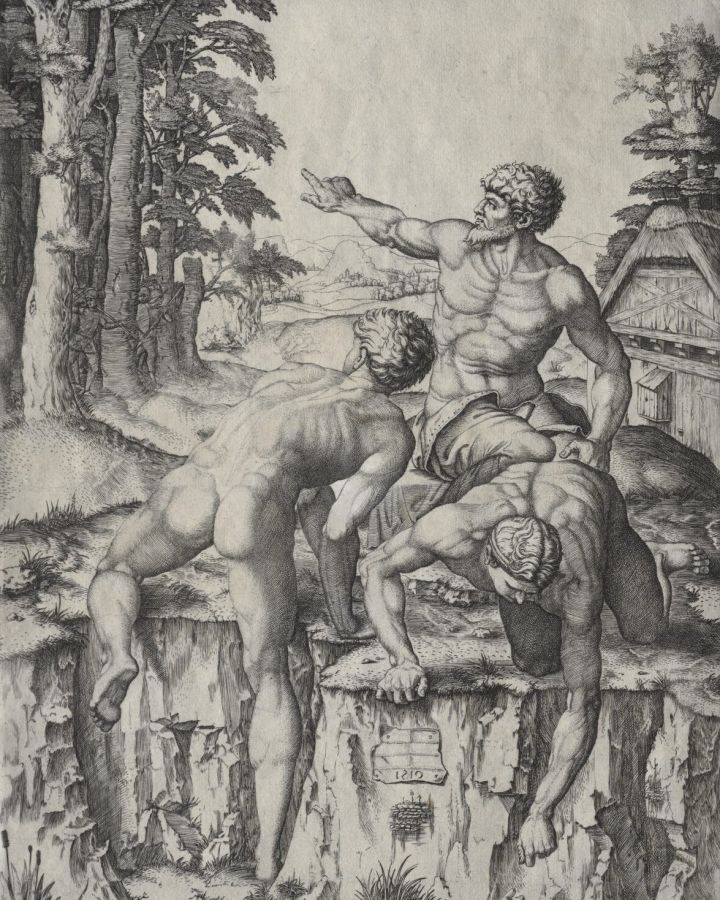
Between 1508 and 1512 he painted the ceiling of the Sistine Chapel for Julius II. Around the scenes from Genesis he placed twenty seated nude young men, the ignudi, holding garlands, ribbons and bronze medallions.
Nobody has ever fully explained what they are doing there. Angels, perfect souls, pure celebrations of the body: all have been proposed. What is certain is that the pope's own chapel was decorated with twenty athletic male nudes, drawn from studio models and from the statues of the Belvedere.

His chalk drawings from the model show a studio assistant on a stool, the muscles of back and thighs studied again and again. People were already collecting them in his lifetime. They are the most private images of the male body the Renaissance produced.
Love letters to a Roman nobleman
In 1532, in Rome, Michelangelo met Tommaso de' Cavalieri, a young Roman nobleman. His date of birth is uncertain: he is usually said to have been in his early twenties, although some accounts make him younger. Michelangelo was fifty-seven.
What followed was the best documented passion of the artist's life. There are letters, dozens of poems and a set of drawings given as presents. Michelangelo calls Tommaso the light of his century, compares himself to a prisoner and to a man burned by fire, and describes his desire as a path towards God, in the language of Plato5.
Whether the relationship was ever physical, nobody knows, and the poems insist on its spiritual side. Tommaso stayed close to him for the rest of his life, married, had children, and was at his bedside when he died in 1564.
The drawings were something new: finished works made not as studies but as gifts, to be looked at and kept. Among them were Tityus, a giant chained to a rock while a vulture tears at his liver, the Fall of Phaeton, and the Rape of Ganymede, in which Jupiter, disguised as an eagle, carries the Trojan prince up to heaven.
The Ganymede original is lost and survives through copies. The myth was read in two ways at once: as the soul rising to God, and as the classic image of love between males. Michelangelo's version became one of the most copied designs of the century6.
The nephew who changed the pronouns
Michelangelo's poems were not printed while he lived. In 1623 his grandnephew, Michelangelo Buonarroti the Younger, published the first edition, and he edited them to protect the family name.
Where a poem spoke to Tommaso or another man, masculine words became feminine, or the person addressed became vague. Readers would imagine a lady, or love in the abstract.
That version was the only one in print for two and a half centuries. In 1863 the scholar Cesare Guasti published the poems from the manuscripts and restored the original words. In 1878 the English writer John Addington Symonds translated the sonnets, and in 1893 he published a life of Michelangelo5. Symonds was one of the first men in Victorian England to write in defence of love between men, and Michelangelo became his favourite example.
The paintings got their own cover-up. Between 1536 and 1541 Michelangelo painted the Last Judgement on the altar wall of the Sistine Chapel, hundreds of naked bodies rising and falling. It was attacked for indecency while it was still being painted. In January 1564, weeks before the artist died, the Church decided to cover the parts judged obscene. The painter Daniele da Volterra added the draperies, and Rome nicknamed him il Braghettone, the breeches maker.
A goldsmith with a record
Michelangelo's private life is known through poems. Benvenuto Cellini's is known through court records, and through his own bragging.
The Florentine goldsmith and sculptor (1500–1571), maker of the bronze Perseus in the Loggia dei Lanzi, was first convicted of sodomy in Florence in 1523, together with another young man. The fine was twelve staia of flour. In 1548 he fled for a while to Venice after the mother of a youth accused him. In 1556 his former apprentice, Fernando di Giovanni di Montepulciano, denounced him for keeping him in his bed for years. This time Cellini was fined and sentenced to four years in prison, which Duke Cosimo I de' Medici turned into four years of house arrest7.
He used the time well. During the confinement he dictated much of his autobiography, one of the most entertaining books of the century, which says nothing about the convictions and a great deal about his genius.
His marbles in the Bargello tell their own story: an Apollo with Hyacinth, the young man the god loved and accidentally killed; a Narcissus; and a Ganymede, made by adding a new head, arms and an eagle to an ancient torso owned by the duke.

A painter called Sodoma
Giovanni Antonio Bazzi (1477–1549), who worked mostly in Siena, has gone down in history under a nickname that means "the sodomite": Il Sodoma.
The main witness is Giorgio Vasari, the author of the Lives of the artists, who did not like him. According to Vasari he surrounded himself with boys and beardless youths, kept a small zoo of exotic animals, and far from resenting the name, used it himself and wrote songs about it8. Documents confirm that he signed as Sodoma. Historians treat the rest of Vasari's portrait with caution.
In 1525 a Sienese confraternity commissioned from him a processional banner of Saint Sebastian, the martyr tied to a tree and pierced with arrows. It is now in the Uffizi, and it is one of the most admired male nudes of the period.
Gods and saints for sale
Printing did for pictures what it did for books. From the 1470s a copper plate could produce hundreds of copies, cheap enough to buy and small enough to carry.
One of the most influential early prints came from Florence. Antonio del Pollaiuolo's Battle of the Nudes shows ten naked men fighting with swords, axes and bows in front of a wall of foliage. There is no story and no religious message. It is a catalogue of male bodies in action, from the front, the back and the side, and artists copied it for generations.
In the next generation the engraver Marcantonio Raimondi turned the designs of Raphael and Michelangelo into prints sold all over Europe. He also found out where the limits were. In 1524 he published I Modi, a series of sexual positions of men and women after designs by Giulio Romano. Pope Clement VII had the prints suppressed and Raimondi thrown into prison for a time.
Explicit sex could not be sold openly. Myth could. The gods of Ovid gave buyers a perfect alibi: Jupiter and Ganymede, Apollo and Hyacinth, Hercules and Hylas were learned subjects any gentleman could own, and at the same time stories of love between males told by the most respected authors of antiquity.

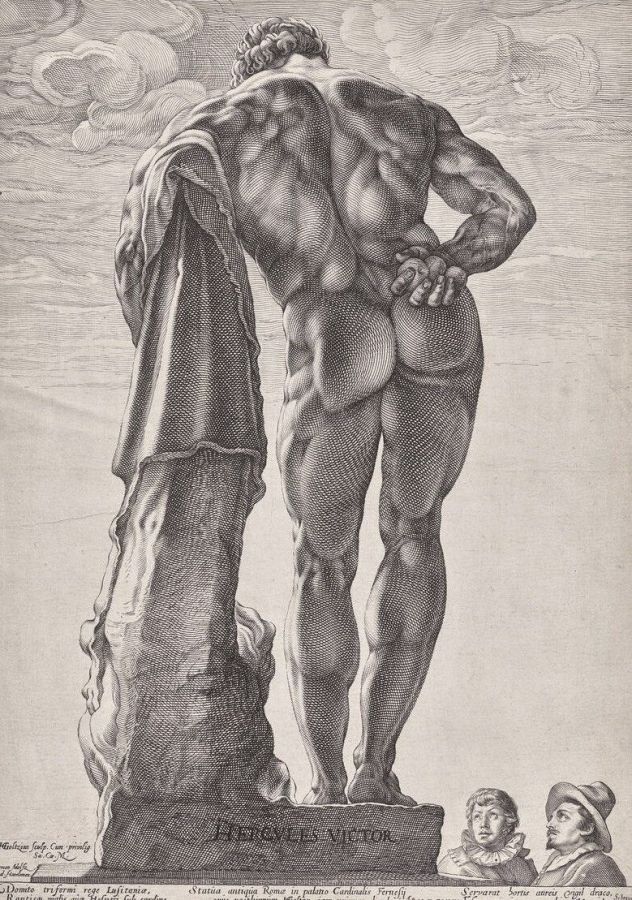
The Dutch engraver Hendrick Goltzius went to Rome in 1590 and 1591 and filled sheets with chalk drawings of the ancient statues. Back in Haarlem he engraved the Apollo Belvedere and the colossal Farnese Hercules, which he showed from behind. The plates were printed only in 1617, after his death, and they sold as souvenirs of antiquity and as studies of the heroic body.
Religion offered a second alibi. Saint Sebastian, a Roman officer executed for his faith, was prayed to against the plague, so his image was everywhere. Renaissance painters turned him into a beautiful, almost naked young man, tied to a column, his body offered to the viewer.
Vasari tells what happened to one of them. Fra Bartolomeo, a friar and painter, made a Saint Sebastian for the church of San Marco in Florence. The friars then heard in the confessional that women had sinned while looking at it, so lifelike was the flesh, and they moved it out of the church8. Vasari speaks only of women. By the twentieth century Sebastian had become an unofficial icon of gay culture.

Caravaggio, a painter on trial
In the 1590s a young painter from Lombardy, Michelangelo Merisi, known as Caravaggio (1571–1610), arrived in Rome and changed European painting. He painted real people off the street under a hard light against dark backgrounds. For several years he lived in the palace of Cardinal Francesco Maria del Monte, a refined collector who protected him.
His early pictures include several half-length young men, musicians, a boy with a basket of fruit, a Bacchus, painted with a sensuality that struck people even then.
In 1971 the American art historian Donald Posner argued that these paintings were homoerotic by design, made for the tastes of the cardinal's circle9. The idea caught on. For decades books, films and exhibitions presented Caravaggio as a gay painter.
Not everyone agreed. In 1995 Creighton Gilbert argued that there is no solid evidence that either Caravaggio or del Monte desired men, and that the paintings should be read within the conventions of their time10. What survives of Caravaggio's life is mostly police records of brawls, insults and a killing. The question is still open.
Many of the young figures in those early paintings are adolescents, and this site does not reproduce them.
Fines in Florence, fire elsewhere
Florence mostly fined. Other places burned.
In Venice sodomy was treated as one of the gravest crimes, a sin that could call down God's punishment on the whole city. From the fifteenth century it was handled by the Council of Ten, the Republic's most feared court, and convicted men could be executed and their bodies burned in public11.
In 1524 Pope Clement VII gave the Inquisition in the Spanish kingdom of Aragon, with its courts in Valencia, Barcelona and Zaragoza, the power to try sodomy, a crime that elsewhere belonged to ordinary judges. In Rome Pope Pius V, a former inquisitor, issued decrees against sodomy in 1566 and 1568, the second aimed at priests, who were to be stripped of office and handed to the secular courts.
One case from Rome shows both the repression and something like a community. In March 1581 the French writer Michel de Montaigne, visiting the city, wrote in his travel journal about some Portuguese men who had married one another in the church of San Giovanni a Porta Latina, with the same ceremonies used for weddings between men and women. They had been arrested in 1578, and several were burned.
The alibi of beauty
The Renaissance had no word for gay men, and the artists in this chapter would not have recognised themselves in modern labels. What it had was a set of images and stories that let desire between men be shown, talked about and enjoyed in public, as long as it wore the right costume: a Greek god, a biblical hero, a martyr, an anatomy lesson.
The same cities that fined, exiled and burned men for sodomy paid fortunes for Ganymedes and Saint Sebastians. The disguise worked because everyone agreed not to look too closely.
By 1700 the male nude was the foundation of artistic training in the academies of Rome, Paris and Bologna, copied from the same Belvedere statues that had come out of the ground two centuries earlier. The next chapter follows that ideal into the age of Winckelmann and Neoclassicism, and to the moment when a new invention, the camera, began to record the naked male body for the first time.
- Francis Haskell and Nicholas Penny, Taste and the Antique: The Lure of Classical Sculpture 1500–1900, Yale University Press, 1981
- James M. Saslow, Pictures and Passions: A History of Homosexuality in the Visual Arts, Viking, 1999
- Michael Rocke, Forbidden Friendships: Homosexuality and Male Culture in Renaissance Florence, Oxford University Press, 1996
- Charles Nicholl, Leonardo da Vinci: Flights of the Mind, Allen Lane, 2004
- James M. Saslow, The Poetry of Michelangelo: An Annotated Translation, Yale University Press, 1991
- James M. Saslow, Ganymede in the Renaissance: Homosexuality in Art and Society, Yale University Press, 1986
- Margaret A. Gallucci, Benvenuto Cellini: Sexuality, Masculinity, and Artistic Identity in Renaissance Italy, Palgrave Macmillan, 2003
- Giorgio Vasari, Le vite de' più eccellenti pittori, scultori e architettori, Giunti, 1568
- Donald Posner, Caravaggio's Homo-Erotic Early Works, The Art Quarterly 34, 1971
- Creighton E. Gilbert, Caravaggio and His Two Cardinals, Pennsylvania State University Press, 1995
- Guido Ruggiero, The Boundaries of Eros: Sex Crime and Sexuality in Renaissance Venice, Oxford University Press, 1985