The Warren Cup, the Roman silver cup nobody wanted
A small Roman silver cup with two scenes of sex between men was refused by US Customs, turned down by museums and accused of being a fake. In 1999 the British Museum paid a record 1.8 million pounds for it.
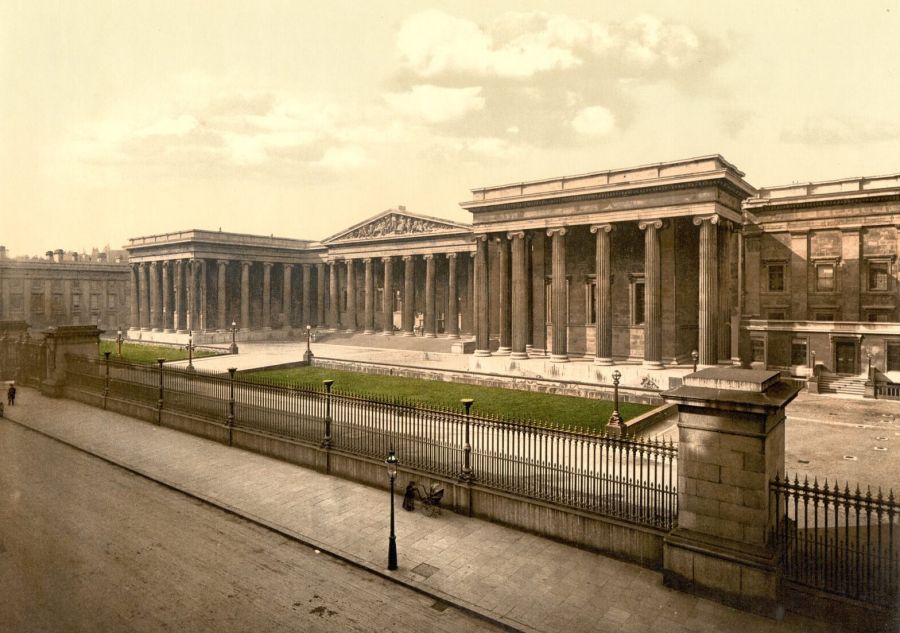
Rome, 1911. Edward Perry Warren, a rich Bostonian who has spent twenty years buying Greek and Roman antiquities for American museums, pays a dealer 2,000 pounds for a small silver drinking cup. The dealer's story is that it was bought in Jerusalem and had been dug up near Battir, a village a few miles south-west of the city, together with coins of the emperor Claudius1. Around its sides, in relief, are two scenes of sex between men.
The Warren Cup, as it came to be known, then spent almost ninety years looking for a home. Customs officers sent it back, museums turned it down, scholars called it a fake. Today it stands in a glass case at the British Museum, which paid more for it than it had ever paid for a single object. This is how that happened.
What the silversmith made
The cup was made in the early first century AD, most probably between AD 5 and 15, when Augustus and then Tiberius ruled Rome. It is about 11 centimetres high, in silver that is around 95 per cent pure, the alloy Roman silversmiths normally used1.
On one side a bearded man makes love to a beardless young man, while a boy looks in through a half-open door. On the other side a young man has sex with a boy. Both rooms are furnished like a rich Greek-style dining room: draped textiles, a lyre on one side, a pair of pipes on the other, and leafy wreaths, probably myrtle, the plant of Venus, on the heads of the active partners.
John R. Clarke, who wrote the first full study of the cup in 1993, placed it among the luxury erotic objects of Augustan Rome, side by side with the paintings and tableware found at Pompeii2. It was a dinner-party piece, meant to be passed from hand to hand and talked about.
Because one of the two couples, and the onlooker, are boys, this site describes the cup but does not show it.
Two men in Lewes
Warren was born in 1860 in Waltham, Massachusetts, into a family that owned paper mills. After Harvard he went to Oxford to study classics, and there he met John Marshall, a wine merchant's son from Liverpool. The two stayed together for the rest of their lives3.
From the end of the 1880s they lived at Lewes House, an eighteenth-century house in the High Street of Lewes, in Sussex. Around them gathered a circle of young men interested in art and antiquity, in a house that visitors described as a mix of monastic severity and luxury. From Lewes and from a second base in Rome, Warren and Marshall bought for the Museum of Fine Arts in Boston, and later Marshall bought for the Metropolitan Museum in New York. For a few years they dominated the market in classical antiquities4.

Marshall married Warren's cousin Mary Bliss in 1907, and the three of them went on living under the same roof. Warren, meanwhile, wrote. Under the pen name Arthur Lyon Raile he published A Defence of Uranian Love (1928 to 1930), which argued for the Greek ideal of love between an older man and a younger one, an ideal that, as the chapter on Greece and Rome explains, involved adolescents. The cup appears in it.
Among friends Warren called the cup his Holy Grail. It was first published in 1921, in a German volume of plates of ancient erotic art edited by Gaston Vorberg, where the photographs show it still uncleaned1.
Marshall died in February 1928. Warren died in a London nursing home on 28 December of the same year. Their ashes were laid in the same tomb, with Mary's, in the Protestant cemetery of Bagni di Lucca, in Tuscany3.
An inheritance nobody could sell
Months before he died, Warren had given Lewes House to his secretary and business partner, H. Asa Thomas, and the cup went to Thomas too. It was put into the 1929 sale of the contents of the house and found no buyer. It went up to Thomas's attic, and by 1931 it had been cleaned1.
Stopped at the border
In November 1952 Harold W. Parsons, an art historian and adviser who had once been part of Warren's circle, took on the job of finding a buyer. He approached Walter Baker, a New York collector, who hesitated. In February 1953 Thomas posted the cup to Baker anyway.
United States Customs opened the parcel, impounded it and asked Washington whether the object should be admitted or banned as obscene. The answer was no. The cup was refused entry and did not get back to England until October 1954, by which time Thomas had died1.
His widow sold it to the London dealer John K. Hewett. Hewett offered it to Denys Haynes, the Keeper of Greek and Roman Antiquities at the British Museum. Haynes sounded out a friend among the trustees, Lord Crawford, and the two concluded that the board, headed at the time by the Archbishop of Canterbury, would never agree. Other museums said no as well.
In 1966 the cup was sold for 6,000 pounds to a private collector abroad. Then, quietly, it started to be seen: on loan to the Antikenmuseum in Basel from 1985 to 1991, and as an anonymous loan at the Metropolitan Museum in New York from 1992 to 1998, in the same city that had refused it forty years earlier.
Ancient or a fake for Warren
As the cup became better known, it also became the subject of a long argument. Clarke and, in 1999, John Pollini treated it as a genuine Roman work, and Pollini read its scenes as a refined visual language of love at the banquet5.
In 2008 and again in 2013 the archaeologist Maria Teresa Marabini Moevs argued the opposite: that it was a modern forgery made around 1900 to suit the tastes of its first owner. Luca Giuliani, a professor at the Humboldt University in Berlin, was at first persuaded by the arguments from the images.
The silver settled it. The British Museum's analyses showed silver chloride corrosion in the cracks, which had survived two cleanings in the twentieth century. In 2015 further tests on two areas that had never been cleaned, the inner shelf of the bowl and the back of the liner, found substantial corrosion of the same kind. Giuliani published a revision accepting that the cup is ancient6. Its shape and style also match vessels of the period, such as the pair of silver cups found at Hoby, on the Danish island of Lolland, in 1920.

The most expensive object in the museum
In 1998 the cup was withdrawn from New York and sold to a British private collector. In 1999 the British Museum bought it for 1.8 million pounds, with money from the Heritage Lottery Fund, the National Art Collections Fund and the British Museum Friends, so that it would not leave the country again7. It was the most expensive single object the museum had ever acquired, and many times the price at which it had been offered in the 1950s.
Seven years later the museum gave it a show of its own. "The Warren Cup: Sex and society in ancient Greece and Rome" ran in Room 3 from 11 May to 2 July 2006, and set the cup next to other ancient images of sex to ask what Greeks and Romans actually thought about it1. The cup then travelled to the Yorkshire Museum in York, and later to exhibitions in Nottingham, Plymouth and at the Brading Roman Villa on the Isle of Wight.
Behind glass in Room 70
Today the cup is normally on display in Room 70, the British Museum's gallery of the Roman Empire, among other silver of the age of Augustus. It leans slightly: its base was dented and its foot pushed up during one of its modern cleanings, and the foot was soldered back on.
It is shown as what it is: a luxury object that tells us how wealthy Romans looked at sex between men, with the hierarchies of age and status described in the chapter on Greece and Rome. Anyone who walks through the gallery can see it, with no permit and no locked door. For an object that was once turned away at a border as obscene, that is the end of a long journey. The wider story, from the painted cups of Athens to the Secret Cabinet in Naples, is told in the chapter on Greece and Rome.
- Dyfri Williams, The Warren Cup, British Museum Press, 2006
- John R. Clarke, The Warren Cup and the Contexts for Representations of Male-to-Male Lovemaking in Augustan and Early Julio-Claudian Art, The Art Bulletin 75, 1993
- Osbert Burdett and E. H. Goddard, Edward Perry Warren: The Biography of a Connoisseur, Christophers, 1941
- David Sox, Bachelors of Art: Edward Perry Warren and the Lewes House Brotherhood, Fourth Estate, 1991
- John Pollini, The Warren Cup: Homoerotic Love and Symposial Rhetoric in Silver, The Art Bulletin 81, 1999
- Luca Giuliani, Der Warren-Kelch im British Museum: Eine Revision, Zeitschrift für Ideengeschichte 9, 2015
- British Museum, The Warren Cup, collection number 1999,0426.1