The Peithinos cup, courtship painted around an Athenian kylix
Around 500 BC an Athenian painter called Peithinos signed a drinking cup with a hero wrestling a goddess inside and two parallel scenes of courtship outside. It is the only complete work he left, and one of the most studied images of love between males in ancient Greece.

Rome, 1834. Christian von Bunsen, the Prussian king's envoy to the Pope and a keen amateur of antiquities, buys for the royal museum in Berlin an Athenian drinking cup that has come out of an Etruscan tomb at Vulci, north of Rome. It is in large pieces that fit back together. Around the picture inside, in small painted letters, runs a signature: Peithinos egraphsen, "Peithinos painted it"1.
The Peithinos cup, catalogued in Berlin as F 2279, is one of the masterpieces of Athenian vase painting and one of the most discussed images of male courtship from the ancient world. It is also a puzzle: a single signed cup by a painter about whom almost nothing else is known.
From an Etruscan tomb to Berlin
From 1828 onwards the Etruscan cemeteries of Vulci, many of them on land owned by Lucien Bonaparte, Napoleon's brother, were dug up on an industrial scale. They produced thousands of Athenian vases that had been buried with Etruscan owners more than two thousand years earlier, and the museums of Europe competed to buy them.
The Peithinos cup was one of the Berlin purchases. When Adolf Furtwängler published the catalogue of the Berlin vase collection in 1885, he recorded it as number 2279: a cup 13 centimetres high and 34 centimetres across, from Vulci, acquired in Rome through Bunsen in 1834, well preserved and reassembled from large fragments1. The letter F in the name used by archaeologists today stands for Furtwängler. The cup belongs to the Antikensammlung, the collection of classical antiquities of the Berlin State Museums2.
A wedding won by force
The picture inside the cup, the one a drinker would see as the wine went down, is a myth. The hero Peleus has seized the sea goddess Thetis around the waist. She is trying to escape the way sea gods do, by changing shape: snakes coil around his legs and arms, one of them bites him, and a small lion leaps down his back1.
Peleus does not let go, and in the myth that is how he wins her. From their marriage Achilles would be born. Both figures are adults, he a young man with the first down of a beard on his cheek, she in an elaborate pleated dress, and their names are written beside them. Next to the signature, the painter added a compliment to a young Athenian: Athenodotos kalos, "Athenodotos is beautiful".

Peithinos, the persuader
The Berlin cup is the only complete vase that carries Peithinos' name. German reference works list a signed fragment of another cup, with a satyr carrying wine vessels, in a private collection in Basel, and nothing else is certain. Even his name is unusual: it is not otherwise recorded in Athens, and it comes from the same root as peitho, persuasion, which suits the subject of his cup almost too well.
He was at work around 500 BC, in the first generation of red-figure painters who drew the body with a brush instead of scratching it into a black silhouette3. His figures are large and fill most of the surface inside and out. His drapery is extremely fussy, with zigzag hems and fine pleats, and the bodies are drawn through the clothes as if the cloth were transparent.
Furtwängler noticed how close the drawing is to another cup in Berlin, signed by the potter Sosias, and thought Peithinos probably worked in Sosias' workshop1. John Beazley, the Oxford scholar who spent his life sorting Athenian vases by painter, saw links with an artist he called the Thalia Painter, but did not go as far as declaring them the same man4.
Two kinds of courtship around the outside
When the cup was lifted to drink, the guests saw the outside, and there Peithinos painted two scenes that mirror each other.
On one side, three young men in long cloaks, leaning on knotted walking sticks, court three young women. The men wear finely laced sandals, the women are barefoot. One woman holds out a flower, another raises a hand as if keeping her distance. Under the handles stand a chair draped with a lion skin and a hunting dog1.
On the other side, the same kind of young men court boys. Between the couples hang the oil flask, sponge and strigil, the scraper athletes used to clean themselves, so the scene is set in the wrestling ground. One young man stands alone, head lowered. Of the four couples, one is an offer of a gift, and in the others the young man embraces the boy and reaches for him while the boy holds back his hand or his arm.
Here we have to be plain. The boys on this side of the cup are adolescents, too young to be adults by any modern standard, and the young men courting them are only a few years older. It was an accepted institution of the Athenian elite, which the chapter on Greece and Rome describes. This site does not reproduce that side of the cup.
The code of the hand and the gift
The courtship scenes on Athenian pottery follow a code, and in 1947 Beazley gave it the labels still used today. In his first type the lover reaches with one hand for the chin of the beloved, a gesture of pleading, and with the other lower down. In the second he offers a gift, often a cockerel or a hare. In the third the two embrace5.
The Peithinos cup stops short of the third: its couples are caught at the moment of the gift and the approach, and always with resistance. Kenneth Dover, who in 1978 used these vases to reconstruct the rules of Greek homosexual courtship, read that resistance as the point: the beloved was supposed to be pursued, to yield slowly and never to show desire of his own6.
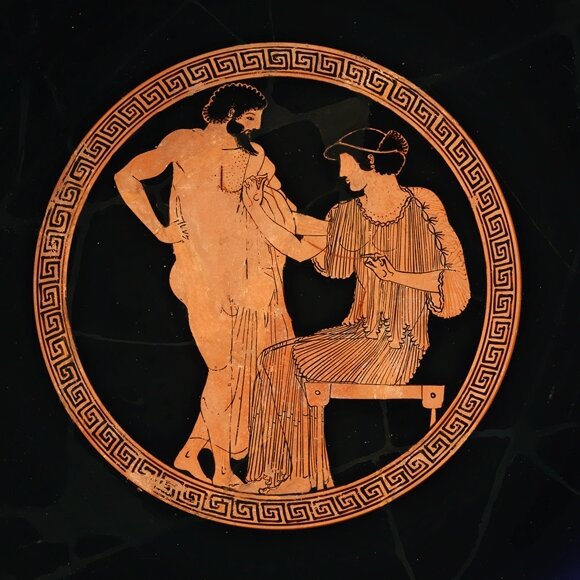
The side with the women uses the same gestures of hesitation and persuasion. The painter seems to say that courtship is courtship, whoever is courted, and that what interests him is the moment before anyone gives in.
A cup that stopped being made
Peithinos painted at the high point of this kind of image. Within a generation the courtship scenes between men and youths became rarer on Athenian cups, while scenes of men courting women went on, as on the cup by Makron shown above. Andrew Lear and Eva Cantarella, who catalogued the pederastic images of Athenian pottery, follow that change and argue that the vases show an ideal, polished for the drinking party, rather than a record of everyday life7.
The Peithinos cup outlived that change, the Etruscan tomb and the diggers of Vulci. It remains in the Berlin Antikensammlung, the only complete work of a painter whose name means something close to "persuader". The wider story of Athenian cups and the symposium is told in the chapter on Greece and Rome.
- Adolf Furtwängler, Beschreibung der Vasensammlung im Antiquarium, W. Spemann, 1885
- Kylix signed by Peithinos, Berlin, Antikensammlung F 2279; Beazley Archive, University of Oxford, record 200977
- John Boardman, Athenian Red Figure Vases: The Archaic Period, Thames & Hudson, 1975
- J. D. Beazley, Attic Red-figure Vase-painters, Clarendon Press, 1942, second edition 1963
- J. D. Beazley, Some Attic Vases in the Cyprus Museum, Proceedings of the British Academy 33, 1947 (published 1948)
- Kenneth J. Dover, Greek Homosexuality, Duckworth, 1978
- Andrew Lear and Eva Cantarella, Images of Ancient Greek Pederasty: Boys Were Their Gods, Routledge, 2008