The Secret Cabinet of Naples, where Pompeii's erotic art was locked away
For almost two centuries the erotic finds of Pompeii and Herculaneum were kept in a locked room in Naples, open only to men with a permit, then walled up, then opened by Garibaldi. It was there that a museum first filed them under the word pornography.
Naples, September 1860. Giuseppe Garibaldi has entered the city a few days earlier, and the Bourbon king Francis II has fled. On 11 September, "by order of the Dictator", the title Garibaldi has taken, a walled-up room of the royal museum is opened and its contents, as the museum's own catalogue would put it, "saw the light again"1. Inside are the erotic finds of Pompeii and Herculaneum, hidden from view for eight years.
That room was the Secret Cabinet of Naples, the Gabinetto Segreto. For almost two centuries it was opened and shut with every change of government, guarded by permits, locks and, for a while, by a wall. It also gave a name to a whole category of images. This is its story.
Treasures nobody knew how to show
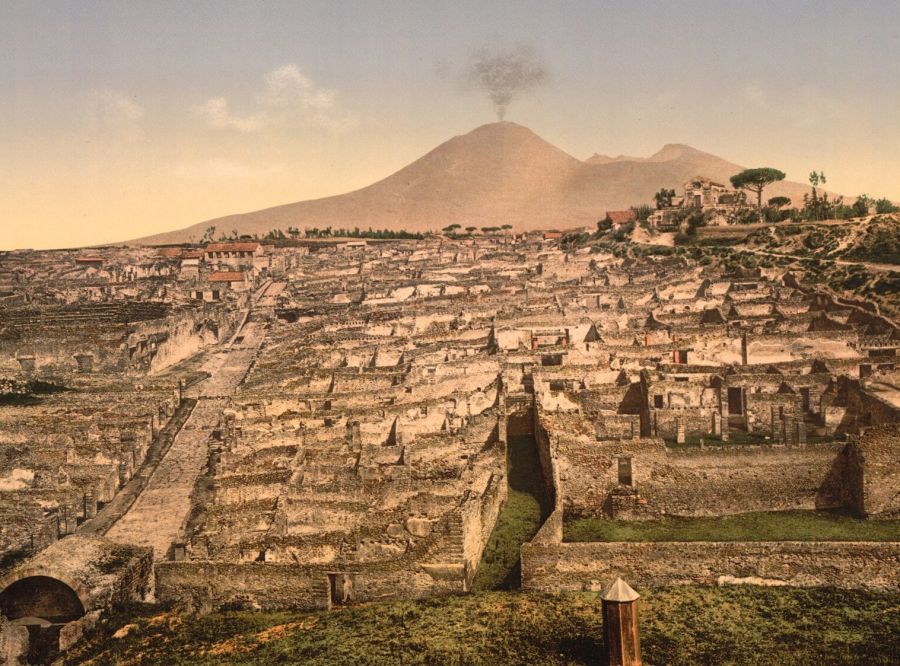
The kings of Naples began digging at Herculaneum in 1738 and at Pompeii ten years later. The finds went first to a royal museum at Portici, near the excavations, and then to the great building in Naples that is today the National Archaeological Museum.
Among the statues, bronzes and wall paintings were objects that nobody had expected: paintings of couples in bed, statues of the garden god Priapus with his huge phallus, lamps and wind chimes in the shape of genitals, amulets for children carved as tiny penises. From the Villa of the Papyri at Herculaneum came a marble group of the god Pan having sex with a goat, which became the most hidden object of the whole collection2. From the beginning, the most explicit pieces were kept apart and shown only on request.
A prince's visit in 1819
According to the museum's catalogue of 1866, the separate collection was created in 1819 at the request of Francis, Duke of Calabria, the heir to the throne, who would become King Francis I in 1825. Visiting the museum, he remarked that it would be a good thing to shut all the obscene objects, whatever they were made of, in one room, to which only "persons of mature age and known morals" should be admitted1.
The new room held 102 objects and was called the Cabinet of Obscene Objects. On 28 August 1823 it was renamed the Cabinet of Reserved Objects, and showing it to anyone without the king's own permission was absolutely forbidden.
The detail that is repeated most often today, that Francis was embarrassed because his wife and young daughter were with him, does not appear in the museum's 1866 account. It may be true, but it is a later and more colourful version of the story.
Behind a wall
The revolutions of 1848 frightened the Bourbon court, and the cabinet became a political problem. In 1849, according to the catalogue, government officials ordered that its doors be shut and riveted, and that all the Venuses and other nude figures, painted or sculpted, be removed from view1.
In 1852 the director of the museum went further. He moved everything into a closed chamber, had its door walled up and asked that every outward sign of the cabinet be erased, so that its memory might be lost "as far as possible".
The panic spread beyond Pompeii. In March 1856 the same director removed from the picture gallery Titian's Danaë, Veronese's Venus mourning Adonis, a cartoon by Michelangelo of Venus and Cupid, a painting of the Virtues by Annibale Carracci and 29 other paintings, together with 22 marble statues, and locked them with three different keys in a damp, dark room. A marble Nereid riding a sea monster survived only because the sculptor Antonio Calì refused, more than once, to cover her nudity with marble patches.
Garibaldi opens the door
When the door was reopened in September 1860, the staff checked the contents against the old inventory, on 19 December of the same year. Many objects found at Pompeii after the closure had never been registered, and they were added to the collection. It was given a new and franker name: the Raccolta Pornografica, the Pornographic Collection1.
The man who wrote the catalogue, dated 15 February 1866, was Giuseppe Fiorelli, the archaeologist then directing the excavations at Pompeii, best known for pouring plaster into the hollows left by the bodies of the victims. Fiorelli also thinned the collection: objects that on closer examination were not really obscene went back to their original departments.
Little doors at Pompeii, permits from Rome
The new Kingdom of Italy did not keep the doors open for long. Access was restricted again, and under Fascism a visit required a permit from the Minister of National Education in Rome2.
At Pompeii itself, some erotic paintings left on the walls were shut behind small locked doors or metal cabinets. According to many visitors' accounts, well into the twentieth century the custodians opened them for men only, usually in exchange for a tip. The brothel known as the Lupanar, excavated in 1862, kept its paintings of couples above the doors of its small rooms, where they still are4.
In Naples, the collection was briefly made accessible at the end of the 1960s, and new rules for visits were issued at the beginning of the 1970s. For most visitors, though, it remained a rumour.

What is inside
The collection today counts about 250 objects, most of them from Pompeii and Herculaneum5. An antechamber and a small vestibule hold the pieces from elsewhere: Greek and Etruscan vases, a Roman sarcophagus with a Dionysian revel, Etruscan phallic grave markers. Then four rooms follow the places where these images lived in a Roman town: the house, the garden, the brothel and the street.
In the house there are mythological frescoes, gods and heroes in love. In the garden there is Priapus, the god who guarded orchards, as a headless alabaster pillar and as small terracotta figures with fruit in their laps, and there is the Pan with the goat, the piece the Bourbons hid most carefully. The brothel room has small, quickly painted panels of men and women in bed. The street has phallic shop signs, among them a relief from a bakery inscribed hic habitat felicitas, "here lives happiness"2.
Sex between men is almost absent. The Roman paintings show men and women; the few male couples are on Greek and Etruscan vases. Roman art was not silent on the subject, as John Clarke has shown, but male couples are far rarer in what survives than men with women, and the best-known example, the silver Warren Cup, is said to have been found at the other end of the empire6.
Open to everyone
In April 2000 the Secret Cabinet reopened to the public with a completely new layout, with a guide to the collection edited by the archaeologist Stefano De Caro2. Since 2005 the collection has had its own rooms on the mezzanine of the National Archaeological Museum of Naples. Children under fourteen may enter with an adult.
The rooms closed again between February 2020 and August 2021, then reopened. What was once locked by order of a prince is now part of the ordinary route through the museum.
The wider story of the Roman erotic finds, and of how the word pornography was born around them, is told in the chapter on Greece and Rome.
- Giuseppe Fiorelli, Catalogo del Museo Nazionale di Napoli: Raccolta pornografica, Stabilimento tipografico in S. Teresa, 1866
- Stefano De Caro, Il Gabinetto Segreto del Museo Archeologico Nazionale di Napoli, Electa, 2000
- Walter Kendrick, The Secret Museum: Pornography in Modern Culture, Viking, 1987
- Michael Grant and Antonia Mulas, Eros in Pompeii: The Erotic Art Collection of the Museum of Naples, Stewart, Tabori & Chang, 1997
- Museo Archeologico Nazionale di Napoli, Gabinetto Segreto, collection page, mann-napoli.it
- John R. Clarke, Roman Sex: 100 B.C. to A.D. 250, Harry N. Abrams, 2003