Omi-palone
Polari for a gay man: omi, man, plus palone, woman, so literally man-woman; the word British gay men used for themselves in the mid-20th century.
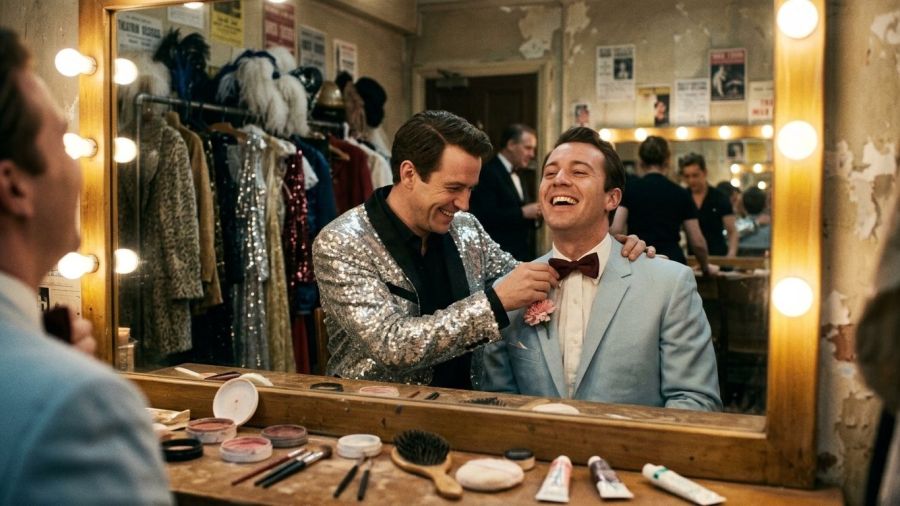
Omi-palone is Polari for a gay man. It is built from two simple words, omi, man, and palone, woman, so it literally means man-woman. It was the word gay men in mid-20th-century Britain used for themselves when they needed to talk about who was and who was not one of us, in a language the straight world could not follow.
It sounds like an insult and it is not. In the mouth of a Polari speaker it was a plain description, often fond, sometimes catty, always from the inside.
Where it comes from
Both halves are older than gay Polari: Green's Dictionary of Slang glosses the compound as omee, from the Italian uomo, plus polone, woman, and both words were already in English street slang in the 19th century. The compound belongs to the gay Polari of the 20th century. Green's finds it as homi-polone in a 1962 study of British gay society, and in 1972 the American gay lexicographer Bruce Rodgers recorded it in The Queens' Vernacular.
Paul Baker, the linguist who has done most to document the language, sums it up neatly: omi is any man, palone any woman, and omi-palone refers specifically to a gay man.
Variants and relatives
- Spellings: omee-palone, homee-palone, homi-polone, omipalone.
- HP: the initials of homee-palone, used as a quick code. Older gay men could be called antique HPs.
- Palone-omi: the reverse, woman-man, a lesbian; see dyke.
- Naff omi: a straight man, the outsider; see naff.
How it is used today
Omi-palone never became mainstream the way naff did, and when Polari faded in the 1970s it faded with it. Today it lives on in the revival of interest in the language: in camp banter, in books and plays about gay history, and among men who like to know where they come from. A linguist writing in 2010 noted that omi palone was one of the Polari words that had passed into wider gay slang.
Polari speakers loved initials as much as code words. HP let you point out a gay man in public with two letters, which is about as discreet as gaydar gets.
If you want the rest of the vocabulary, start with Polari, then bona and vada.
Related terms
Sources 3
- Baker, Paul. "Polari: The Lost Language of Gay Men." Lancaster University, Linguistics and English Language (accessed 19 October 2026). https://lancaster.ac.uk/staff/bakerjp/polari/home
- Green, Jonathon. "omee-polone, n." Green's Dictionary of Slang, online edition. https://greensdictofslang.com/entry/av3hasq
- Green, Jonathon. "polone-omee, n." Green's Dictionary of Slang, online edition. https://greensdictofslang.com/entry/rcyyuua