Polari
The secret slang British gay men used in the twentieth century, when being gay was a crime: a few hundred words mixed into English.
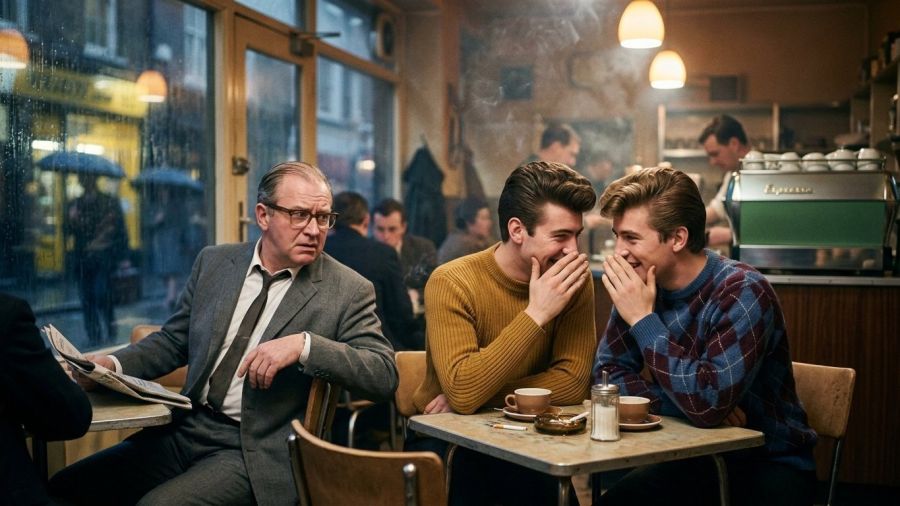
Polari is the secret slang that British gay men used for much of the twentieth century, when sex between men was a crime and talking openly about it could cost you your job, your family or your freedom. With a few hundred words, sprinkled into ordinary English, two men could gossip about the waiter, admire a stranger's trousers or comment on the people around them, all in front of listeners who had no idea what was being said.
It was never a full language with its own grammar: it was a vocabulary, used for fun, for camp and for safety. It was also a test. Drop a bona (good) or a palone (woman) into a conversation, and if the other man picked it up, you knew he was one of us.
Where it comes from
Polari grew out of Parlyaree, the slang of travelling entertainers, which had Italian roots and borrowed from the simple trade language of sailors around the Mediterranean. It passed through the West End theaters, the music halls of the nineteenth century, fairgrounds and market stalls, the world of buskers, beggars and prostitutes, and spread through Britain, above all in London and the port cities. On the way it picked up words from Cockney rhyming slang, backslang (words said backwards), French, Yiddish and even American air force slang. In his book Fabulosa!, the linguist Paul Baker traces it further back still, to the thieves' cant of Elizabethan England and the molly slang of the Georgian era, with Italian words brought in by Punch and Judy men and organ grinders in the nineteenth century.
In the first half of the twentieth century it belonged above all to gay men and female impersonators. Speakers gave themselves camp names, like Scotch Flo or Diamond Lil.
A few words
- Omi: a man, from Italian. Put him together with palone and you get omi-palone, the word for a gay man, which later critics disliked because it made every gay man half a woman.
- Vada: look, have a look at.
- Eek: the face, from "ecaf", which is "face" said backwards.
- Naff: awful, tacky.
More of them have their own pages here, from lallies and riah to zhoosh and dish.
Round the Horne and the fall
The thing that made Polari famous also helped kill it. In the sixties the BBC radio comedy Round the Horne introduced Julian and Sandy, two cheerfully gay chorus boys played by Hugh Paddick and Kenneth Williams, who slipped past the censors with a mix of camp innuendo and Polari. The show went out on Sunday afternoons to a family audience of around nine million people. Their Polari was simplified and toned down for the nation, but it was enough: the secret was out, and a code the whole country could follow on a Sunday was no longer much use.
Then the law changed. Sex between men was partly decriminalized in England and Wales in 1967, and the need for a hidden language faded. In the seventies a younger generation, busy with gay liberation and coming out, saw Polari as a relic of the closet; activists in the gay magazine Lunch attacked it as ghettoizing, and it fell out of use. When Baker surveyed 800 gay men in 2000, about half had never heard of it.
How it is used today
Polari is now a heritage language, respected rather than spoken, a bit like Latin in the Catholic Church. The Sisters of Perpetual Indulgence produced a Polari Bible by running an English Bible through a Polari word list, and a leather-bound copy is kept at the John Rylands Library in Manchester; in 2012 Baker took part in a public reading of it, in white gloves. In 2017 trainee priests in Cambridge held an evensong in Polari that called God "the Duchess", and the college later said it regretted it.
And some of it never really left. Plenty of people say naff or zhoosh without knowing whose words they are borrowing, and camp, our favorite word for a whole sensibility, sits right next to them.
The Polari Bible has its own Genesis: "And the rib, which the Duchess Gloria had lelled from homie, made she a palone", that is, "and the rib which God had taken from man was made into a woman".
Related terms
Sources 4
- Paul Baker, "A brief history of Polari: the curious after-life of the dead language for gay men", The Conversation, republished by PinkNews, 13 February 2017. https://thepinknews.com/2017/02/13/a-brief-history-of-polari-the-curious-after-life-of-the-dead-language-for-gay-men/
- Thom Cuell, review of Paul Baker, Fabulosa! The Story of Polari, Britain's Secret Gay Language (2019), minor literature[s], 9 July 2019. https://minorliteratures.com/2019/07/09/fabulosa-the-story-of-polari-by-paul-baker-thom-cuell/
- Philip Hensher, "Bona to vada your dolly old eek", review of Paul Baker, Fabulosa!, The Spectator, 22 June 2019. https://spectator.com/article/bona-to-vada-your-dolly-old-eek
- "Julian and Sandy", Fabulosa! The Story of Polari, Britain's Secret Gay Language, Lancaster University. https://wp.lancs.ac.uk/fabulosa/games/