Bob Mizer and the Athletic Model Guild, the studio in a Los Angeles living room
From 1945 until his death in 1992, Bob Mizer photographed and filmed thousands of men at his mother's house on West 11th Street and sold the pictures by post. He went to jail for it, coded his models in astrological signs, and left behind close to two million images that nearly ended up in a dumpster.
Los Angeles, the months after May 1992. Behind a modest house on West 11th Street, workers are clearing out a compound that has grown over half a century: an office, a pool, guest rooms, a fake woodland set. Broken props, stained mattresses, collapsed plaster columns and old cameras go into dumpsters, by one estimate between 16 and 33 of them. Boxes of photographs are sealed into storage lockers1.
The man who had filled those rooms was Bob Mizer, founder of the Athletic Model Guild, who had just died at the age of seventy. For almost fifty years he had photographed and filmed men in his mother's living room and sold the results by post, going to jail more than once for it. What survived the dumpsters, close to two million images and thousands of films, is now one of the great archives of gay history. This is how it was made, and how it was nearly lost.
A boy from Idaho with a camera
Robert Henry Mizer was born on 27 March 1922 in Idaho and moved to California with his family at the age of five. From the late 1920s he lived with his mother, Delia, in the house at 1834 West 11th Street, near downtown Los Angeles, and he would live and work there for the rest of his life1.
He kept diaries from his teens, and, according to the foundation that now holds them, he was open about his sexuality unusually early for the 1930s. His first surviving photographs date from 1942. Through the war years he worked the sands of Muscle Beach, photographing the bodybuilders who trained there1.
In December 1945 he gave the business a name, the Athletic Model Guild. AMG presented itself as an agency that supplied athletic models to artists and photographers. In practice it was Mizer, a camera, the living room on 11th Street and a mailing list2.
Saugus, 1947
The police noticed him quickly. In 1947 he was convicted of contributing to the delinquency of a minor: one of the young men he had photographed nude was seventeen. He was sent to the prison farm at Saugus, north of Los Angeles. Accounts of how long he stayed vary between six months and a year3.
From the camp he wrote to his mother. "I feel more strength now than ever before," he told her, "but this strength … shall be carefully bridled and directed with wisdom"1.
The bridle, in practice, was the posing strap. Back on 11th Street, Mizer photographed his models in a small pouch of cloth that covered exactly what the Post Office objected to, and built a business around what the law allowed.
Numbers, directories and secret signs
AMG was a mail-order catalogue before it was anything else. Customers chose a model from small printed pictures, noted the reference and ordered a set of prints. When Mizer launched Physique Pictorial in 1951, the magazine worked the same way: full-page photographs, a few lines about each man, and the information needed to order more.
In 1957 he gathered everyone he had photographed into the 1000 Model Directory, a 98-page booklet with twelve tiny photographs to a page. A second directory followed in 1968. In 2016 Taschen reprinted both in two volumes, printed from Mizer's original 4 by 5 inch negatives4.
His bulletins, mailed to regular customers in the size of the magazine, sold photo sets, colour and 3-D slides, films, combs, exercise cables and posing straps. One from the late 1950s announced, in a sentence aimed as much at postal inspectors as at readers, that no nude photographs were taken and none were available by mail, express or in person5.
From 1963 a stranger code appeared. Next to the models' photographs Mizer printed clusters of symbols: a ring with arrows pointing outwards, crosses, squares, squiggles. Readers with his code sheet could decode what he called "subjective character analysis", based on astrology, his lifelong passion. A cross meant a religious man; an x with a black circle above it, a dangerous one. The code ran in the magazine until its last issue in 19906.
Two more trials
In 1954 Mizer was convicted again. The foundation describes the charge as distributing obscene material by mail, the material being photographs of men in posing straps1. The historian David K. Johnson gives a narrower version: a misdemeanour conviction for aiding and abetting another dealer's sale of lewd pictures, and ninety days in the Los Angeles County jail2.
The third case was more serious. In March 1960 Mizer and others were charged with sex offences on the word of a sixteen-year-old from Texas who had posed as a boxer at the studio and been paid the usual model's rate. The judge acquitted Mizer on every count except a lesser one, annoying or molesting a child, and convicted him on that7.
On 29 August 1961 the California Court of Appeal reversed the conviction. Mizer's lawyers had collected sworn answers from the accuser's school principal and a police sergeant in his home town, both saying that his reputation for honesty was bad, and the trial judge admitted he had never read them. To let the conviction stand, and force Mizer to register as a sex offender for life, would be in the court's words "a travesty of justice"7.
Gladiators on a shoestring
Mizer filmed as well as photographed. AMG films were advertised from 1957 and sold by post on 8mm and 16mm; in the late 1950s a new title came out on the first day of every month. The 1958 releases included Street Fight and Pharaoh's New Slave5.
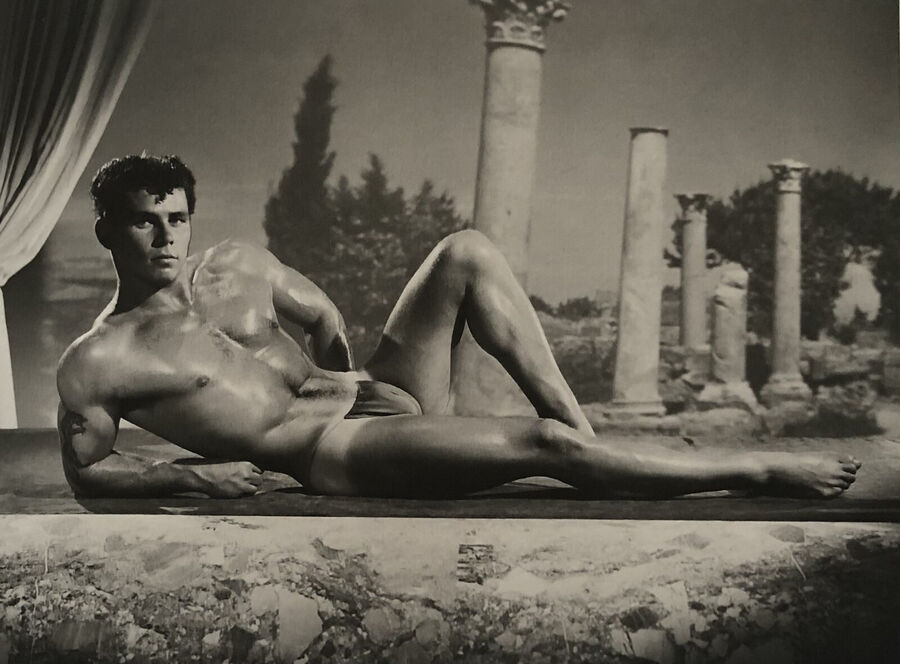
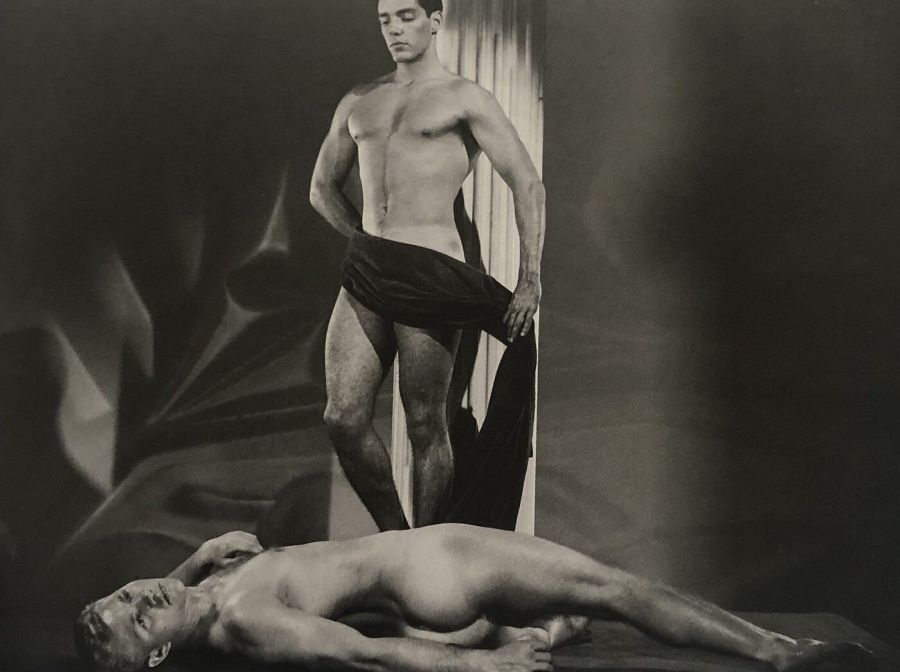
The classicist Alastair Blanshard has counted more than 2,700 AMG films known by title, made with almost no money. A helmet, a sword and a strip of cloth turned a garden into Rome; a few columns and a painted backdrop did for Greece8. Physique, wrestling, comic morality tales and crime stories were the staples.

Delia Mizer died in September 1964. Her son mourned her, and wrote in his journal that he would no longer be "held down". The compound grew around the old house, models came to live there for days or years, and the work grew bolder1.
In January 1969, after a gap of most of a year, Physique Pictorial came back fully nude. In an essay in that issue Mizer mocked the stuffed posing straps of the old days and the retouching that was replacing them. "We call our nude studies natural," he wrote, "and that is the way we plan to keep them"9.
Video, and the end
The models changed with the times. Tattoos, chipped teeth and rough trade replaced the clean-cut bodybuilders of the 1950s. In 1975 he photographed a young Austrian bodybuilder called Arnold Schwarzenegger1.
In 1980, on the advice of his friend David Hurles of Old Reliable, he began recording on VHS, filming complete sessions of two and three hours. He kept going until the spring of 1992, when he photographed his last model. He died on 12 May 19921.

Two million images and a foundation
His brother Joe inherited the estate and died a month later, leaving everything to Wayne Stanley, a friend who had lived in the compound. Stanley kept AMG going for a while, then sold the properties. The dumpsters took the props and much of the furniture; the painter John Sonsini and other friends rescued what they could. The black and white negatives went to Stanley's garage, the colour work to a storage unit, the films to the Academy of Motion Picture Arts and Sciences1.
In 2003 the photographer Dennis Bell, who had worked for Falcon Studios, bought the estate and spent years tracking down pieces already sold to collectors. In 2010 he founded the Bob Mizer Foundation, a non-profit now based at 920 Larkin Street in San Francisco, with a gallery and an archive of more than two million photographic works. In 2017 the foundation relaunched Physique Pictorial1.
From the mail to the museum
The art world arrived late. In 1998 Thom Fitzgerald's docudrama Beefcake told the AMG story with actors and real former models. In 2009 Taschen published Bob's World, edited by Dian Hanson, a survey of the life and the pictures10.
In 2013 the Museum of Contemporary Art in Los Angeles paired Mizer with Tom of Finland, and early in 2014 New York University's 80WSE gallery opened Devotion: Excavating Bob Mizer, billed as the first major institutional solo show of his work. The New York Times treated him as an artist whose imagination went well beyond his beefcake reputation.
Mizer had always claimed that he made art, not pornography, and had been prosecuted for it. The sheer scale of what he left, every model logged, every session filmed, has made him something else too: the most complete witness to how gay desire was photographed, coded and mailed across America before Stonewall. The wider story is told in the chapter on the physique era.
- Bob Mizer Foundation, Behind the Lens: The Life and Times of Bob Mizer, parts I–IV, Bob Mizer Foundation, 2016
- David K. Johnson, Buying Gay: How Physique Entrepreneurs Sparked a Movement, Columbia University Press, 2019
- Bob Mizer Foundation, Setting the record straight on ‘Beefcake’, Bob Mizer Foundation, 2016
- Dian Hanson (ed.), Bob Mizer: AMG’s 1000 Model Directory, Taschen, 2016
- Bob Mizer Foundation, Mizer promoted, marketed AMG in a variety of ways, Bob Mizer Foundation, 2017
- Bob Mizer Foundation, Character analysis revealed the core of Mizer’s models, Bob Mizer Foundation, 2017
- People v. Mizer, 195 Cal. App. 2d 261, District Court of Appeal of California, 1961
- Alastair J. L. Blanshard, Shoestring budgets and shoestring costumes: evoking antiquity in the films of Bob Mizer’s Athletic Model Guild, Classical Receptions Journal 18 (1), 2026
- Bob Mizer Foundation, The fig leaf drops: 1969 issue of Physique Pictorial quietly heralded arrival of nudity, Bob Mizer Foundation, 2017
- Dian Hanson, Bob’s World: The Life and Boys of AMG’s Bob Mizer, Taschen, 2009