Tom of Finland, the Finnish artist whose lumberjacks first appeared on a physique cover in 1957
Touko Laaksonen served in Helsinki's anti-aircraft defences, played the piano in restaurants and drew for an advertising agency, while his secret drawings of men travelled to Los Angeles under the name Tom of Finland. He ended up in the Museum of Modern Art and on Finland's best-selling stamps.

Finland, 8 September 2014. Queues form at post offices for a new set of stamps, and the national postal service, Posti, announces that it has already taken orders from 178 countries, most of them from Sweden, Britain, the United States and France. No Finnish stamps have ever sold like these. They show three of his muscular men, drawn in a style that millions of people recognise without knowing the artist's name1.
The author was Touko Laaksonen, a former army officer and advertising man from the south-west of Finland, who signed his work Tom of Finland. Half a century earlier his drawings had been smuggled into the world through a pocket magazine in Los Angeles. This is the story of the man behind the name: the war, the double life in Helsinki, the move from the posing strap to the leather jacket, and the long road from a mail-order catalogue to the walls of the Museum of Modern Art.
A schoolteachers' son from Kaarina
Laaksonen was born on 8 May 1920 in Kaarina, near Turku, the son of two schoolteachers. By the age of five he was playing the piano and drawing2.
He grew up in the countryside, and he later traced his fascination with working men back to a farmhand he used to watch as a small boy. Farmhands, labourers and lumberjacks would fill his drawings for decades2.
In 1939 he moved to Helsinki to study advertising. He had been drawing men privately for years, and he kept the drawings to himself.
Blackouts and uniforms
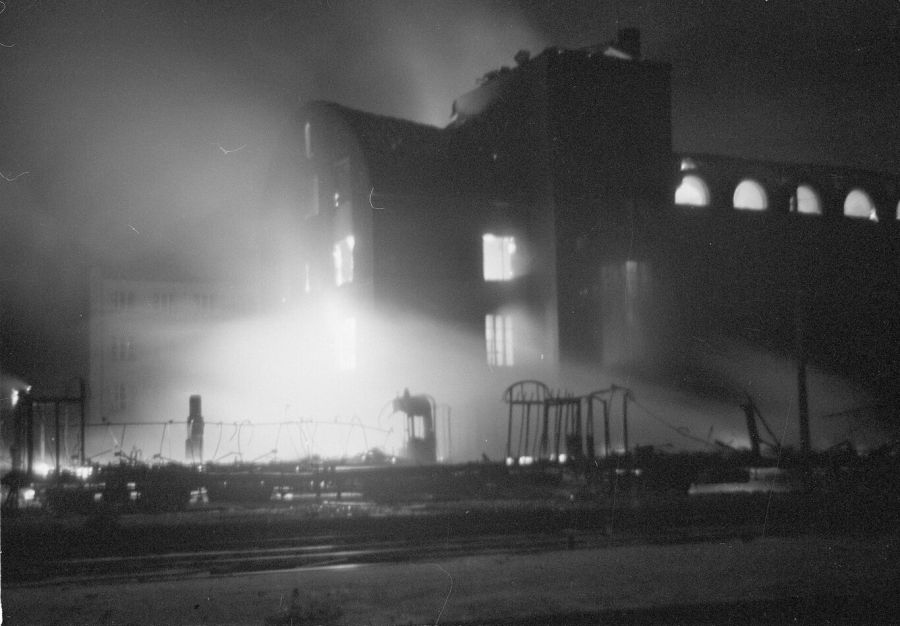
The war caught up with him almost at once. He was called up in the spring of 1940 and served in the anti-aircraft defences of Helsinki, among other places on the sea fortress of Suomenlinna. He was promoted to lieutenant in 1943 and awarded the Cross of Liberty, fourth class, in 19443.
The bombing raids and the blackouts that went with them gave the city a darkness that suited men looking for other men. Laaksonen later spoke of encounters in the blacked-out streets and parks, some of them with soldiers, German soldiers among them2.
The uniforms stayed with him. Boots, belts, caps and tight breeches would come back in his drawings for the rest of his life, worn by men who were never ashamed of what they wanted.
Pianist by night, illustrator by day
After 1945 Laaksonen studied music at the Sibelius Academy and earned a living at the keyboard. He played in Helsinki restaurants, for the longest stretch at the Palace Hotel on the waterfront, and worked as a rehearsal pianist at the Swedish Theatre4.
By day he drew for advertising. He joined an agency on Töölönkatu that later became McCann Helsinki, rose to art director, and stayed in the business until 19734.
In 1953 he met Veli Mäkinen, known as Nipa, who became his partner for the next twenty-eight years. They lived together for most of that time, in Punavuori, in Munkkivuori and from 1969 in a large flat on Tehtaankatu. The Laaksonen family was fond of Nipa and never asked questions about what the two men were to each other2.
A sailor, two hoods and a film
At the end of 1956 Laaksonen sent some drawings to Physique Pictorial in Los Angeles, and the magazine's editor, Bob Mizer, renamed him Tom of Finland. The story of that first cover belongs to the chapter on the physique era. What followed is less often told2.
Mizer did not just print the drawings. He sold them. In July 1962 Physique Pictorial offered prints from Tom's series Tattooed Sailor and the Hoods at a dollar fifty each, or five dollars for a set of six. The same issue announced that AMG had made a film based on the drawings, with the same title, and that Tom had promised a new series based on an AMG film called Two Hoods in Hollywood5.
Photographs and drawings fed each other. Mizer's models inspired Tom, and Tom's men told Mizer what his customers wanted to see. In print, the rules were the same for both: the straps stayed on and the bulges were modest.

Kake and the leather jacket
When the American courts loosened their grip in the 1960s, Tom's men undressed. The posing straps disappeared, the bodies grew bigger, and sex, which had only been hinted at, moved to the centre of the page.
In 1968 he created Kake, a moustached hero in a leather cap and jacket who has sex his way through a series of wordless comic books. There were twenty-six Kake stories by 1986, and in 2008 Taschen collected them all in a single volume6.

Kake's look, the biker's leather, the cop's boots, the sailor's tight trousers, helped to define the image of the gay leather scene in the 1970s. The men are huge, hairy where they choose to be, and smiling. Nobody in a Tom of Finland drawing is sad about being gay.
In 1973 he earned enough from his art to leave advertising for good2.
Los Angeles, at last
The first exhibition of his work, in Hamburg in 1976, ended badly: most of the drawings were stolen. Two years later he finally crossed the Atlantic for a show at the Eons Gallery in Los Angeles, his first trip to the United States2.
There he was welcomed by Durk Dehner, an admirer who became his business partner. Together they set up a company to protect the copyright of drawings that had been pirated for years, and in 1984 they founded the Tom of Finland Foundation to preserve his work and erotic art in general2.
From the end of the 1970s Laaksonen divided his time between Helsinki and Dehner's house at 1421 Laveta Terrace in Echo Park, which served as studio and home. The house is now a Los Angeles Historic-Cultural Monument and the headquarters of the foundation7.
Nipa died in 1981. Seven years later Laaksonen was diagnosed with emphysema, and he gave up his meticulous pencil work for pastels. He returned to Finland for treatment at the end of 1989 and died in Helsinki on 7 November 1991, at seventy-one3. His ashes were scattered in the memorial grove of Hietaniemi cemetery4.
From the drawer to the museum
He left about 3,500 drawings1. In 2005 the Museum of Modern Art in New York received five of them, made between 1977 and 1989, as part of a large gift of contemporary drawings8.
Finland caught up later. The stamps of 2014, designed by Timo Berry from Laaksonen's drawings, became the best-selling issue in the history of the Finnish post. Berry explained what he thought mattered most: Tom had given gay men their masculinity, at a time when they had been drawn as girlish1.
In 2017 the director Dome Karukoski told his life in a feature film, Tom of Finland. The schoolteachers' son from Kaarina, who spent the war in an anti-aircraft battery and his evenings at a restaurant piano, had become one of the best-known Finnish artists in the world. The wider story is told in the chapter on the physique era.
- Yle News, Tom of Finland stamps on sale Monday; Finland's biggest seller ever, Yle, 2014
- F. Valentine Hooven III, Tom of Finland: His Life and Times, St. Martin's Press, 1993
- Postal Museum, Correspondence of Tom of Finland, Postal Museum (Vapriikki, Tampere), 2014
- MyHelsinki, In Tom of Finland's footsteps in Helsinki, Helsinki Partners, 2025
- Bob Mizer (ed.), Physique Pictorial, Vol. 12 No. 1, Athletic Model Guild, 1962
- Dian Hanson (ed.), Tom of Finland: The Complete Kake Comics, Taschen, 2008
- Los Angeles Conservancy, Tom of Finland House, Los Angeles Conservancy, 2024
- The Museum of Modern Art, Tom of Finland (Touko Laaksonen), Untitled (Hitchhiker), 1977, object 3255.2005, The Museum of Modern Art, 2005