Boys in the Sand, the 1971 film that took gay porn from Fire Island to Manhattan
In August 1971 a Broadway choreographer shot three wordless episodes of sex on Fire Island for about 8,000 dollars. Boys in the Sand opened in a Manhattan art house with an advertisement in The New York Times, made Casey Donovan the first gay porn star and beat Deep Throat to porno chic by six months.
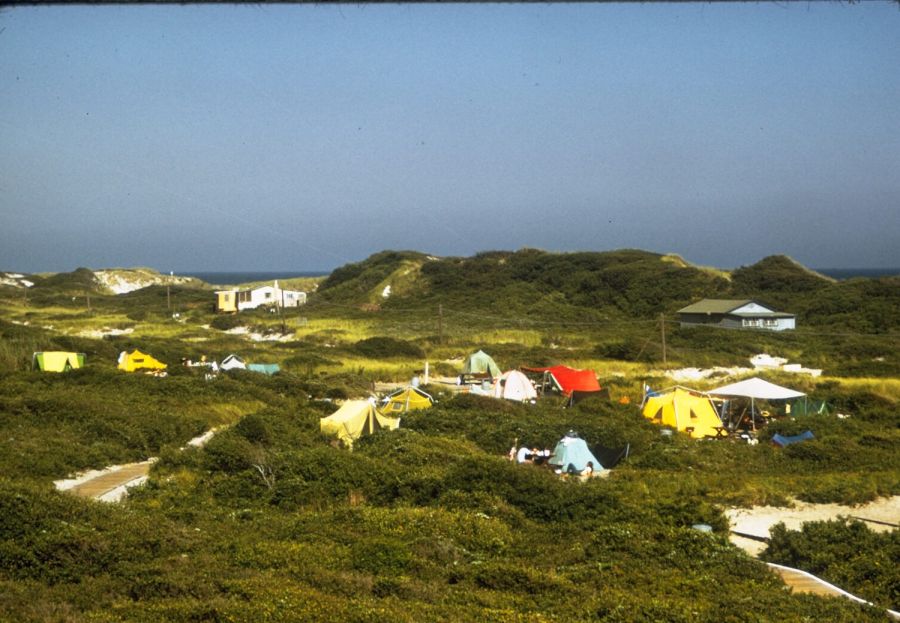
Fire Island, August 1971. On the barrier island off the south shore of Long Island, a Broadway choreographer called Wakefield Poole is making a film with a 16mm camera, a few friends and three summer weekends. In the first scene a blond man walks naked out of the sea, up the beach and into the trees, where a stranger is waiting. There is no dialogue and almost no money: the budget is usually given as about 8,000 dollars1.
The film was Boys in the Sand, and four months later it opened in a Manhattan art cinema with an advertisement in The New York Times. It was the first gay hardcore film with proper credits, the first reviewed by Variety and the first to draw queues of ordinary cinemagoers. This is the story of how it was made, who was in it, how it was sold, and what became of it over the next fifty years.
A dancer walks out of a porn film
Wakefield Poole was born in 1936 in Salisbury, North Carolina. He danced with the Ballet Russe de Monte Carlo from 1957, then moved to Broadway as a dancer and choreographer. By the end of the 1960s he lived in New York with his partner, Peter Fisk, and knew the theatre world well1.
Around 1970 he went with friends to the Park-Miller, a cinema near Times Square that showed gay films, to see what the new hardcore looked like. The feature was Highway Hustler. Poole found it ugly and joyless, and left convinced that he could make something better1.
What he wanted, he said later, was a film that gay men could watch without shame: sex between men shown as beautiful, in daylight, with nobody punished at the end. He took the title from The Boys in the Band, Mart Crowley's 1968 play about a group of unhappy gay friends, filmed in 1970. His boys would be on a beach, and happy.
Three weekends, three episodes
Poole produced the film with Marvin Shulman and shot it over three successive weekends in August 1971. He began with a ten-minute segment called "Bayside" and then added two more. The result was a film in three almost wordless episodes cut to music, made with the eye of a dancer rather than the habits of the loop trade, and the film historian Jeffrey Escoffier places it at the start of gay porn as a cinema of its own2.
In "Bayside" the blond man rises from the water and meets Peter Fisk in the woods behind the dunes. In "Poolside" he sits alone by a swimming pool, throws a magic tablet into the water, and a lover, played by Danny Di Cioccio, appears from it. In "Inside" he is at home, fantasising about a telephone repairman played by Tommy Moore, until the fantasy turns real.
The settings were the point. Fire Island had been a summer refuge for New York's gay men for decades, and Poole filmed it as a place of freedom: sun, sand, scrub pine and boardwalks, men who desire each other and say so with their bodies.

The blond from the model agency
The man who rises from the sea is Casey Donovan. Under his own name, Calvin Culver, he had trained as a teacher and worked as a schoolteacher before becoming a fashion model with the Wilhelmina agency. He had also acted in a straight feature, Ginger (1971). He used both names in public3.
His looks did half the film's work. Fair, athletic and smiling, he could have sold breakfast cereal. Gay men had been told for a century that they were sick and sad, and here was a man who plainly enjoyed what he was doing.
His biographer Roger Edmonson describes how the film made him the first star of gay porn, recognised far beyond New York. The mainstream acting career he hoped for never came. He toured the country in Tubstrip, a stage comedy set in a gay bathhouse, and worked in adult films, on and off, for about fifteen years3.
Opening night on 55th Street
Boys in the Sand opened on 29 December 1971 at the 55th Street Playhouse, a small art house in a converted stable between Sixth and Seventh Avenues. Poole promoted it like a studio release: screenings for friends and press, and advertisements in The New York Times and in Variety, with his own name on them1.
On the first day the queue stretched to Seventh Avenue. The film took about 25,000 dollars in its first week at a single screen, enough to enter Variety's weekly chart of the fifty top-grossing films in the country. Within six months it had grossed, by Poole's account, about 140,000 dollars and was playing in other American cities and abroad1.
Variety reviewed it, something it had never done for a gay hardcore film, and the gay press was enthusiastic. For the first time the trade paper of the film industry was treating gay porn as part of the business2.
The audience was not only gay. Straight couples came out of curiosity, and so did the famous. Obituaries of Poole list the designer Halston, the dancer Rudolf Nureyev and the actress Liza Minnelli among those who saw it4.
Before Deep Throat
Six months after Poole's opening, Deep Throat reached the World Theater near Times Square and became a national event. In January 1973 the reporter Ralph Blumenthal described the new fashion for sex films among respectable people in The New York Times Magazine under a name that stuck: porno chic5.
Boys in the Sand had got there first, with an audience that only a few years earlier would not have dared to queue in public. It also set habits the industry kept: credits with performers' names, a director who signed his work, and a title that parodied a mainstream hit.
Above all it was a film without guilt. Poole said that, over the years, hundreds of men told him that it had helped them come out4.
Back to the beach
Poole followed it quickly with Bijou (1972), darker and more dreamlike, then lost money on Wakefield Poole's Bible! (1973). In 1984 he and Donovan went back to Fire Island to shoot Boys in the Sand II. Donovan was the only member of the original cast to return, and the film restaged "Bayside" with a new partner, Pat Allen3.
The sequel arrived at the wrong moment. Litigation held up its release, by some accounts until 1986, and it landed in a home video market flooded with cheap tapes. It made little impression.
Casey Donovan died in 1987, aged forty-three, of an illness related to AIDS. Poole stopped making films in the 1980s, retrained at the French Culinary Institute and worked in food service. He died in Jacksonville, Florida, on 27 October 2021, at eighty-five4.
Restored and seen again
For years the film survived mostly in worn copies. In 2002 TLA Releasing brought out The Wakefield Poole Collection, two DVDs with Boys in the Sand, its sequel, Bijou and Poole's commentary, which won a GayVN award for best classic release the following year.
In 2013 the filmmaker Jim Tushinski finished I Always Said Yes: The Many Lives of Wakefield Poole, a documentary built on long interviews with Poole, his producer and his friends, which toured gay and lesbian film festivals6.
In 2014 Vinegar Syndrome, a company that restores neglected American films, released a new restoration made from the surviving film elements, with Poole's early shorts and short documentaries on how Boys in the Sand was made and received. A film once shown in a single cinema on 55th Street could now be watched in something close to its original colours.
Historians of the genre treat it as a founding text: the film with which gay sex on screen stopped being furtive and became public, commercial and signed2. The wider story of those years is told in the chapter Out on the screen.
- Wakefield Poole, Dirty Poole: The Autobiography of a Gay Porn Pioneer, Alyson Books, 2000
- Jeffrey Escoffier, Bigger Than Life: The History of Gay Porn Cinema from Beefcake to Hardcore, Running Press, 2009
- Roger Edmonson, Boy in the Sand: Casey Donovan, All-American Sex Star, Alyson Books, 1998
- Pioneering Gay Porn Filmmaker Wakefield Poole Dead at 85, The Advocate, 2021
- Ralph Blumenthal, Porno Chic, The New York Times Magazine, 1973
- Jim Tushinski (director), I Always Said Yes: The Many Lives of Wakefield Poole, documentary film, 2013