Out on the screen, when gay sex left the peep booth for the cinema
In December 1971 a dancer from Broadway opened a film of sex between men in a Manhattan art cinema, advertised it in The New York Times and watched the queue reach Seventh Avenue. Between Stonewall and the Supreme Court's new obscenity test, gay porn came out of the booth and onto the big screen.

- A most unusual film festival
- A riot on Christopher Street
- Quarters in the booth
- The law loses its grip
- The worst film he had ever seen
- Three weekends on Fire Island
- The blond on the beach
- The queue on 55th Street
- Porno chic
- Bijou and the bible
- Los Angeles plays itself
- Hand in hand in New York
- Whose community, whose standards
- Out of the booth, onto the newsstand
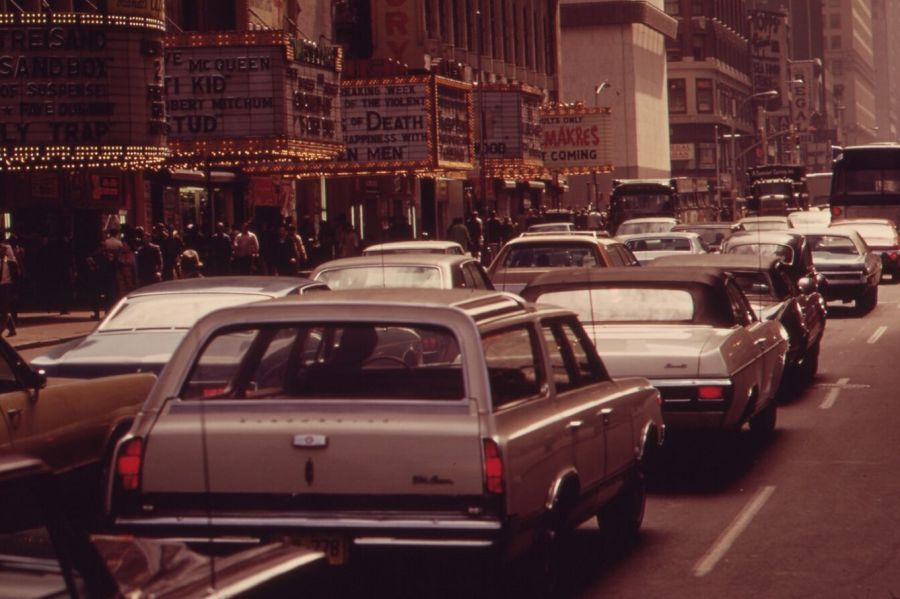
New York, 29 December 1971. On West 55th Street, between Sixth and Seventh Avenues, a small art cinema called the 55th Street Playhouse opens a new film. The house has 253 seats in a converted stable, and it has shown Eisenstein, Cocteau and, more recently, Andy Warhol. The new film is Boys in the Sand, an hour of explicit sex between men shot on Fire Island the previous summer. It has been advertised in The New York Times and in Variety, with the director's real name on it. For the first showing, the queue reaches Seventh Avenue1.
Two and a half years earlier, a film like this could not have been made openly, let alone advertised in the newspaper of record. Between 1968 and 1975 the law around obscenity cracked, the gay liberation movement came out into the streets, and sex between men moved from the coin slot of a peep booth to the screen of a real cinema. This chapter follows the people who put it there: a dancer from Broadway, a gardener from Los Angeles, a few cinema owners with a nose for a new audience, and the men who were brave enough to be filmed.
A most unusual film festival
The story starts on the West Coast. In 1968 two men who ran the Park Theatre, a cinema in the Westlake district of Los Angeles, decided there was an audience nobody was serving. Shan Sayles and Monroe Beehler began to programme short films made for gay men, and soon founded their own production company to supply them2.
The films they showed that summer were not hardcore. Most came from Pat Rocco, a photographer and amateur filmmaker who had begun to film young men in the open air: running on beaches, swimming, undressing, kissing. They were nude, romantic and sometimes funny, and there was no explicit sex in them.
In July 1968 the Park presented "The Original Pat Rocco Male Film Festival". It is usually described as the first programme of all-gay films shown publicly in an American cinema3.
Rocco went on making these shorts and longer compilations, with titles like Pat Rocco Dares (1969) and Sex and the Single Gay (1970). He was also an activist: in June 1970 he helped organise the first gay pride parade in Los Angeles. His films and papers, more than 800 items, are now kept by the UCLA Film and Television Archive3.
The Park's owners soon took the idea north. In 1969 cinemas in San Francisco began showing gay films, and Sayles and Beehler opened a second house there, the Park Show Room on Geary Street, that October. In New York their chain ran the Park-Miller, near Times Square2.
The audience was there. The films that followed it would get steadily more explicit.
A riot on Christopher Street
In the early hours of 28 June 1969, police raided the Stonewall Inn, a Mafia-run gay bar at 53 Christopher Street in Greenwich Village. Raids on gay bars were routine. This time the customers and the crowd outside fought back, and the confrontations went on for several nights4.
The historian David Carter, who reconstructed those nights from interviews and police records, showed that the people at the front were often the most marginal of the crowd: young men who lived on the street, drag queens, regulars with nothing to lose4.
Stonewall was not the first gay protest in America, but it became the symbol of a new attitude. Within months New York had a Gay Liberation Front. On 28 June 1970, the first anniversary, thousands marched from Greenwich Village to Central Park in what the organisers called Christopher Street Liberation Day, and Los Angeles and San Francisco held their own events the same weekend.
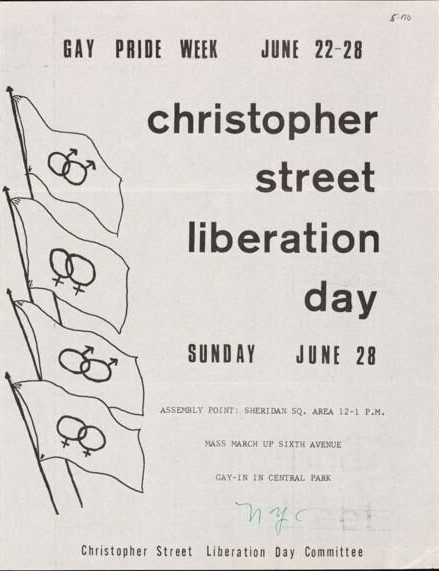
The new movement's motto was to come out. A film in which men had sex with each other under their own faces, in a cinema with a marquee, was a kind of coming out too, and its makers knew it.
Quarters in the booth
Before gay sex reached the big screen, it played in the dark of a booth. From the late 1960s the adult bookstores around Times Square installed coin-operated machines that showed short silent loops, a few minutes of film for a quarter. The same arcades opened in San Francisco and Los Angeles.
The loops were the stag film's direct heirs: short, anonymous, without titles or credits. Some showed men alone or men together, and gay customers learned which booths carried them. Around 1969 and 1970, as prosecutors lost case after case, the loops and then the films in the gay cinemas went from nudity to hardcore2.
The first feature-length gay films followed in Los Angeles and San Francisco. Tom DeSimone, who directed for the Park's owners under the name Lancer Brooks, made The Collection (1970), often described as the first gay hardcore feature with a plot and dialogue. Most of these early features were cheap, quick and, by general agreement, not very good.
The law loses its grip
The courts and the governments of the late 1960s were changing what could be shown. In April 1969 the US Supreme Court ruled in Stanley v. Georgia that the state could not punish a man for owning obscene films in his own home. That summer Denmark became the first country in the world to legalise pictorial pornography, two years after it had freed the written word.
The news from Copenhagen became a film of its own. Censorship in Denmark: A New Approach (1970), a documentary about the Danish sex trade, played at the 55th Street Playhouse, and in 1970 the cinema was charged with obscenity for showing it. A New York judge found it offensive to "contemporary community standards", a phrase that would come back in this story.
In Washington, Congress had created a Commission on Obscenity and Pornography in 1967, and President Johnson appointed its members the following year. Its report, published on 30 September 1970, found no reliable evidence that explicit material caused crime or harm to adults. It recommended repealing the laws that stopped adults from buying it, while keeping restrictions for children5.
The politicians wanted none of it. The Senate rejected the report by 60 votes to 5. On 24 October 1970 President Nixon, who had inherited the commission from Johnson, said that he categorically rejected its "morally bankrupt conclusions", and promised that while he was in the White House there would be no relaxation of the effort to "eliminate smut" from national life6.
Officially, nothing changed. In practice, prosecutors in big cities had lost so many cases that adult cinemas were opening across the country, and nobody was quite sure any more what a court would call obscene.
The worst film he had ever seen
Wakefield Poole was not a pornographer. Born in 1936 in Salisbury, North Carolina, he had danced with the Ballet Russe de Monte Carlo from 1957 and then worked on Broadway as a dancer, choreographer and director7.
Around 1970 he went to the Park-Miller in New York to see what a gay sex film looked like. The feature was called Highway Hustler. Poole found it ugly and depressing, and walked out convinced that he could do better2.
What he wanted, he said later, was a film that gay men could watch and feel good about being gay. Not a furtive transaction in the dark, but sex between men shown as something beautiful and joyful7.
He borrowed the title from The Boys in the Band, Mart Crowley's 1968 play about a group of unhappy gay friends at a birthday party. Poole's boys would be on a beach, in the sun, and not unhappy at all1.
Three weekends on Fire Island
Poole shot Boys in the Sand on 16mm film over three weekends in August 1971, on Fire Island, the barrier island off Long Island where New York's gay men had spent their summers for decades. He produced it with Marvin Shulman, and the budget is usually given as about 8,000 dollars1.
The film has three episodes and almost no words. In "Bayside" a man rises naked from the sea and meets a stranger in the woods. In "Poolside" a man throws a magic tablet into a swimming pool and a lover appears. In "Inside" a man at home watches a telephone repairman through the window, and gets more than a phone line.
Poole edited it to music and filmed it like a dancer, with long shots of bodies moving in daylight. Nobody is ashamed, nobody is punished, and nobody pretends to be straight.
The blond on the beach
The man who rises from the sea is Casey Donovan. Under his real name, Calvin Culver, he had trained as a teacher, taught Latin, then become a fashion model with the Wilhelmina agency and acted in an ordinary feature film, Ginger (1971). He used both names publicly8.
Blond, athletic and smiling, he looked like the boy next door in an American advertisement, and that was exactly the point. Gay men had been taught that they were sick and sad. Here was a gay sex star who looked healthy and happy, and who seemed to be enjoying himself.
Boys in the Sand made him the first star of gay porn. His biographer Roger Edmonson describes how the film brought him fame far beyond New York, while the mainstream acting career he hoped for never quite arrived8.
He kept working in adult films, on and off, for about fifteen years. He died in 1987, at the age of forty-three, of an illness related to AIDS, a story that belongs to a later chapter of this history8.
The queue on 55th Street
Poole promoted his film like a mainstream release. He held screenings for friends and the press, and paid for advertisements in The New York Times, where its advertisement ran beside those for the new James Bond film and Dirty Harry7.
The audience came. Boys in the Sand took about 25,000 dollars in its first week at a single cinema and entered Variety's weekly chart of the fifty top-grossing films in the country, where it stayed for about three months. Variety reviewed it, which it had never done for a gay hardcore film2.
Not everyone in the seats was gay. Straight couples came out of curiosity, and so did celebrities. According to obituaries of Poole, the fashion designer Halston, the dancer Rudolf Nureyev and the actress Liza Minnelli were among those who saw it7.
Porno chic
Six months after Poole's opening, a heterosexual film did the same thing on a much larger scale. Deep Throat opened in June 1972 at the World Theater, near Times Square, and became a national event. Couples queued for it, comedians made jokes about it, and politicians and judges went after it.
In January 1973 the reporter Ralph Blumenthal described the phenomenon in The New York Times Magazine under a title that stuck: "Porno Chic". Sex films had become something that respectable people talked about at dinner, and some of them went to see9.
Boys in the Sand had got there first, with an audience that a few years earlier would not have dared to queue for it in public.
Bijou and the bible
Poole followed his hit quickly. Bijou (1972) begins on a New York street, where a construction worker sees a woman hit by a car, steals her handbag and finds inside it an invitation to a club called Bijou. What follows is a dreamlike sequence of sex in a darkened club, darker and more experimental than the beach of the first film.
His next project, Wakefield Poole's Bible! (1973), was a softcore retelling of Old Testament stories, and it failed at the box office. Poole kept directing into the 1980s, struggled with cocaine, and later retrained at the French Culinary Institute and worked in food service. He died in Jacksonville, Florida, in October 2021, at eighty-five7.
Los Angeles plays itself
On the other coast, a very different director was at work. Fred Halsted ran a plant nursery in the suburbs of Los Angeles and had no training as a filmmaker. He produced, directed and filmed L.A. Plays Itself himself, and released it in 197210.
It is a short film in two halves. The first is a pastoral, two young men in the hills and canyons around the city. The second is the city at street level: hustling, cruising and sadomasochistic sex, with Halsted himself and his partner Joey Yale. Halsted said he wanted to put sadomasochism on the screen where people could look at it and think about it10.
The film was a hit in the gay cinemas and an event in the art world. According to an often repeated story, Salvador Dalí left a screening murmuring that it was new information to him. The Museum of Modern Art in New York later acquired prints of L.A. Plays Itself and of Halsted's Sex Garage (1972), and they remain the only gay porn films in its collection10.
In 1975 Halsted made Sextool, a film about a party and the games of power played there, shot on expensive 35mm film in the hope of reaching art cinemas. It did not, but it confirmed him as the first auteur of gay porn, a man who used sex on screen to say something about the world around it10.
Hand in hand in New York
Back in New York, three men set up what is often called the first gay film studio on the East Coast. Hand in Hand Films was founded in 1972 by Jack Deveau, an industrial designer, Robert Alvarez, a film editor who had worked on the documentary Woodstock, and Jaap Penraat, a Dutch-born designer who had been in the resistance during the Second World War2.
Their first film, Left-Handed (1972), directed by Deveau and Penraat, is the story of a hustler who seduces a straight man and then drops him. It had original music by the Broadway composer Stan Freeman and opened at the Carnegie Hall Cinema, an art house under the concert hall2.
Drive (1974), directed by Deveau, was a camp science-fiction spy story in which a drag queen plots to steal a drug that wipes out the sex drive. Hand in Hand would go on to release more than forty titles, made with real scripts, real sets and a regular team, and showed that gay porn could be a business with a future2.
Whose community, whose standards
Then the Supreme Court changed the rules again. On 21 June 1973, in Miller v. California, a majority of five justices led by Chief Justice Warren Burger set a new test for obscenity11.
A work could be banned if the average person, applying contemporary community standards, would find that it appealed to a prurient interest in sex; if it showed sexual conduct in a patently offensive way, as defined by state law; and if, taken as a whole, it lacked serious literary, artistic, political or scientific value11.
The key words were "community standards". There was no longer one national line, but as many lines as there were towns and juries. A film that played freely in Manhattan or San Francisco could lead to a prosecution in Memphis or Kansas City.

For gay films the danger was double. Many local juries were ready to find sex between men offensive by definition. The industry did not disappear, but it learned to be careful about where its films were shown and where they were made, and most production stayed in the big coastal cities.
Out of the booth, onto the newsstand
By the mid-1970s gay erotic images had come a long way from the physique magazines that hid nudity behind posing straps. Glossy monthlies now sold openly on city newsstands: Blueboy, relaunched as a colour magazine in 1974, and Mandate, founded in 1975, published full-frontal male nudes next to interviews, fashion and film reviews.
The gay press grew alongside the films. Papers like The Advocate, born in Los Angeles in 1967, reviewed the new features and carried the advertisements of the cinemas that showed them, so that a man in a small town could at least read about what was playing in New York or San Francisco.
In seven years, sex between men had moved from the coin slot of a peep booth to the listings of The New York Times. The next step was to turn the cinemas' hits into a steady industry, with studios, contracts and stars, and that is the story of the studio age, the subject of the next chapter.
- Wakefield Poole, Dirty Poole: The Autobiography of a Gay Porn Pioneer, Alyson Publications, 2000
- Jeffrey Escoffier, Bigger Than Life: The History of Gay Porn Cinema from Beefcake to Hardcore, Running Press, 2009
- UCLA Film & Television Archive, Remembering Pat Rocco (1934–2018), UCLA, 2018
- David Carter, Stonewall: The Riots That Sparked the Gay Revolution, St. Martin's Press, 2004
- The Report of the Commission on Obscenity and Pornography, United States Government Printing Office, 1970
- Richard Nixon, Statement About the Report of the Commission on Obscenity and Pornography, 24 October 1970, The American Presidency Project
- Pioneering Gay Porn Filmmaker Wakefield Poole Dead at 85, The Advocate, 2021
- Roger Edmonson, Boy in the Sand: Casey Donovan, All-American Sex Star, Alyson Books, 1998
- Ralph Blumenthal, Porno Chic, The New York Times Magazine, 1973
- William E. Jones, Halsted Plays Himself, Semiotext(e), 2011
- Miller v. California, 413 U.S. 15, Supreme Court of the United States, 1973