The physique era, posing straps, muscle magazines and the fight with the Post Office
After the war a Los Angeles photographer, Bob Mizer, began selling pictures of nearly naked bodybuilders by mail, and soon a flood of pocket magazines was doing the same under the cover of art and fitness. Their real readers were gay men, and the Post Office fought them all the way to the Supreme Court.
Alexandria, Virginia, 25 March 1960. Six parcels are waiting at the post office, bound for Chicago. Inside are 405 copies of three small magazines called MANual, Trim and Grecian Guild Pictorial, full of photographs of muscular young men wearing almost nothing. The local postmaster stops them. A Post Office official later rules that the magazines are obscene, written for "sexual deviates", and cannot travel by mail1.
The man who sent them, a Washington publisher called Herman Lynn Womack, took the Post Office all the way to the Supreme Court and won. His case closed a story that had begun in a Los Angeles living room fifteen years earlier. This chapter is about that story: how a handful of photographers sold the nearly naked male body by post under the cover of bodybuilding and art, how their customers found each other in the back pages, and how the government spent two decades trying to stop them2.
A living room on West 11th Street
Bob Mizer was born in Hailey, Idaho, in 1922. In 1945 he spent his days photographing the bodybuilders who trained on the beaches at Venice and Santa Monica.
In December of that year he gave his business a grand name, the Athletic Model Guild, and ran it from the house he shared with his mother Delia at 1834 West 11th Street, in the Pico-Union district. AMG presented itself as an agency for athletic models. In practice it was a studio that sold Mizer's photographs by mail.
The models were bodybuilders, servicemen and young men looking for work or a break in Hollywood. Mizer paid them, photographed them in the living room and the back garden, and wrote down everything about them.
Over his career he is estimated to have photographed more than 10,000 men. In 1957 he gathered them into a model directory, so that customers could order a favourite by name and number.
Trouble came early. In 1947 he was convicted of contributing to the delinquency of a minor, because one of the young men he had photographed nude was seventeen. He served six months at the prison farm in Saugus, north of Los Angeles, while his mother kept the business running3.
A magazine because nobody else would print the ads
Until the early 1950s a physique photographer found his customers through the bodybuilding press. Magazines like Strength & Health carried small advertisements at the back offering photographs of champions and models, sent by post.
Under pressure from the Post Office, the big muscle magazines began to refuse those ads. Mizer's answer was to publish his own. In 1951 he put out a single issue of a booklet called Physique Photo News, and later that year replaced it with Physique Pictorial4.
It was small, printed on cheap paper and sized to slip into a pocket. Inside were full-page photographs of AMG models, a few lines about each one, and the catalogue numbers you needed to order more pictures from the studio.
Artists came too. Besides Quaintance, the magazine printed drawings by Dom Orejudos, who signed himself Etienne, and soon by a Finn who will appear later in this chapter.
Everything in it came with an alibi. The models were athletes, and the pictures were for students of anatomy, painters and sculptors. A 1954 issue described the magazine as an art reference book used in colleges and schools. Nobody involved really believed it, but it had to be printed.
Two square inches of cloth
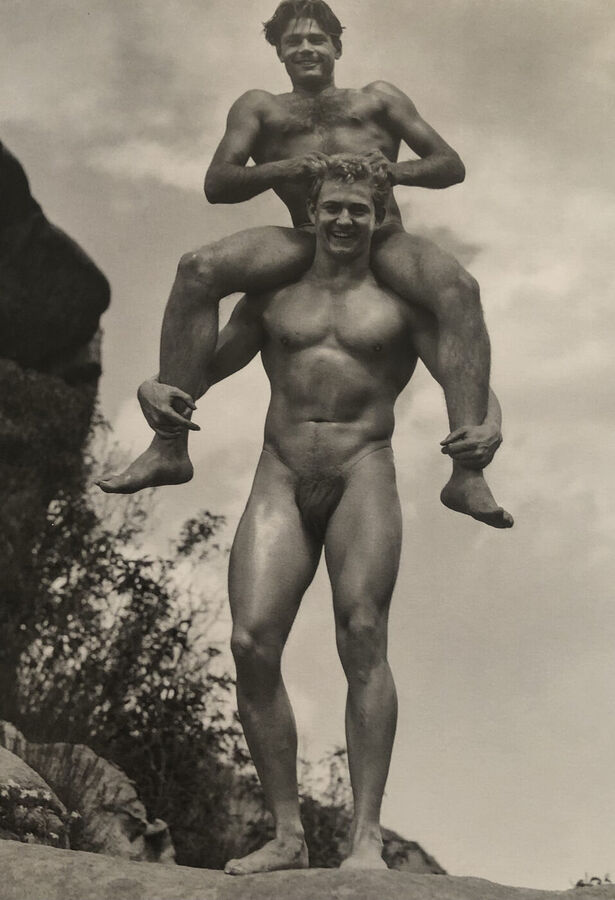
The law drew its line at the genitals. A naked torso was fine, a naked backside was dangerous, and anything more could send the photographer to jail.
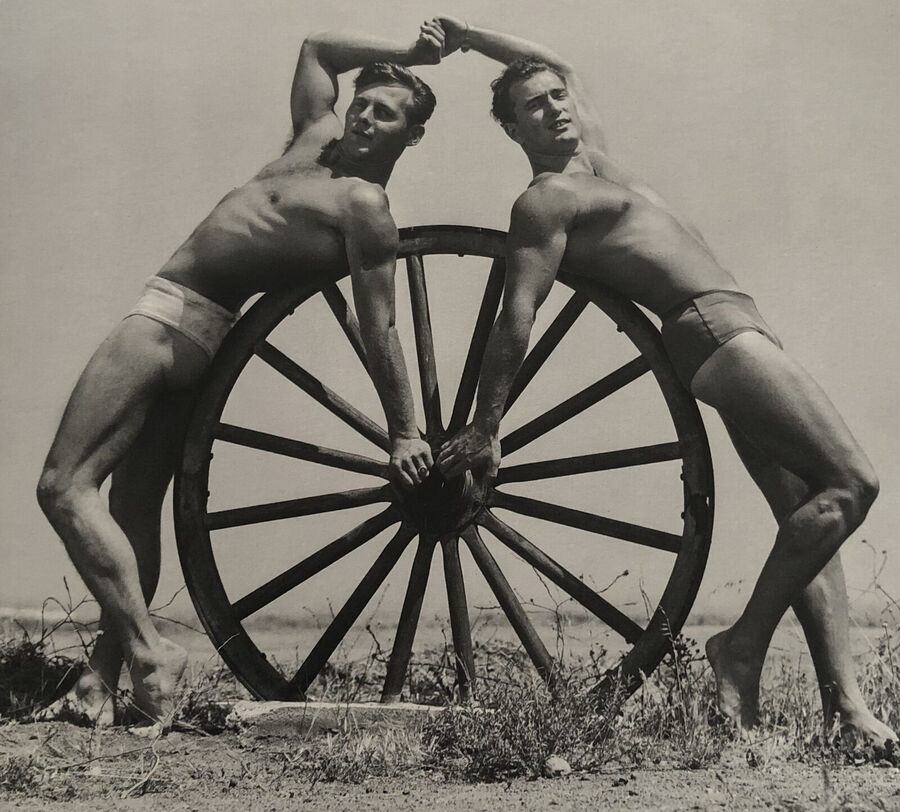
The solution was the posing strap: a small pouch of fabric held up by a string around the hips. It covered exactly what the Post Office objected to and nothing else. In some early prints the studios went further and painted over the groin or retouched it away.
The strap became the uniform of a whole genre. Models wore it to flex, to wrestle, to pose as gladiators and sailors and cowboys. The historian Alastair Blanshard describes it as both a way round the obscenity laws and the visual signature of everything AMG produced5.
Back behind bars
In 1954 Mizer was convicted again. The Bob Mizer Foundation describes the charge as distributing obscene material through the mail, the material being photographs of bodybuilders in posing straps4.
The historian David K. Johnson, whose book Buying Gay is the fullest account of the physique trade, gives a more precise version: Mizer was convicted of a misdemeanour, aiding and abetting the sale of lewd pictures by another dealer, and spent ninety days in the Los Angeles County jail2.
He came out and carried on, and used his magazine to fight back, with editorials on censorship, freedom of expression and the latest court cases.
His legal troubles were not over. In 1960 he was convicted of annoying a child, on the word of a sixteen-year-old who said he had been abused at the studio. In 1961 the California Court of Appeal reversed the conviction, finding that the trial judge had ignored evidence casting doubt on the accuser's honesty.
Films sold by the foot
Still photographs were only half the business. Mizer had been shooting film for years before AMG films were first advertised in Physique Pictorial in 1957.
They were sold by mail on 8mm and 16mm, priced by length. A black and white reel of fifty feet cost $6.50; colour cost much more. Most ran for a few minutes: men posing, flexing, wrestling on a mat in the garden, or acting out tiny comic plots5.
Blanshard counts more than 2,700 AMG films known by title. About 480 have some kind of story, and about 80 are set in antiquity or borrow something from it, with titles like Gladiator and the Rebel Slaves (around 1956) and Cleopatra and the Blond Slave (1961). The costumes were whatever could be found: a helmet, a sword, a strip of cloth5.
The films were sold to be watched at home, on the same small projectors that had carried the stag reels into living rooms. But they showed something stag films never had: men looking at the camera, aware of being admired.
Bruce, Lon, Al and Don
Mizer was the most famous physique photographer, but far from the only one. Every studio worked the same way: a darkroom, a mailing list and small ads offering sets of photographs by post.
Bruce Bellas taught chemistry at a school in Alliance, Nebraska, until 1947, when he moved to Los Angeles and began photographing bodybuilders at contests. As Bruce of Los Angeles he sold prints and 8mm films, and from 1956 published his own magazine, The Male Figure. His pictures were often playful and openly campy.
Bellas travelled across the country looking for models, and he is said to have delivered many of his prints by hand, because so much of what went through the mail was seized.
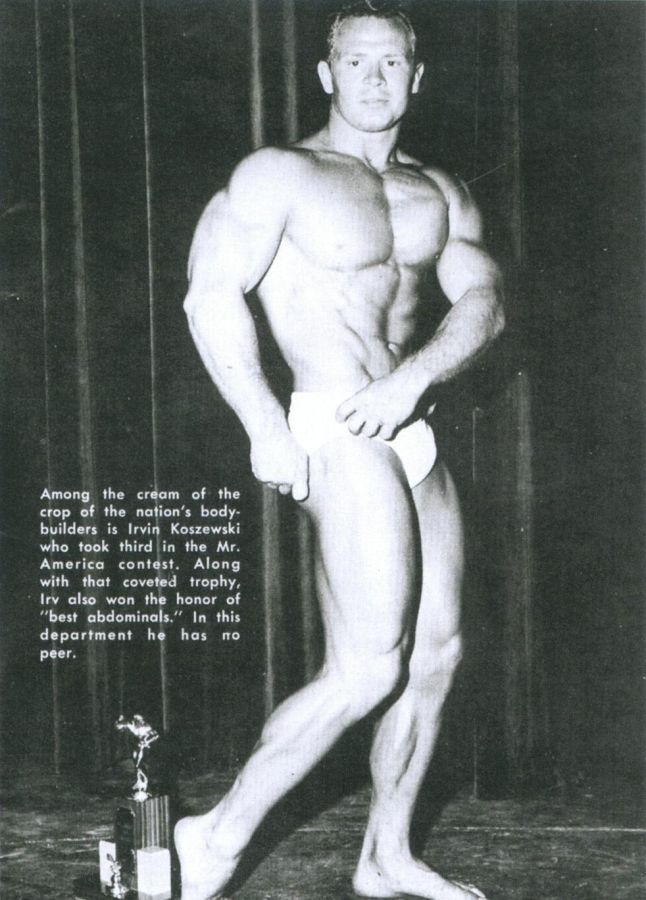
Al Urban had been advertising physique photographs in the back pages of Strength & Health since 1937. Working mostly from New York and New Jersey, he sold his pictures through catalogues of tiny numbered prints. Thomas Waugh, the historian of gay erotic images before Stonewall, counts him among the pillars of the postwar physique world6.
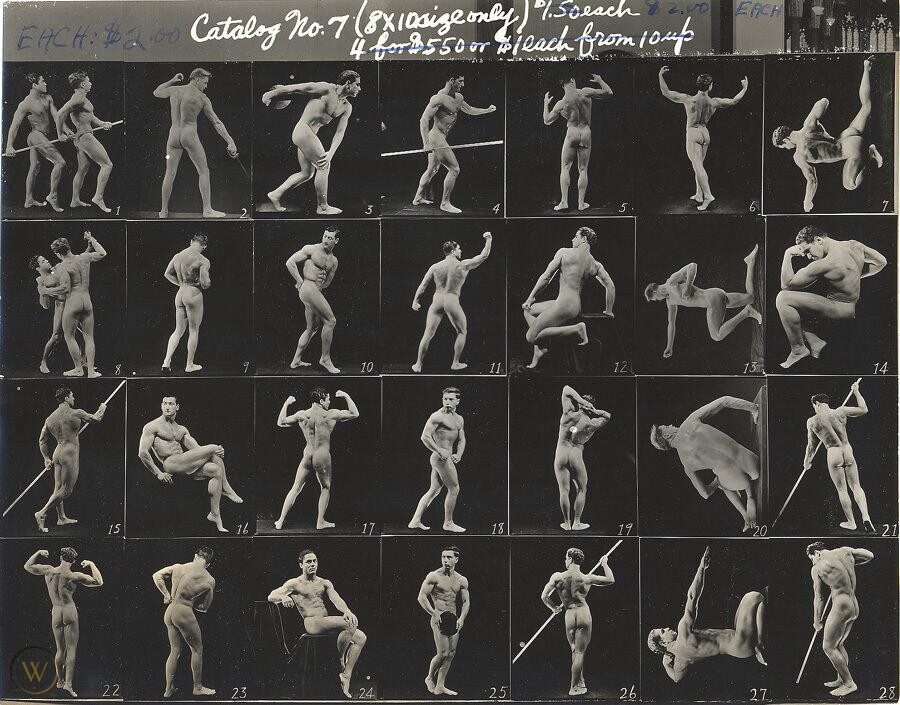
In New York, Alonzo Hanagan, a trained musician who had played the organ at Radio City Music Hall, worked as Lon of New York. He posed his bodybuilders like ancient statues and photographed Black and Puerto Rican athletes with a respect that was rare in the 1940s. He used to tell his models that they were standing there because they were objects of beauty. A brutal police raid in the early 1960s, together with his age, made him give up photography7.
In Denver, a former tax accountant called Don Whitman ran the Western Photography Guild from 1947, posing his models against the Colorado mountains. In the late 1950s Walter Kundzicz's Champion studio added colour, taking athletic young men out of the studio and into everyday settings8.
A newsstand full of Greeks
After Physique Pictorial came a flood. In 1952 Irvin Johnson, who ran a gym in Chicago, launched Tomorrow's Man. Within a few years it was claiming the largest circulation of any physique magazine in the country8.
Its first cover model, a young bodybuilder called Glenn Bishop, appeared in no other magazine for two years. Physique models were becoming stars of a very particular kind, famous to thousands of readers whose names they would never know.
Others followed in the same digest size, among them Vim and Adonis, sold on newsstands and by subscription. Their covers promised art and bodybuilding. Their readers, in large part, were gay men who had never before been able to buy pictures of men openly.
In 1955 Randolph Benson and John Bullock, a couple who had met as students at the University of Virginia, launched Grecian Guild Pictorial. They turned the alibi into a philosophy. The magazine praised the Greek ideal of the male body, readers were invited to join the Guild as members, and the editorials mixed physical culture with lessons in classical history2.
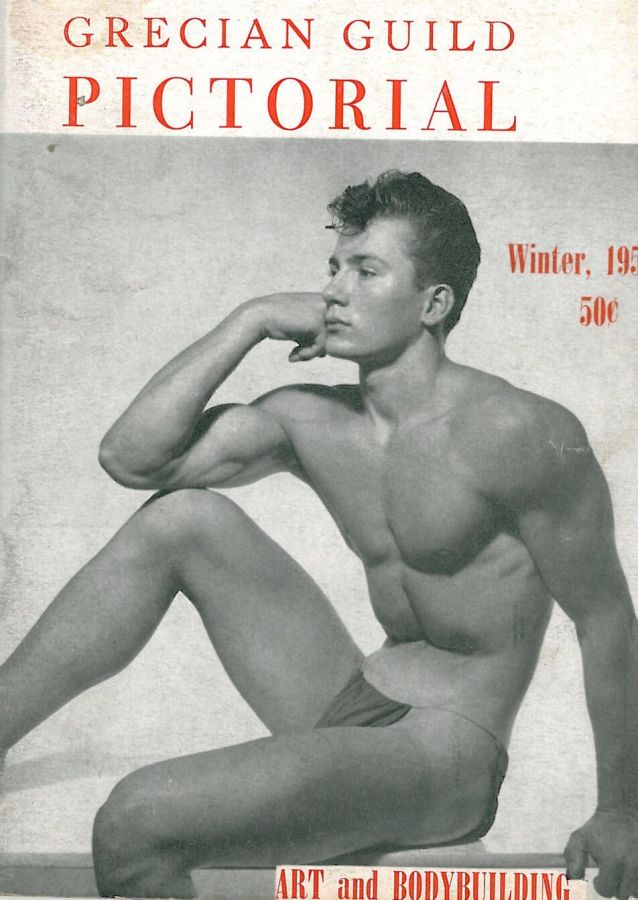
The real bodybuilders were furious. In June 1957 Harry Paschall published a piece in Strength & Health called "Let Me Tell You a Fairy Tale", attacking the physique magazines. The sport wanted to keep its distance from a market that it knew perfectly well existed9.
A lumberjack from Finland
In late 1956 a Finnish advertising illustrator, Touko Laaksonen, sent some drawings to Physique Pictorial. He was 36, a veteran of the Second World War, and had been drawing men privately for years.
Mizer put one on the cover of the Spring 1957 issue: lumberjacks working logs down a river, with another man watching. It was signed simply Tom. By the end of the year the magazine was crediting him as Tom of Finland10.
Over the next decade his drawings filled the pages of Physique Pictorial, still obeying its rules: the straps stayed on, the bulges were discreet. When the rules changed, his men would undress with them.
The postman's war
The physique trade lived and died by the mail, and the mail belonged to the Post Office. The Comstock Act of 1873, the same law that had hunted the stag films, made it a federal crime to send obscene material by post, and gave postal officials the power to decide what that meant.
Arthur Summerfield, President Eisenhower's Postmaster General from 1953 to 1961, made the war on smut his crusade. Postal inspectors infiltrated mailing lists, posed as customers, raided studios and, according to Johnson, paid "educational visits" to buyers and even their employers2.
For a customer, a name on a seized mailing list could mean a knock at the door, a conversation with the boss, the loss of a job.
The Post Office had already lost one battle. In 1954 the Los Angeles postmaster, Otto Olesen, had refused to mail the October issue of ONE, a homosexual magazine published in Los Angeles since 1953. On 13 January 1958 the Supreme Court reversed the ban in a one-line decision, citing its new definition of obscenity from Roth v. United States. Writing about homosexuality was not obscene in itself11.
The decision protected words, not pictures, and it did not stop the inspectors. In 1959 new owners of Vim started a pen-pal service called the Adonis Male Club, which within months had more than 600 members around the country. The Post Office treated it as a conspiracy. More than fifty members were indicted, and the two founders, Jack and Nirvana Zuideveld, were each sentenced to a year in federal prison9.
Unpleasant, uncouth and tawdry
Herman Lynn Womack was an unlikely hero. Born in Mississippi in 1923, he had a doctorate in philosophy from Johns Hopkins and had taught at George Washington University. In the late 1950s he bought a printing plant in Washington and started publishing physique magazines, eventually including Grecian Guild Pictorial itself.
He was also prosecuted personally. In 1960 he was convicted in a separate federal case for mailing obscene photographs, and managed to serve his sentence not in prison but at St Elizabeths, the federal psychiatric hospital in Washington2.
The case of the seized parcels, MANual Enterprises v. Day, reached the Supreme Court in February 1962. The government's argument was simple: the magazines were made for homosexuals and appealed to their prurient interest.
On 25 June 1962 the Court ruled for Womack, with only Justice Tom Clark dissenting. Writing the leading opinion, Justice John Marshall Harlan called the magazines "dismally unpleasant, uncouth, and tawdry", but said that was not enough. To be obscene, material also had to be patently offensive, an affront to current standards of decency, and photographs of nearly naked men were not1.
For the first time the highest court in the country had looked at images made for gay men and said they could be sent through the mail like anything else.
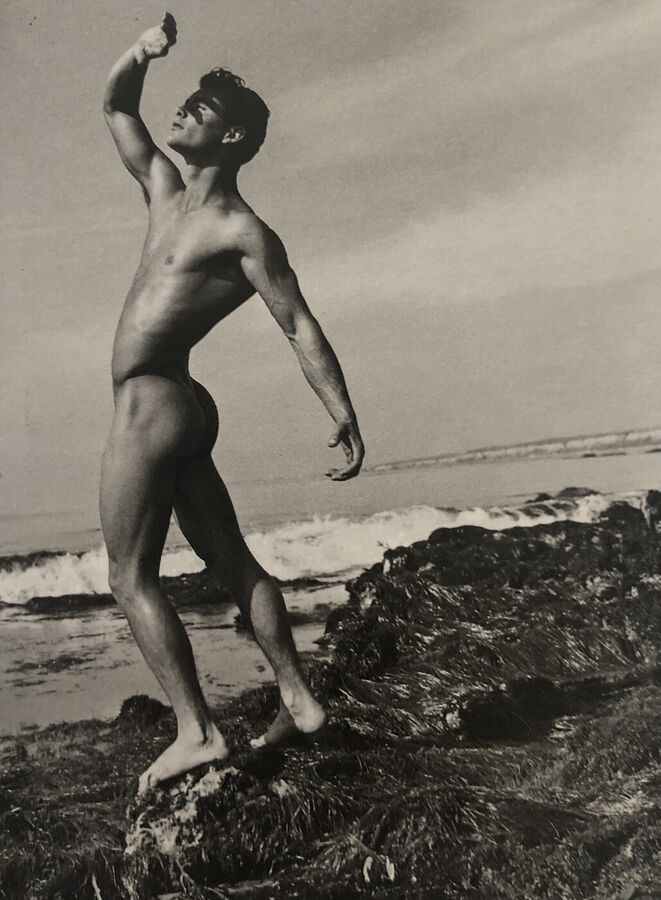
The strap comes off
The victory did not end the raids, but it changed what could be printed. Through the mid-1960s the magazines grew bolder, and new publishers began testing the next line, full nudity.
In 1967 the Supreme Court began reversing obscenity convictions one after another, starting with Redrup v. New York, and the old rules collapsed. That same year Directory Services, Inc., a Minneapolis mail-order company with a gay clientele, went on trial for obscenity9.
The physique magazines could not survive their own success. Once a reader could buy photographs of completely naked men, there was little reason to pay for a posing strap and a lecture on Greek art. Grecian Guild Pictorial published its last issue in 1968. Johnson dates the physique era from 1951 to 19672.
Mizer adapted. After a gap that covered most of 1968, Physique Pictorial returned in January 1969 with its first fully nude issue. He kept photographing almost to the end of his life and died in Los Angeles in 1992, leaving an archive of close to two million images4.
Bruce Bellas died in 1974, while on holiday in Canada. Lon of New York lived until 1999, long enough to see his photographs hung in a New York gallery and admired as art, the very thing the physique trade had always claimed it was making7.
The physique entrepreneurs had built something no one had planned: a national network of men who knew, from the magazines in their drawers, that they were not alone. Within months of the last Grecian Guild Pictorial, the Stonewall riots and the first gay feature films would bring that audience out into the open, and that is the story of chapter VII.
- Manual Enterprises, Inc. v. Day, 370 U.S. 478, Supreme Court of the United States, 1962
- David K. Johnson, Buying Gay: How Physique Entrepreneurs Sparked a Movement, Columbia University Press, 2019
- Bob Mizer Foundation, Setting the record straight on ‘Beefcake’, Bob Mizer Foundation, 2016
- Bob Mizer Foundation, Behind the Lens: The Life and Times of Bob Mizer (Part II), Bob Mizer Foundation, 2016
- Alastair J. L. Blanshard, Shoestring budgets and shoestring costumes: evoking antiquity in the films of Bob Mizer’s Athletic Model Guild, Classical Receptions Journal 18 (1), 2026
- Thomas Waugh, Hard to Imagine: Gay Male Eroticism in Photography and Film from Their Beginnings to Stonewall, Columbia University Press, 1996
- David Chapman, Alonzo James “Lon” Hanagan 1911–1999, Iron Game History 6 (3), 2000
- F. Valentine Hooven III, Beefcake: The Muscle Magazines of America 1950–1970, Taschen, 1995
- Jake Hall, A very homosexual history of beefcake magazines, Xtra Magazine, 2026
- F. Valentine Hooven III, Tom of Finland: His Life and Times, St. Martin’s Press, 1993
- One, Inc. v. Olesen, 355 U.S. 371, Supreme Court of the United States, 1958