Physique Pictorial, the pocket magazine that became the model for a whole genre
Bob Mizer's Physique Pictorial began in 1951 as a free eight-page booklet and ran for almost forty years: full-page photographs of nearly naked men, measurements, price lists and the editor's opinions on everything from posing straps to the death penalty. Every beefcake digest that followed was built on its formula.

Los Angeles, July 1962. At 1834 West 11th Street the Athletic Model Guild sends out Volume 12, Number 1 of Physique Pictorial. On the cover a bodybuilder called Larry Scott, Mr California, flexes against a rock in a pair of brief trunks. Inside the front cover the magazine explains that it comes out four times a year, that twelve issues cost five dollars by first-class sealed mail, and that it carries no paid advertising at any price1.
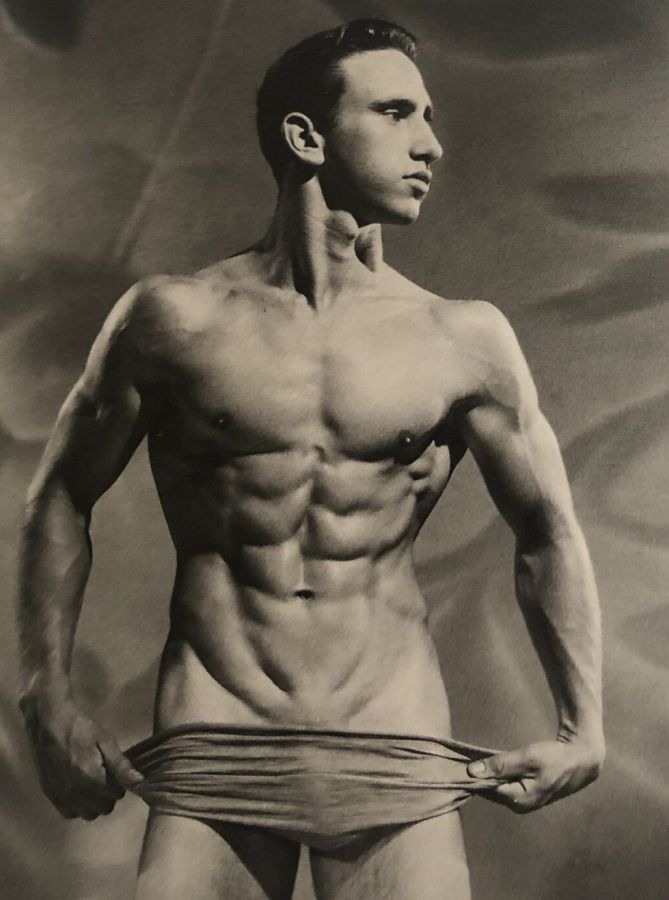
The little booklet was eleven years old, and it had already turned into the model for a whole genre: digest size, full-page photographs of nearly naked men, a few lines of text, an address to write to. Its editor, Bob Mizer, used it to sell his own pictures, to promote his rivals, to print the work of artists nobody else would print and to lecture his readers on politics. This is what was inside, issue after issue, and what became of it.
Eight free pages
The magazine was born out of a closed door. In the late 1940s physique photographers sold their prints through small advertisements at the back of the bodybuilding press. Under pressure from the Post Office, the big muscle magazines began turning those advertisements away, and the photographers needed somewhere else to be seen2.
Mizer's answer, in May 1951, was a free eight-page booklet called Physique Photo News. Within months it had become Physique Pictorial, a title he thought more honest because it carried drawings and paintings as well as photographs. The first cover was a drawing by George Quaintance3.
It was a quarterly, small enough to slip into a jacket pocket and cheap enough to throw away. That was part of the point. A magazine you could hide was a magazine a man could buy.

Measurements, hobbies and a price list
Open the summer issue of 1955 and the formula is all there. Each photograph has a caption that reads like a cross between a sports card and a mail-order catalogue: name, age, height, weight, waist, chest, biceps, then a line about the man himself. One is a navy frogman who wants to become a barber, another a scholarship student who hopes to open a free gym for poor boys4.
Then comes the price. Twelve photographs of a model cost two dollars fifty, a set of six colour slides three dollars, the miniature catalogues ten cents each. Customers were told to collect all twenty of AMG's index catalogues, which between them listed some 700 models4.
The same issue sold clothes. Posing straps cost one dollar in more than twenty colours, from aqua to heliotrope; a two-toned "Domino" strap cost two, and was offered to match the reader's new 1955 car. There were bikinis "not recommended for US beaches", terry-cloth wraps and Coronado sharkskin trunks4.
Ages were printed too, and they are a reminder of how the trade worked. Some of the youths in the 1950s issues were listed as sixteen or seventeen: minors, then as now. The magazine presented them as young athletes in training, and it was exactly this kind of picture that the police and the Post Office used against the physique studios.
A directory of the trade
Most of each issue was AMG's own work, but the magazine also printed photographs from other studios, each with an address. Lon of New York appears in 1955 as "one of the pioneers of physique photography" and, the caption adds, a talented organist who gave recitals. There are pictures from Massachusetts, from Michigan and a professional wrestler sent in by a studio in Paris4.
For a reader in a small town this was the real value of the magazine. It was a map of a hidden industry, with dozens of names and post office boxes where more pictures could be ordered. The historian David K. Johnson argues that these mailing lists and directories built a national network of gay customers long before there was a gay movement to join2.
The magazine policed its contributors to protect itself. Anyone whose work appeared, a notice explained, had signed a statement promising that nothing they sent out would embarrass the magazine or its readers, and readers who received anything objectionable were asked to report it at once4.
Rules for staying out of court
In 1955 Mizer printed a short guide for readers who wanted to take physique photographs of their own, under the title "Taking your own physique photos: legal aspects". It warned that even an attorney's advice was no guarantee against prosecution4.
Then it listed the precautions: show no pubic hair, make the model wear a garment thick enough to hide the outline of what it covered, and avoid "slovenly or erotic postures". The photographers brought to trial in recent years, it added, had been careless in one way or another4.
The advice was sincere and also a performance. Every caption about diet and training, every editorial about health, helped the magazine claim that it served bodybuilders and art students. The same posing strap that kept a photograph legal was sold on the back pages for a dollar.
The editor's soapbox
Mizer did not keep his opinions to himself. The 1955 issue used a caption about a young man who wanted to become a doctor to launch an attack on capital punishment: it fell, he wrote, only on poor and friendless men, and readers were urged to join the American Friends Committee, a Quaker group, in fighting it4.
Over the years his editorials took on censorship, the Supreme Court, the war in Vietnam and freedom of expression3. In 1962 he was telling readers why he supported the American Civil Liberties Union: if Communists could be silenced today, he argued, tomorrow it might be some other group, perhaps their own1.
The July 1962 issue printed a letter from a priest in a small town, who asked not to be named and told the editor to stop protesting so much and be proud of his work. Mizer answered that protest was essential: closing your eyes, he wrote, would not make "the oppressors" go away1.
The same issue announced a film AMG planned to call Vice Raid. It would open, the magazine said, with a scene taken from a Los Angeles policeman's testimony in court: officers bursting into a physique studio with a "battering ram", handcuffing the photographer and his model to a pillar and stamping on the negatives1.
Painters and a Finn
From the first cover, drawings and paintings were part of the deal. Quaintance's cowboys and Native American braves, muscular and barely dressed, were sold as 8 by 10 prints by mail from his studio in Arizona. Other artists followed: Art-Bob with his rodeo scenes, the former marine combat artist Bill MacLane, Etienne, and from 1957 Tom of Finland4.
Drawings had an advantage over photographs. A painted man could be as perfect as the artist liked, and nobody could ask how old the model was or arrest him. In July 1962 the magazine was selling Tom's series Tattooed Sailor and the Hoods at a dollar fifty a print, and announced that AMG had made a film based on the drawings, while Tom had promised a new series based on an AMG film1.
A genre in its image
By the mid-1950s the newsstands were full of booklets that looked like Physique Pictorial: the same small format, the same full-page photographs, the same mix of measurements and alibis. The genre now has its own history, F. Valentine Hooven's Beefcake, a survey of the American muscle magazines from 1950 to 19705.
Some had bigger budgets and glossier paper. None had Mizer's voice, and none lasted as long. When the Supreme Court opened the mail to male nudes in 1962, and when the posing strap finally came off at the end of the decade, the copies changed far more than the original did.
Forty volumes, and a second life
The magazine carried on through the 1970s and 1980s, nude now, more irregular, increasingly a catalogue for AMG's films and videos. The last issue of the original series, numbered volume 41, is usually dated 1990, two years before Mizer's death.
In 1997 Taschen published The Complete Reprint of Physique Pictorial, which put almost every issue back into print and turned a disposable pocket magazine into a collector's book6.
In 2017 the Bob Mizer Foundation revived the title as a quarterly, numbering the first new issue volume 42 so that it picked up where the old one had stopped. The covers are glossier and the paper is better, but the idea is the one from 1951: pictures of men, sent by post to people who want them3. The wider story is told in the chapter on the physique era.
- Bob Mizer (ed.), Physique Pictorial, Vol. 12 No. 1, Athletic Model Guild, 1962
- David K. Johnson, Buying Gay: How Physique Entrepreneurs Sparked a Movement, Columbia University Press, 2019
- Bob Mizer Foundation, Physique Pictorial was a visual feast, with a message, Bob Mizer Foundation, 2017
- Bob Mizer (ed.), Physique Pictorial, Vol. 5 No. 2, Athletic Model Guild, 1955
- F. Valentine Hooven III, Beefcake: The Muscle Magazines of America 1950–1970, Taschen, 1995
- The Complete Reprint of Physique Pictorial, Taschen, 1997