Playgirl magazine and the male centerfold, from Burt Reynolds on a bearskin rug to the newsstand
In April 1972 Cosmopolitan laid Burt Reynolds naked across its centre pages, and a year later a Los Angeles nightclub owner built a whole magazine on the idea. Playgirl was sold to women as their answer to Playboy, and for thirty-five years it was also the naked man that gay readers could buy at any newsstand.

April 1972. The new issue of Cosmopolitan reaches American newsstands, and in the middle of it, across the fold, lies Burt Reynolds. He is stretched out naked on a bearskin rug, one arm laid across his groin. The photographer is Francesco Scavullo. The idea came from the editor, Helen Gurley Brown, who had told Reynolds during a commercial break on The Tonight Show that women had the same appetite for looking as men. The print run of about 1.5 million copies sold out1.
A Los Angeles nightclub owner called Douglas Lambert was paying attention. Barely a year later he launched Playgirl, a monthly built around the male centerfold, sold as a magazine for women and read, from the start, by a great many gay men. This page tells how a single folded photograph turned into a magazine, what it showed and what it hid, who posed, who bought it, and how it survived fifty years of changing owners.
The rug that started it
Reynolds was a rising television and film actor, not yet the biggest box-office star in America. The Cosmopolitan picture was half a joke, and the body was not the smooth, boyish kind that magazines usually showed: Reynolds was hairy and unmistakably adult. It was also the first time a mainstream magazine had sold a naked man to women as something to look at, and it worked1.
He came to regret it. Deliverance, the serious drama he had just made, opened that summer, and Reynolds believed for the rest of his life that the centerfold had cost him an Oscar nomination. In his memoir he called the whole episode "a total fiasco" and wrote that he had wrongly assumed people would separate the joker from the actor2.
The readers did not care about any of that. They had seen that a man could be a pin-up, and that a magazine could make money from it.
A magazine for women, June 1973
Lambert's first plan, the usual account goes, was yet another men's magazine with naked women. He turned it around and aimed it at the women who had bought Cosmopolitan, at a moment when the women's movement was arguing loudly that female desire was real and deserved its own media. After a preview issue earlier in the year, the first regular issue of Playgirl appeared in June 19733.
Its cover promised a four-page nude foldout of Lyle Waggoner, the handsome comic actor from The Carol Burnett Show, and a nude centerfold. Inside, the pictures were discreet: shadows and angles did much of the work. The issue sold about 600,000 copies, and within three years circulation had passed a million3.
The first editor, Marin Scott Milam, wanted a magazine that spoke for the women of the 1970s rather than to them. Next to the men, early issues ran articles on abortion rights, the Equal Rights Amendment, nuclear power and inflation, along with fiction and long celebrity interviews3.


The centerfold, unfolded
What made Playgirl different from Cosmopolitan was the centerfold itself, a full-length photograph of a naked man printed across the middle pages. The first issue still hid what the Reynolds picture had hidden. Soon the magazine showed men fully frontally, and that became its rule for most of its print life, with a pause of about ten months in 1986 and 1987, when new owners tried to widen its readership and then gave up the experiment.
Showing the penis was the easy part. Making a naked man look comfortable was harder. In 1982 the film scholar Richard Dyer studied male pin-ups and found the same problem again and again: a man posed to be looked at seems to fight the passivity of the role. He looks away from the camera or past it, tenses his muscles, holds a prop, as if he were busy with something else and only happened to be naked4.
Playgirl's men were firemen, cowboys, lifeguards and boys next door, photographed in barns, on beaches and in bedrooms with a story around them. They were also, as the magazine insisted, all heterosexual, interested in the women who were supposed to be reading.
Stars on the cover, men in the middle
For its first decade Playgirl traded on celebrity. Famous men gave interviews and appeared on the cover with their clothes on, while lesser-known men took them off inside. In December 1974 the cover star was Burt Reynolds himself, in a Santa Claus hat, with a long interview about his career. Warren Beatty, Jack Nicholson and Clint Eastwood followed in the same years5.
Some famous men did undress. In September 1982 the magazine ran a pictorial of Christopher Atkins, then twenty-one and known from The Blue Lagoon5. Athletes and musicians posed over the years too, though big names grew rarer as the magazine moved down market.
The rest of the issue belonged to the Man of the Month and the readers' votes for Man of the Year. Some of these men went on to modelling and television; at least one went much further. A former sailor who appeared as Man of the Month in February 1989 was making gay videos as Ryan Idol within a year.


The readers nobody put on the cover
The question of who actually bought Playgirl followed it all its life. Jessanne Collins, managing editor in 2007 and 2008, cited marketing figures from the 1990s that put the readership at about 60 per cent women, with gay men making up the rest. Other estimates over the years ranged much higher6.
A former editor of The Advocate, Matt Breen, put the logic simply: who buys magazines of naked men? Gay men. A Philadelphia archivist of the magazine's gay fandom, who writes as Blackdogue, told the same reporter that for many gay men Playgirl was their first sight of the naked male body6.
The reasons are easy to see. Playgirl sat on ordinary newsstands, next to Time and Cosmopolitan, at a time when gay magazines were sold only in certain shops in certain cities. A man in a small town could buy it with less risk, and if anyone asked, it was a women's magazine.
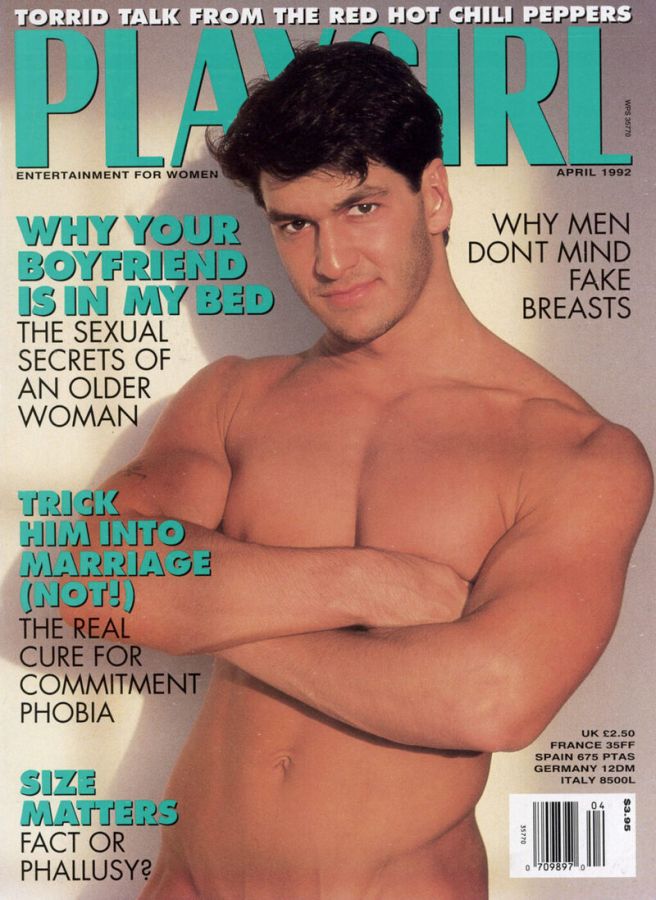
The editors knew, and for decades said little. By the 1990s the magazine was openly courting both audiences. Its own archive now recalls that the man on the cover of April 1992 was "better known by his gay fans as Kris Lord", a name from gay adult video5.
Changing hands
Ira Ritter, president and publisher from the mid-1970s, kept the feminist and journalistic tone, but circulation fell by more than half from its peak during the 1980s3. In 1986 the company went into Chapter 11 bankruptcy and the magazine was sold. Under Drake Publishers the serious articles shrank and the covers turned to plain beefcake.
In 1993 it passed to Crescent Publishing, which also owned High Society and other straight adult titles. Crescent fought costly battles over paparazzi pictures of famous men, and in 2001, after a settlement with the Federal Trade Commission over billing on its websites, it renamed itself Blue Horizon Media.
In August 2008 Blue Horizon announced that the print edition would end with the January 2009 issue and that Playgirl would live online. It came back in print in 2010, was sold to Magna Publishing in 2011 and limped on until 2016, when, according to one account, it had about 3,000 subscribers3.

A second life in 2020
In November 2020 a new owner, the publisher Jack Lindley Kuhns, brought Playgirl back as a print annual with Skye Parrott as editor. The cover showed the actress Chloë Sevigny, heavily pregnant and photographed by Mario Sorrenti, a nod to the magazine's feminist start. The first run of 10,000 copies sold out and went back to press7.
The new Playgirl lives mostly online, with a free site of features and a paid archive. Its men are now posed more like art nudes than like centerfolds, and its old covers are republished month by month as history.
It never became the female Playboy that Lambert imagined. It became something stranger and more lasting: the one place on an ordinary newsstand where, for thirty-five years, a naked man was on sale to anyone who wanted to look, whoever they were. The wider story of those years, when gay erotica moved from the booth to the newsstand, is told in the chapter on Out on the screen.
- Rebecca Onion, That Hairy Burt Reynolds Cosmo Centerfold Was a Game-Changer for My Teenage Self, Slate, 2018
- Burt Reynolds, But Enough About Me: A Memoir, G. P. Putnam's Sons, 2015
- Cleo Stiller, How Did Playgirl Magazine Go from Feminist Force to Flaccid Failure?, Jezebel, 2016
- Richard Dyer, Don't Look Now: The Male Pin-Up, Screen, 1982
- Playgirl, Classic Cover of the Month (online archive series), Playgirl, 2024–2026
- C. Brian Smith, Blackdogue and the Fandom of Gay Men Who Love Playgirl, MEL Magazine, 2019
- Emma Tucker, Playgirl Is Back, Creative Review, 2020