Male nudity in mainstream cinema, from the Hays Code to the first male full frontal nudity
For more than thirty years Hollywood's Production Code kept the male body covered, and then in barely a decade it came off: two actors wrestling naked by the fire in Women in Love, Joe Dallesandro in Flesh, Richard Gere in American Gigolo. This is how mainstream cinema learned to sell the naked man as soft porn for audiences who would never enter an adult cinema.
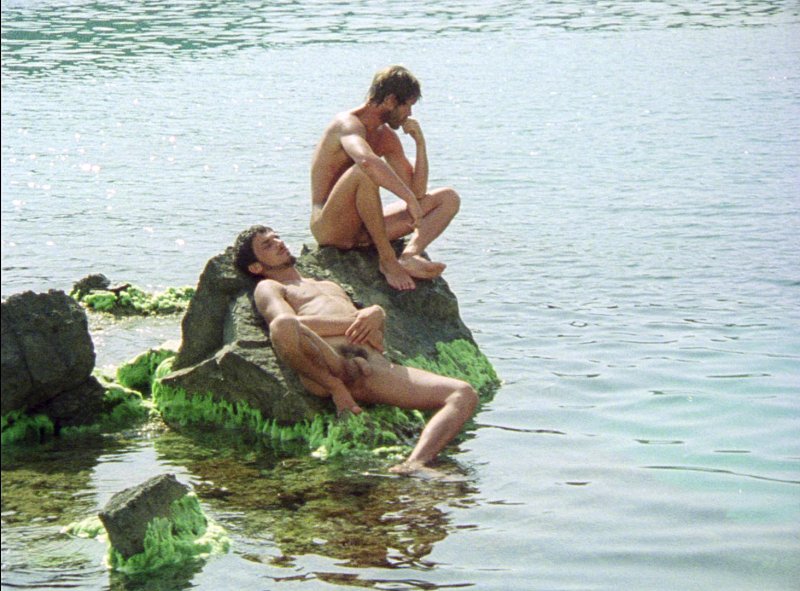
London, 1969. John Trevelyan, secretary of the British Board of Film Censors, sits down to watch Ken Russell's Women in Love, an adaptation of D. H. Lawrence with an all-British cast. Halfway through, two men lock a door, strip and wrestle naked in front of a fire. They are Alan Bates and Oliver Reed, and the camera does not look away. Trevelyan had warned the producer that this scene could sink the film. Having seen it, he let it through, and later called the decision a milestone, because male frontal nudity was still a rarity1.
That scene is the moment usually given as the first male full-frontal nudity in a mainstream film. It was not the first naked man on a screen, and it would not be the last argument about one. This page tells how mainstream cinema kept the male body covered for decades, how it uncovered it between 1968 and 1980, and how it learned to use the naked man as a lure, a kind of soft porn for audiences who would never have walked into an adult cinema.
The Code that kept men dressed
In 1922 the Hollywood studios hired Will H. Hays, a former Postmaster General, to run their new trade body and clean up the industry's image after a run of scandals. In 1930 they adopted a Production Code of moral rules, written by a Catholic publisher and a Jesuit priest, but for four years nobody enforced it seriously2.
That changed in 1934. Under pressure from the Catholic Legion of Decency, the studios set up the Production Code Administration, run by Joseph Breen, and from July of that year no member company could release a film without its seal. Breen and his staff read scripts, demanded cuts and negotiated every kiss2.

The rules on the body were blunt. In the edition printed in December 1956, the section on costumes says that complete nudity, in fact or in silhouette, is never permitted. The explanatory part adds that nudity used simply to put a "punch" into a picture is immoral, and that the beauty of the nude body does not make it moral on screen3.
The same Code forbade "sex perversion or any inference of it", which in practice meant any open homosexuality. Gay characters survived only as hints, jokes or villains, until an amendment in 1961 allowed the subject to be treated with care and restraint4.

The punch the Code was afraid of
The men who wrote the Code knew exactly why nudity sold tickets, and said so in writing. What they banned in Hollywood flourished elsewhere. Stag films circulated privately, and from the late 1950s independent producers made cheap "nudie" features and then sexploitation films, shown in small cinemas outside the studio system5.
These films sat between art cinema and hardcore. They promised sex and delivered bodies, almost always female ones, framed for a straight male audience. The historian Elena Gorfinkel describes sexploitation as a genre of looking, built on suggestion and delay rather than on explicit acts5.
The naked man had no place in that market, except in the physique films and magazines sold to gay men under cover of bodybuilding. For mainstream cinema he was a problem twice over: indecent under the Code, and dangerously close to "perversion" if the camera admired him.
The fall of the Code
By the mid-1960s the Code was losing its grip. Foreign art films, with their frank sex, were drawing American audiences. In 1964 Sidney Lumet's The Pawnbroker obtained an exception for a scene with a woman's bare breasts, and other exceptions followed6.
In 1968 the studios gave up. Jack Valenti, the new head of the Motion Picture Association of America, replaced the Code with a system of ratings that took effect on 1 November 1968: G, M, R and X. The X was not a trademark of the association and carried no seal, and within a few years pornographers had adopted it as their own label6.
For a short time, though, X still meant adult rather than obscene. Midnight Cowboy (1969), John Schlesinger's film about a young Texan who comes to New York to sell himself, went out with an X. In April 1970 it won the Oscar for Best Picture, the only X-rated film ever to do so, and it was later re-rated R.
Two men by the fire
Women in Love was produced and written by Larry Kramer, then a young American working for the studios in London, and later a writer and AIDS activist. He knew the wrestling scene, which Lawrence had written in a chapter called "Gladiatorial", would be the censor's sticking point. According to the journalist Robert Hofler, Kramer sold it to Trevelyan as high art: D. H. Lawrence and a British director, not American camp7.
Russell said the scene was not in the original script, and that Reed talked him into it by wrestling with him, jujitsu style, in his kitchen. Kramer later claimed that Reed arrived on the set drunk and got Bates drunk too. The fight was filmed by firelight7.
The British censor passed the film for adults. Trevelyan wrote that it was passed without cuts; Kramer remembered snipping a couple of feet from the wrestling and from a sex scene, "not so you could tell". Abroad the fate was rougher: some South American prints lost the whole sequence, and the scene is reported to have got the film banned in Turkey1.
Women in Love opened in Britain in November 1969 and in the United States in March 1970. Glenda Jackson won the Oscar for Best Actress. What people remembered, though, was the fight: two famous actors, naked, in a respectable literary film, locked together at length on the carpet.
Flesh, a kiss and a martyr
New York had got there by another route. In September 1968, weeks before the ratings came in, Flesh opened at the Andy Warhol Garrick Theatre on Bleecker Street. Made by Paul Morrissey for about 4,000 dollars, it follows a young hustler through a day of clients, and its star, Joe Dallesandro, spends much of it naked7.
Dallesandro became the first male sex symbol of underground cinema. In London, police raided the Open Space Theatre in February 1970 and seized Flesh after a complaint; screenings resumed in March, and the censor gave it an X certificate that October.
In 1971 Schlesinger made Sunday Bloody Sunday, in which Peter Finch, as a London doctor, kisses his young lover, played by Murray Head, on the mouth. It is not a nude scene, but it was one of the first times a mainstream film showed love between two men as something ordinary and tender4.
In 1976 Derek Jarman and Paul Humfress released Sebastiane, the story of the martyr saint among Roman soldiers, spoken entirely in Latin and full of naked men on a sunbaked shore. It was made for a gay audience, and the British censor gave it an X certificate. Here the naked male body was no longer an accident of art: it was the point of the film.

The gigolo in the mirror
In February 1980 Paramount released Paul Schrader's American Gigolo, with Richard Gere as Julian Kay, an expensive escort in Los Angeles dressed by Giorgio Armani. John Travolta had been cast first and dropped out. The film made more than 50 million dollars on a budget of about five million.


Gere appears fully naked, frontally, in a few brief shots. Gere later told The Advocate that the nudity was not in the original script but came "in the natural process of making the movie". Several major reviews of the time did not mention it at all8.
That is why the film has a special place in the story. It is often remembered as the first male nude in a mainstream film, which it was not: Bates, Reed and Dallesandro had been there a decade earlier. What it was, precisely, is the first time a major Hollywood star, in a studio film, showed full-frontal nudity8.
The film scholar Peter Lehman argued that the penis remained the most hidden part of the male body in cinema, shown rarely and usually with a joke or a wince. Gere's shots, matter-of-fact and unexplained, cut against that habit, and they were part of the film's sell: the gigolo as an object to be looked at, by women and by men9.
After Gere: the double standard
Male frontal nudity stayed rare. Actors who did it, and films that showed it, were counted one by one in the press, while female nudity remained routine. In 2011 Steve McQueen's Shame, with Michael Fassbender as a New York executive with a sex addiction, received an NC-17 in the United States. Fox Searchlight refused to cut it, its president calling the rating "a badge of honor, not a scarlet letter".
Fassbender won the best actor award at the Venice Film Festival, and his nude scenes became part of a wider conversation about why a naked man still made headlines. In 2021 the journalist Brooke Marine wrote in W that the uneven amount of nudity between the sexes showed Hollywood had not been fair to performers or audiences in a century of filmmaking8.
The line between art film, sexploitation and soft porn has moved many times since 1934, and the naked man has crossed it later and more nervously than the naked woman. The wider story of those years, when the same bodies moved from the art house to the gay cinemas, is told in the chapter on Out on the screen.
- John Trevelyan, What the Censor Saw, Michael Joseph, 1973
- Thomas Doherty, Hollywood's Censor: Joseph I. Breen and the Production Code Administration, Columbia University Press, 2007
- Motion Picture Association of America, The Motion Picture Production Code, Motion Picture Association of America, 1956
- Vito Russo, The Celluloid Closet: Homosexuality in the Movies, Harper & Row, 1981
- Elena Gorfinkel, Lewd Looks: American Sexploitation Cinema in the 1960s, University of Minnesota Press, 2017
- Jon Lewis, Hollywood v. Hard Core: How the Struggle over Censorship Saved the Modern Film Industry, New York University Press, 2000
- Robert Hofler, Sexplosion: From Andy Warhol to A Clockwork Orange, How a Generation of Pop Rebels Broke All the Taboos, It Books, 2014
- Brooke Marine, Full-Frontal Male Nudity Was 2021's Most Provocative Trend in Film, W Magazine, 2021
- Peter Lehman, Running Scared: Masculinity and the Representation of the Male Body, Temple University Press, 1993