Naked on stage: male nudity in theatre from Hair and Oh! Calcutta! to Equus
On 27 September 1968, the day after Britain abolished its theatre censor, Hair opened in London with its cast standing naked at the end of the first act. Within five years Oh! Calcutta! had kept men and women naked for whole scenes and Equus had put a naked young man in a stable at the National Theatre.

London, 27 September 1968. At the Shaftesbury Theatre the American musical Hair opens to a West End audience. The night before, a law passed by Parliament in July had come into force and abolished the power of the Lord Chamberlain to license plays. The producers had held back their opening for exactly that day. Time reported that Hair was the first play publicly staged in London without the censor's licence since the early seventeenth century1.
Near the end of the first act, members of the cast stood naked on the stage. It lasted seconds, in half darkness, and it became the most famous moment of the evening. This page follows the naked body, and especially the naked man, onto the stages of London and New York between 1968 and the mid-1970s: Hair, Oh! Calcutta! and Equus, the censors who tried to stop them and the courts that let them through.
If it moves, it's rude
For two centuries every new play performed in public in Britain needed a licence from the Lord Chamberlain, a court official whose office had controlled the stage since the Licensing Act of 1737. His examiners read every script and could cut a word, a gesture or the whole play2.
On nudity the office had a famous rule of thumb. A naked performer could appear only standing still, as a living statue; the moment the body moved, it became indecent. The Windmill Theatre in Soho built a business on that loophole with its motionless nude tableaux of women, summed up in the saying "if it moves, it's rude". A naked man was not even part of the conversation.
Homosexuality was more strictly forbidden still. Until 1958 the subject itself could not be shown on a licensed stage. That year the Lord Chamberlain relented, but grudgingly: his office noted that it would still not allow embraces between men or "practical demonstrations of love"2.
Theatres learned to dodge the censor by turning themselves into private clubs, whose members' performances he could not touch. In 1965 the Royal Court staged John Osborne's A Patriot for Me, refused a licence for its homosexual characters and a drag ball, as a club production. The prosecution of the same theatre over Edward Bond's Saved helped persuade Parliament to act.

The end of the censor
The Theatres Act 1968 received royal assent on 26 July 1968 and came into force on 26 September. From then on, plays could be prosecuted after the event under the ordinary law, for obscenity for example, but nobody had to ask permission in advance. The last Lord Chamberlain to read scripts was Lord Cobbold, a former governor of the Bank of England1.
The critic Kenneth Tynan, literary manager of the new National Theatre, had campaigned against the censor for years. In 1965 he had become the first person to say "fuck" on British television. Now he set out to prove what the stage could do without a licence3.
Hair, from the Public Theater to Broadway
Hair was written by two actors, Gerome Ragni and James Rado, with music by Galt MacDermot. It opened in October 1967 at Joseph Papp's Public Theater in New York, moved briefly to a discotheque, and reached Broadway at the Biltmore Theatre on 29 April 1968, directed by Tom O'Horgan. In the earlier versions nobody undressed4.
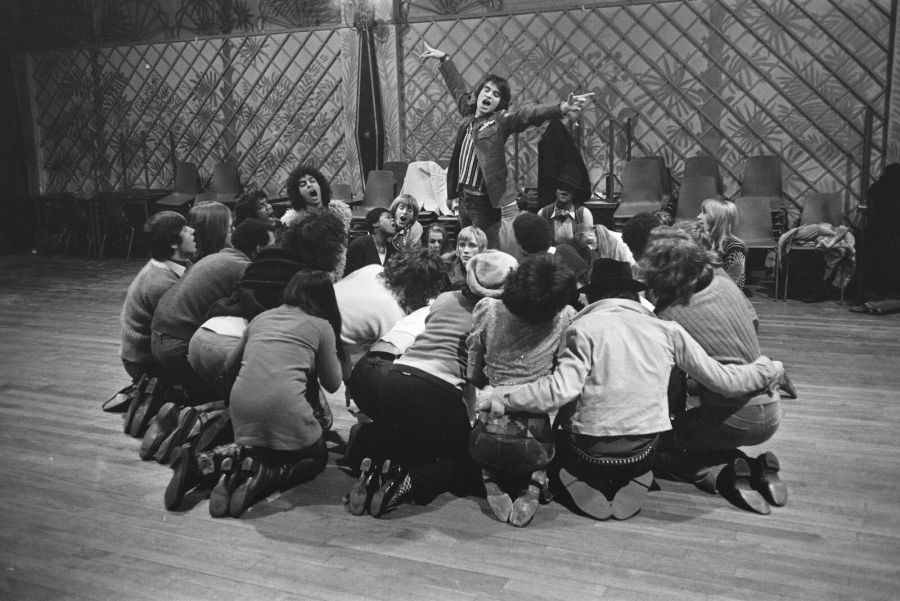
The nude scene came with Broadway. The authors had watched an anti-war demonstration in Central Park where two men took their clothes off in defiance, and O'Horgan, who had used nudity in other productions, built the idea into the show. At the end of Act I, during the song "Where Do I Go?", cast members who chose to took off their clothes behind a gauze screen and stood still, under dim light, for about twenty seconds4.
It was taking part that was voluntary, and the image was deliberately static, almost a tableau. But it was full frontal, it involved men as well as women, and it was on Broadway, two weeks after an off-Broadway hit that had put a party of gay men on stage.
Hair on the road
Off Broadway the experiments went further. In 1968 Richard Schechner's Performance Group staged Dionysus in 69, an adaptation of Euripides' Bacchae in which the actors stripped and drew the audience into the dancing. When the company toured to Michigan in 1969, the whole ensemble was arrested for indecent exposure5.
Hair had to fight city by city. In Boston in 1970 the district attorney objected to the nudity and to the treatment of the American flag, and the state's highest court ordered that each member of the cast be "clothed to a reasonable extent". The producers went to the federal courts, and a 4 to 4 vote in the Supreme Court left in place an order allowing the show to go on5. In Mexico the production was banned after one night in Acapulco.
In October 1971 the board that ran the municipal theatres of Chattanooga, Tennessee, refused to rent its stage to Hair without seeing it or reading the script, on reports of nudity and obscenity. The case reached the Supreme Court, which ruled on 18 March 1975 that the city had imposed an unlawful prior restraint. The trial court had found that in the scene "all performers, male and female, appear nude upon the stage"6.
Oh! Calcutta! and the naked revue
Tynan's answer to the end of censorship was an evening of erotic sketches. Oh! Calcutta! opened off Broadway at the Eden Theatre in June 1969, directed by Jacques Levy, with contributions credited to writers including Samuel Beckett, John Lennon, Sam Shepard, Jules Feiffer and Edna O'Brien. The title came from a painting by Clovis Trouille and hid a French pun on the buttocks3.
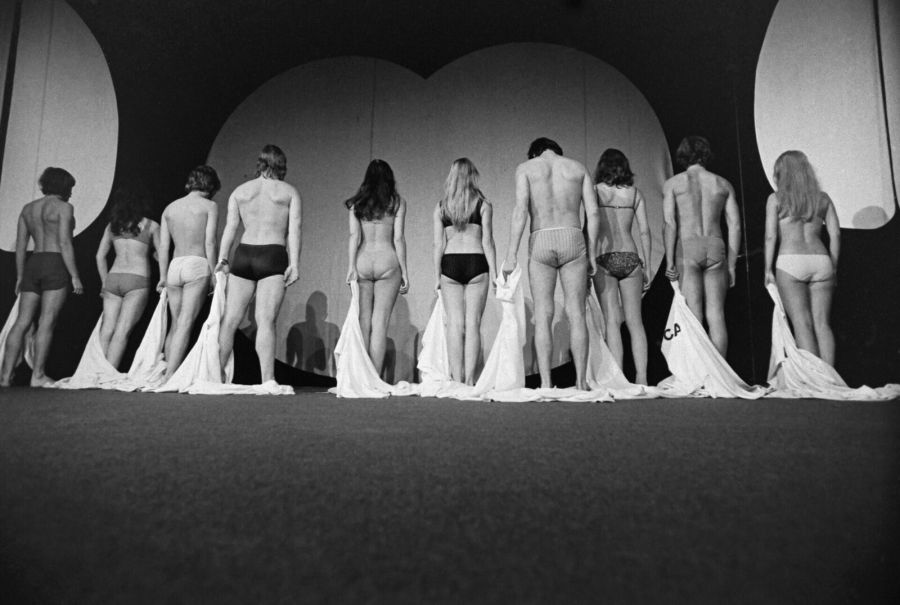
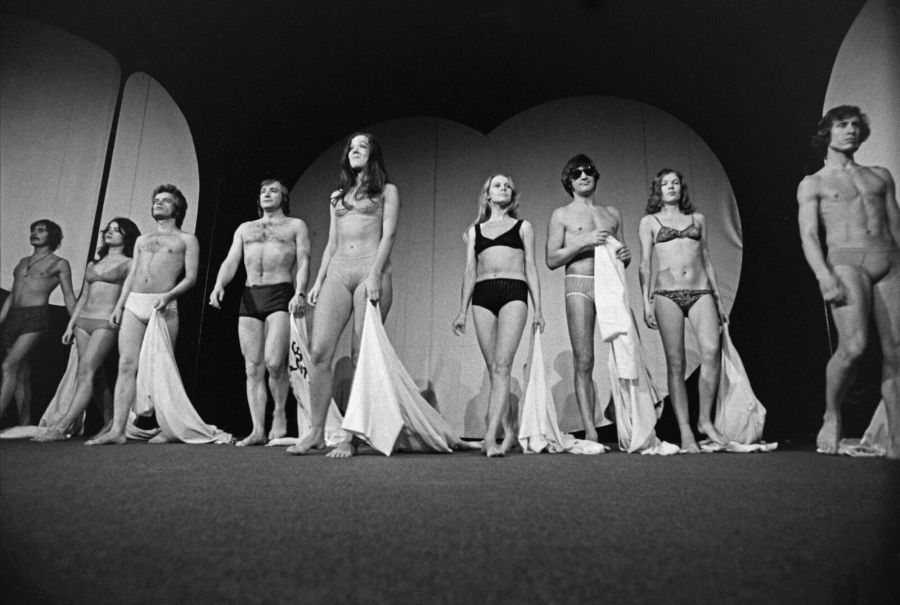
Unlike Hair, it kept its cast naked for long stretches, men as well as women, moving, dancing and talking. Audiences came, and kept coming.
The London production opened at the Roundhouse on 27 July 1970. Officers from the Metropolitan Police's obscene publications squad went to a preview, Conservative MPs complained in Parliament, and the Attorney General decided not to prosecute. The show moved to the West End and ran until 1980. A Broadway revival that opened at the Edison Theatre in 1976 played until 1989, nearly 6,000 performances, the longest run of any revue on Broadway. In the United States, police in some cities still tried to arrest casts on tour3.
Equus: a naked man in a stable
The most serious male nude of the period came from the National Theatre itself. Peter Shaffer's Equus, directed by John Dexter, opened at the Old Vic in July 1973. Shaffer had heard of a crime in a small town in northern England, in which a seventeen-year-old boy blinded twenty-six horses, and built a play around a psychiatrist, Martin Dysart, trying to understand why7.
The horses were played by actors in wire masks and hooves. The climax, at the end of the second act, is the scene of the crime: in a dark stable the stable girl Jill Mason undresses and tries to make love with Alan Strang, the boy who worships the horses, and he cannot do it with the animals watching. Both actors are naked. Then, in a frenzy, he takes a hoof pick to the horses' eyes7.
The nudity was not an attraction but the point of the scene: a young man stripped, physically and mentally, in front of the gods he has invented. Peter Firth, who created Alan in London, was nineteen at the premiere; he played the part again on Broadway in October 1974, opposite Anthony Hopkins, and in Sidney Lumet's film of 1977. The Broadway production ran for more than 1,200 performances and won the Tony Award for best play.

After the curtain
By the mid-1970s nudity was ordinary in serious theatre on both sides of the Atlantic, and male nudity less unusual than it had been ten years earlier, though still rarer than female. The fights moved to the courts after the fact, and to touring towns rather than capitals. In Britain the most famous later case, the private prosecution of the National Theatre's The Romans in Britain in 1982, was brought under the Sexual Offences Act, because a prosecution under the Theatres Act needed the consent of the Attorney General.
What the stage had done between 1968 and 1975 was to put the naked man in front of a paying, respectable audience, live, in the same room. The wider story of those years, when the same freedom reached cinemas and newsstands, is told in the chapter Out on the screen.
- The London Stage: Exit the Censor, Time, 1968
- Dominic Shellard, Steve Nicholson and Miriam Handley, The Lord Chamberlain Regrets...: A History of British Theatre Censorship, British Library, 2004
- Kathleen Tynan, The Life of Kenneth Tynan, Weidenfeld and Nicolson, 1987
- Barbara Lee Horn, The Age of Hair: Evolution and Impact of Broadway's First Rock Musical, Greenwood Press, 1991
- Ken Kaissar, Baring It All, American Theatre, 2013
- Southeastern Promotions, Ltd. v. Conrad, 420 U.S. 546, Supreme Court of the United States, 1975
- Peter Shaffer, Equus, André Deutsch, 1973