Clone
The macho gay look of the 1970s: mustache, short hair, tight Levi's, plaid shirt and boots, worn by so many men that they looked like copies.
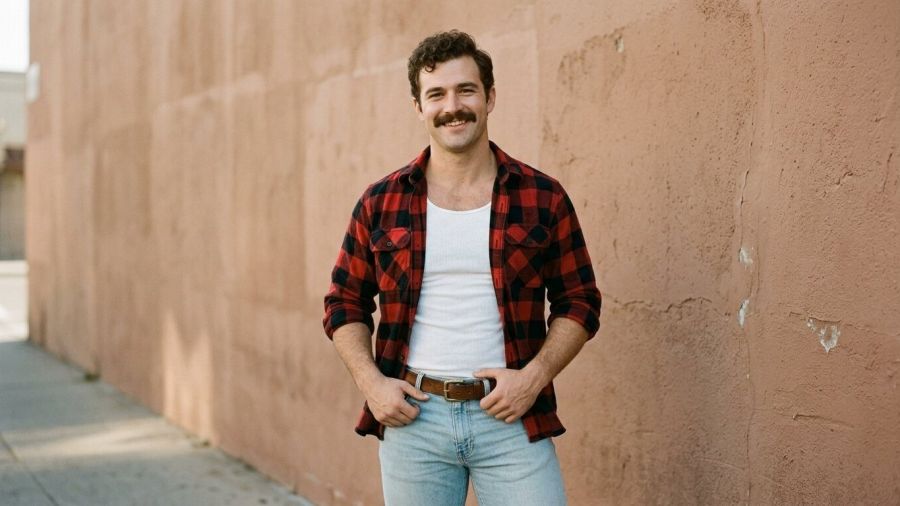
A clone is the classic gay macho look of the 1970s: short hair, thick mustache, tight faded Levi's, plaid or flannel shirt, work boots, a gym body under it all. Picture a lumberjack, a construction worker or a cowboy, then picture a whole street of them in San Francisco's Castro or New York's West Village, all dressed the same, all cruising each other. That is where the name comes from: they looked like copies of one another.
The clone was not trying to look straight. He was trying to look like the men gay men desired, and to show that being gay and being masculine were not opposites. It was a uniform, a fantasy and a statement all at once.
Where it comes from
Clone in the general sense, someone who slavishly copies others, comes from the biological clone. The gay sense, a man who adopts a super-masculine stereotype such as truck driver, soldier or cowboy, is recorded from 1981, when it already appeared in a glossary of gay speech and in a gay mystery novel that mentions "gay clone work shoes". People also said Castro clone, after the San Francisco neighborhood, and a place full of them was a clone zone.
The sociologist Martin P. Levine, who lived inside that world, studied the clones of 1970s New York and described a culture built around hypermasculine looks, the gym, drugs, dancing and a lot of casual sex, with a strict code about how a man should look and behave. The Village People, with their cop, cowboy, construction worker and leatherman, sold a cartoon version of it to the whole world.
The end and the return
AIDS hit the clone generation hard, and Levine's book about them carries the subtitle "The Life and Death of the Homosexual Clone" for a reason. By the late 1980s the look itself felt like a memory of a lost world.
It never really went away, though. The bear movement took the beard, the flannel and the working-class masculinity and added fur and weight. The leather daddy kept the boots and the attitude. And every few years the full mustache-and-501s outfit comes back, now as a deliberate retro look, half homage and half camp.
Clone or masc
A clone and a masc guy can look alike, but they mean different things. The clone was openly, loudly gay: his masculinity was a style shared in gay spaces. Masc on the apps often means "not obviously gay", and sometimes comes with "no fems". The clone wanted to be seen by other gay men. Many mascs would rather not be seen at all. For the even more butch look of the same years, see leather bar.
Related terms
Sources 2
- Green, Jonathon. "clone, n." Green's Dictionary of Slang, online edition. https://greensdictofslang.com/entry/7wxywdq
- Levine, Martin P. Gay Macho: The Life and Death of the Homosexual Clone. Edited by Michael S. Kimmel. New York: New York University Press, 1998. https://nyupress.org/9780814746950/gay-macho/