Ballroom
The competition scene created by Black and Latino gay men and trans women in New York, with balls, categories, houses and a language all its own.
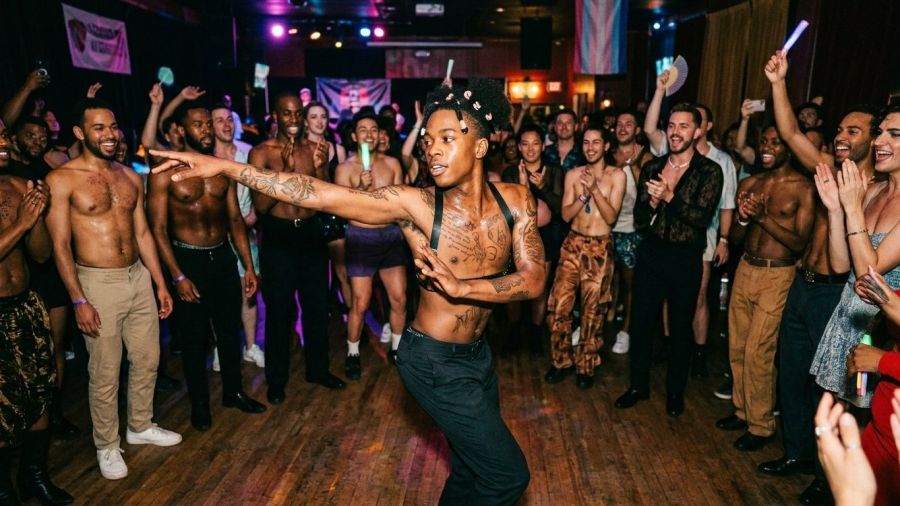
Ballroom is the underground competition scene created by Black and Latino gay men and trans women in New York, and the culture that grew around it. At a ball, people "walk" in categories, from runway to vogue to realness, in front of judges who score them, while a commentator on the mic keeps the room on fire. The winners take home trophies and, more importantly, status.
Ballroom is not only the balls. It is a social world with its own families, the houses, led by a mother and a father, and its own language. A huge share of the slang gay men use today, from shade and reading to werk, serve and slay, was born or polished there.
Where it comes from
Drag balls are old. New Zealand's national museum, Te Papa, dates the first queer masquerade ball in Harlem to 1869, and by the end of the 1920s drag balls were drawing thousands of people to venues like Madison Square Garden. But the old pageants were judged mostly by white people, and Black queens were expected to meet white standards of beauty.
The answer came from the queens themselves. After a contest that was allegedly fixed for a white queen, Crystal LaBeija and Lottie LaBeija organized a ball of their own, and in 1972 the first annual House of LaBeija Ball founded the first ballroom house, which still exists. Crystal's fury at the old pageants is on film, in the 1968 documentary The Queen. Through the 1970s and 1980s houses multiplied across Harlem and Brooklyn.
Paris Is Burning and beyond
Most of the world met ballroom through Jennie Livingston's 1990 documentary Paris Is Burning, with legends like Dorian Corey explaining the rules of the game on camera. The film gave mainstream culture voguing, reading and shade, and its quotes have been repeated ever since. Later the TV series Pose and RuPaul's Drag Race carried ballroom language to millions more.
The scene survived the AIDS years and is now international, with houses and balls as far away as New Zealand. Next to the big competitive balls there is also a looser, more playful kiki scene.
A culture, not a costume
Ballroom words are everywhere now, on social media and in ads, often used by people who have no idea where they come from. Inside the scene that can sting: these words came from Black and Latino queer people with very few places to be fabulous, and they deserve the credit. Using the slang is fine; knowing its history is the least we can do.
Related terms
Sources 2
- "Origins of Ballroom." Te Papa, Museum of New Zealand Te Papa Tongarewa (accessed 19 October 2026). https://tepapa.govt.nz/digital-museum/explore-digital-museum/lgbtqi-histories-aotearoa-new-zealand/origins-of-ballroom
- Cosca, Ivy. "Phrases and Words From Ballroom Culture We Still Use Today." The Village Voice, 8 February 2023. https://www.villagevoice.com/?p=749974