Cottaging
British gay slang for cruising for sex in public toilets, called cottages; the American word for the same place is tearoom.
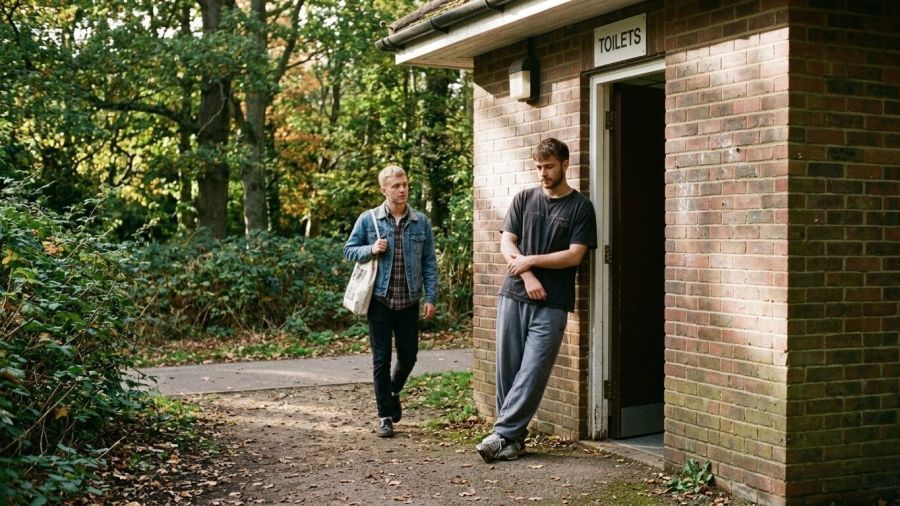
Cottaging is British gay slang for looking for, or having, sex with men in public toilets. The toilet is the cottage, the man who goes there is a cottager, and "going cottaging" is the British twin of the American tearoom. Green's Dictionary of Slang extends the word to parks and other public spots used the same way.
It is a very British word: cozy, rural, faintly absurd, the opposite of the grim Victorian urinal it describes. That contrast is the joke, and it kept a lot of men safe when you couldn't say what you were really doing.
Where it comes from
Cottage for a public lavatory is older than its gay use: Green's finds it in 1909, in a dictionary of Victorian slang that credits it to "fast youths" and defines it as a urinal, a place for a brief stop. Where the cottage itself comes from is unclear. Green's repeats a story about an eccentric will that left money to build "cottages of convenience", and labels it only "said to be" the origin. The small brick or iron toilet buildings in British parks and streets did look a bit like little cottages, which helped the word stick.
The verb, to cottage, and the gay sense belong to the 20th century, with the verb in print by 1950 and cottager by 1985.
The law and the scandals
For most of the century, cottaging was where the police found gay men. Officers watched toilets and arrested men for "persistently importuning" or gross indecency, and the courts and the newspapers did the rest. The most famous case is the actor John Gielgud, arrested in a Chelsea public lavatory in October 1953 and fined £10 the next morning; an evening paper ran the story within hours. He was advised to stay away from the United States for years afterwards.
Today the law in England and Wales no longer singles out men who have sex with men: the Sexual Offences Act 2003 has a gender-neutral offense of sexual activity in a public lavatory, punishable by up to six months in prison or a fine.
How it is used today
Many public toilets have closed or been redesigned, and Grindr made the cottage less necessary, so cottaging is now partly history and partly a thing some men still do. The word survives in British gay banter, in plays and memoirs, and as a mild tease for anyone who spends too long in the gents. The same need found indoor homes in the sauna, the darkroom and the glory hole wall, and outdoor ones in cruising grounds.
Related terms
Sources 4
- Green, Jonathon. "cottage, v." Green's Dictionary of Slang, online edition. https://greensdictofslang.com/entry/uq4opqa
- Green, Jonathon. "cottage, n." Green's Dictionary of Slang, online edition. https://greensdictofslang.com/entry/2kiymby
- "John Gielgud." LGBT History UK wiki (accessed 19 October 2026). https://www.lgbthistoryuk.org/wiki/John_Gielgud
- Sexual Offences Act 2003, section 71: Sexual activity in a public lavatory. UK Public General Acts, legislation.gov.uk. https://www.legislation.gov.uk/ukpga/2003/42/section/71