Hanky code
A code of colored handkerchiefs worn in a back pocket to show what a man is into: the color says what, left pocket top, right pocket bottom.
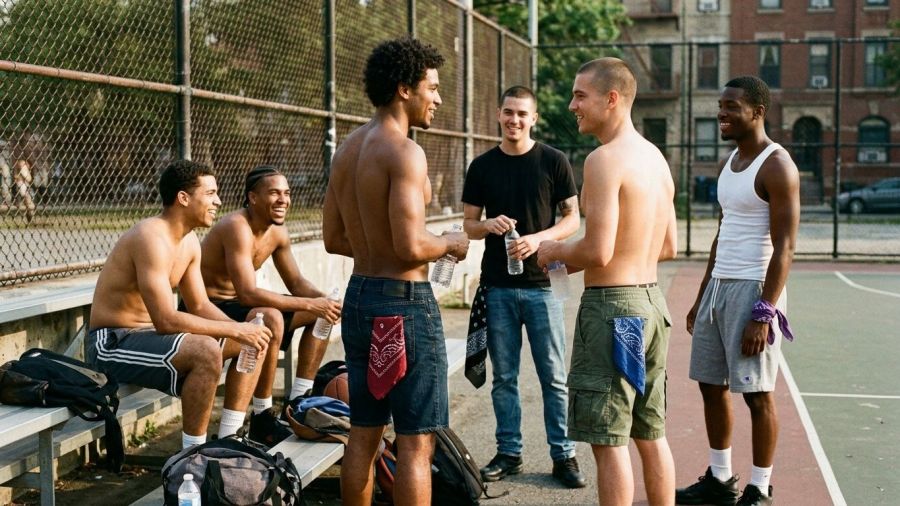
The hanky code is a system of colored handkerchiefs, or bandanas, worn in a back pocket to tell other men what you are into sexually. The color says what, the pocket says how: worn on the left, you are the one doing it, the top or the active partner; worn on the right, you want it done to you. One square of cotton, and a man across a dark bar knew more about you than a whole conversation would have told him.
It is also called flagging, and it belongs above all to the leather scene and to the clone look of the seventies, the jeans, boots, mustache and checked shirt of the Castro and the West Village. It found its way into leather bars everywhere. It is not a secret anymore, and it was never a precise science: the code changed from city to city and from chart to chart, and nobody ever memorized all of it.
Where it comes from
Nobody knows exactly who started it. The code spread in the early seventies in places like San Francisco and New York, and the people who study it admit that no one wrote down the first night a man walked into a bar with a hanky in his pocket. There are hints that early motorcycle clubs carried bandanas for bike maintenance, so the signaling may have started there. One of the few early printed traces is a hanky chart in The Village Voice in the early seventies; Drummer, the leather magazine, printed a code in 1977, and a year earlier a letter to the same magazine had dismissed the whole thing as a media hoax. Several shops and writers later claimed to have invented it; none of the stories can be proved, so take every "first" with a pinch of salt.
By the end of the seventies the code was everywhere. In 1977 the photographer Hal Fischer put it in Gay Semiotics, his deadpan study of the signs of gay San Francisco: a man with a red handkerchief in his right pocket "plays the passive role", one with it in the left is the active one, and, Fischer adds, a handkerchief can also just be for blowing your nose. By 1980 the code was printed in Bob Damron's Address Book, the gay travel guide to bars and cruising spots across America.
The colors
The charts grew longer every year, but the classics are few. Some of the colors you will find on most lists:
- Light blue: oral sex.
- Red: fisting.
- Yellow: watersports.
- Black: S&M.
- White: jerking off.
- Hunter green: daddies, or men looking for one.
- Red gingham: sex in the park.
- Lime green: he buys dinner, or he wants you to.
The early charts had about a dozen colors, and most men only ever used six or eight. Later lists ran to dozens of shades, patterns and objects, some of them more joke than code.
How it is used today
The apps killed most of the hanky's practical job, since a profile says it all in writing. But the code never died. It is alive at leather weekends and fetish events, in the piping on leather vests and in armbands, and for many men it has become less about hooking up and more about identity, a way of saying "this is what I am into, in general". It has even been revived and stretched, with new colors and patterns for every kink and identity you can name. Younger queers who never saw it the first time are picking it up as history, as fashion, or both.
A bandana in the back pocket can still be read. If you wear one because you like the color, be ready for the questions it might bring.
Related terms
Sources 4
- John Riley, "The History of the Hanky Code", Metro Weekly, 18 January 2026. https://www.metroweekly.com/?p=251987
- Caitlin Shamberg, "If You Know, You Know", Getty News, 8 June 2021. https://www.getty.edu/news/if-you-know-you-know
- "The Handkerchief Code, According to 'Bob Damron's Address Book' in 1980", The Saint Foundation, 25 April 2019. https://thesaintfoundation.org/community/hanky-code-bob-damrons-address-book
- Chris Thomas, "What exactly is the Hanky Code? Let's untuck its colorful, queer history!", Out, 8 July 2024. https://out.com/sex/hanky-code-color-explanations-meanings