Lavender
The color of gay: for about a century lavender has been a code word for homosexuality, from lavender men and lavender marriages to the Lavender Scare.
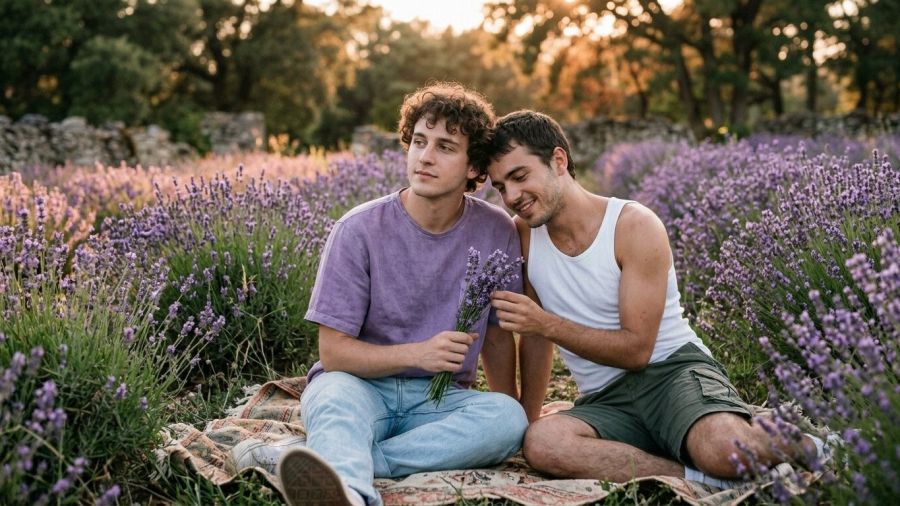
Lavender is the color of gay. For about a century the pale purple has been a code for homosexuality and anything connected to it: a lavender man, a lavender marriage, a streak of lavender, the Lavender Scare. Long before the rainbow, it was the shade people reached for when they meant gay and did not want to say it.
It has always cut both ways. Straight people used it to sneer, the way you might call a man "a bit pink"; gay people used it to wink at each other. Today it is mostly ours again, a soft, slightly vintage color that says queer history.
Where it comes from
Green's Dictionary of Slang treats lavender as an American euphemism for homosexual. It quotes an 1870 army song about "Sir Lavender Silk", a pretty young officer with the look of a lady in men's clothes, and then the clear gay sense in a 1928 play by Mae West, where one character tells another: "Lavender, maybe, but violet never". By 1938 the gossip columnist Walter Winchell was joking that when a certain man crossed the street, the traffic light turned lavender.
Why lavender and not another color, nobody knows for sure. The Mae West line suggests that by the 1920s the whole purple family was already loaded, with lavender as the softer, more forgivable shade.
The Lavender Scare
The word's darkest moment came in Cold War America. In the 1950s, alongside the hunt for communists, the United States government purged gay men and lesbians from federal jobs, on the theory that they were security risks open to blackmail. In 1953 President Eisenhower signed an executive order that made "sexual perversion" grounds for firing. The historian David K. Johnson named this persecution the Lavender Scare, the title of his 2004 book, and showed that it destroyed thousands of careers.
Lavender marriage and today
A lavender marriage is a marriage of convenience between a gay man and a woman, often a lesbian, to keep up straight appearances: a classic of old Hollywood, where studio contracts depended on a clean image. The woman in it is a beard, and the marriage is the closet with a wedding ring.
The color still shows up whenever queer history is on display: on Pride merchandise, in the names of queer groups and bars. It has the faded charm of a code we no longer need, and a reminder of why we once needed it.
Related terms
Sources 2
- Green, Jonathon. "lavender, adj." Green's Dictionary of Slang, online edition. https://greensdictofslang.com/entry/72bt4aa
- Johnson, David K. The Lavender Scare: The Cold War Persecution of Gays and Lesbians in the Federal Government. Chicago: University of Chicago Press, 2004. ISBN 978-0226404813.