Cruising
Looking for sex with strangers in public or semi-public places, like parks, beaches and toilets; more loosely, checking someone out.
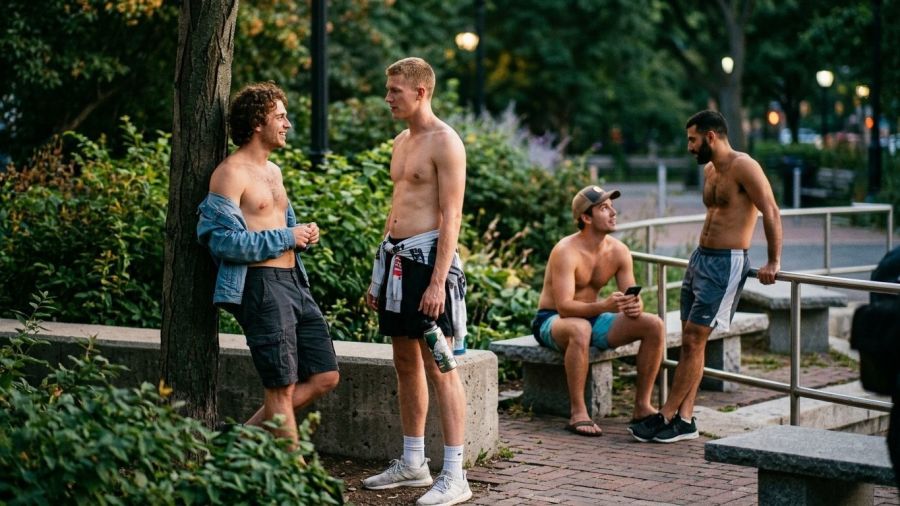
Cruising means looking for sex with strangers in public or semi-public places: walking a park path after dark, lingering at a beach, a rest stop or a public toilet, catching a man's eye and holding it a second too long. It covers the whole ritual, from the slow walk and the glance over the shoulder to the nod toward the bushes, and it covers the places too: a cruising ground, a cruising spot, a cruisy park.
The word also has a softer, everyday sense: checking someone out. If a man at the bar is "cruising you", he is just looking, with intent. But for gay men the strong meaning is the old one, the hunt for anonymous sex outside, which for most of the twentieth century was one of the few ways men who loved men could find each other at all.
Where it comes from
"Cruise" first meant to sail to and fro with no fixed destination, and slang borrowed it for wandering the streets looking for company. Green's Dictionary of Slang records two sexual senses: approaching someone with obvious sexual intent, and a gay one, searching for sexual contacts by walking particular streets or areas. The earliest gay contexts in Green's quotations come from American novels of the early thirties, starting with A Scarlet Pansy in 1932, and by the late forties the word was turning up in psychiatric journals.
From the start, cruising had its own language: a man could "cruise back" to show he was interested, and the toilets and parks where men met had names of their own, from the American tearoom to the British cottaging. A whole kit of signals grew around it, from the long look to, later, the hanky code.
Cruising on screen
The word reached the multiplex in 1980 with Cruising, William Friedkin's thriller starring Al Pacino as an undercover cop sent into the gay leather and S&M bars of Greenwich Village. Gay activists, fearing a film that would show gay men as violent freaks, protested the shoot all through the summer of 1979: on 20 August about 800 people interrupted filming, and organizers urged people to make noise and block the streets around the set. The film opened in February 1980 and has been argued about ever since, as a homophobic thriller and as an accidental record of a world that AIDS was about to change for good.
How it is used today
Cruising never died, but it moved. Grindr and the other apps took over a lot of what parks and toilets used to do, and men now cruise each other on a screen from a few hundred meters away. The outdoor kind survives in famous parks, beaches and woods, at highway rest stops, and indoors, in a safer and legal form, in the bathhouse, the darkroom and the backroom.
For a lot of gay men cruising is also history: the thing their elders did because they had no bars, no apps and no legal way to be together, and a practice that tells you how gay men built a sex life in a world that wanted them invisible.
Public sex is illegal in many places, and the laws are not always generic: in England and Wales, for example, sexual activity in a public toilet is a specific criminal offence, punishable by up to six months in prison. Know the local rules, go with your eyes open, and never cruise somewhere you could be seen by people who did not sign up for it.
Related terms
Sources 3
- Jonathon Green, "cruise, v.", Green's Dictionary of Slang, online edition. https://greensdictofslang.com/entry/fjem53q
- American Film Institute, "Cruising (1980)", AFI Catalog of Feature Films. https://catalog.afi.com/Catalog/moviedetails/68137
- Sexual Offences Act 2003, section 71, "Sexual activity in a public lavatory", legislation.gov.uk. https://www.legislation.gov.uk/ukpga/2003/42/section/71